
Sinclair Harding — Makers of Fine English Clocks & Watches
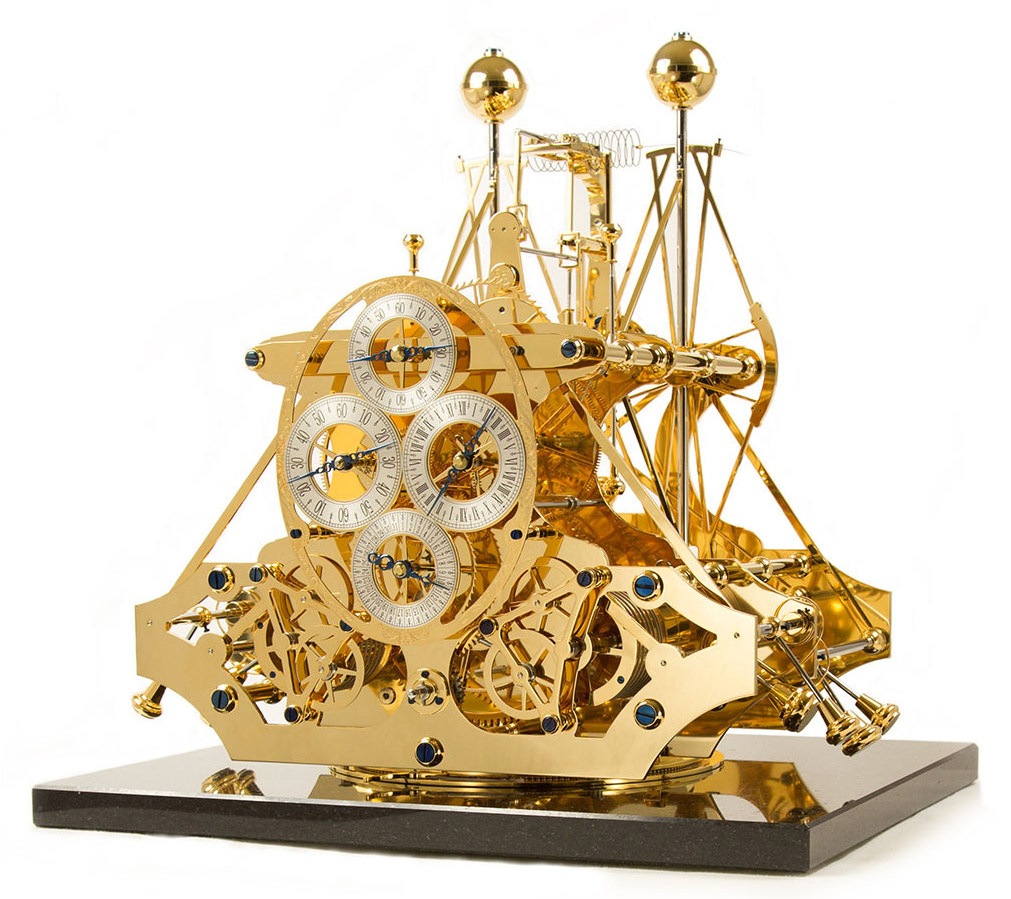
In a world where fine mechanical clocks are increasingly rare, Sinclair Harding (UK) Ltd stands apart. Based in West Yorkshire, England, this small family-run company is one of the last manufacturers in Britain designing, machining, finishing and assembling every component of a mechanical clock entirely in-house. Their work ranges from exquisite skeleton clocks to a full-size working replica of John Harrison's H1 marine timekeeper — pieces that stand comparison with the finest horological work anywhere in the world.
History of Sinclair Harding
The company was founded in 1967 in Cheltenham by William Sinclair and Mike Harding. During their partnership — which lasted until William Sinclair's departure in 1976 — over 700 clocks were produced. Mike Harding continued to develop the range, creating the Perpetual Calendar and the popular Sea Clock. In 1975 he worked alongside Tim Bazley on the chiming movement, followed by the Bracket Clock and Three Train Fusee movement. Public commissions included the celebrated Wishing Fish Clock in Cheltenham and a Seven Ages of Man Congreve Clock.
By 1995 the company was in crisis — one week from closing, with no orders and no workforce. It was then that Robert (Bob) Bray, an engineer introduced to Mike Harding by his uncle Brian Kitson, decided to take on the company. Bob had four young children, no knowledge of clockmaking, and no shortage of determination. As he described it to the British Horological Institute: "the gearbox that works backwards."
Bob Bray and the Modern Sinclair Harding
From the outset Bob's goal was total independence — to design, machine and finish every single component in-house. That goal was fully realised in 2017. Over 30 years and 1,000 clocks later, Sinclair Harding has built capability across an extraordinary range of traditional crafts. Today the team numbers eleven — mainly family members — all involved across multiple processes.
Bob's son Stuart Bray leads design and production. Domonic Bray oversees polishing, electroplating and quality control. Adrian Bray, the company's main clockmaker, has been with Sinclair Harding for over 22 years. Georgie Green manages sales, marketing and stock control.
In 2025, Bob Bray was appointed President of the British Horological Institute — one of the most prestigious positions in British horology — a recognition of his extraordinary contribution to keeping English clockmaking alive.
The Clock Collection
Sinclair Harding produce a wide range of mechanical clocks, all designed, manufactured and assembled in-house at their West Yorkshire workshop. Every clock can be personalised — finish, base material, engraving — making each one a unique object. All brass components are protected with a thin layer of 23.5-carat gold or platinum. Bases are French-polished or in a choice of granite.
- Sinclair Harding H1
- John Harrison Sea Clocks
- Three Train Skeleton Clocks
- Table Regulators
- La Colonne du Temps
- Two Train Condliff Clocks
- Single Train Condliff Clocks
- Sun & Moon Clocks
- Congreve Rolling Ball Clocks
- Great Wheel Skeleton Clocks
- Carriage Clock
- The Rosemary
- Longcase & Bracket Clocks
- Commissions & One-Offs
To see the full collection with photographs, visit clockmakers.com/clocks.
The Sinclair Harding H1 — A Homage to John Harrison
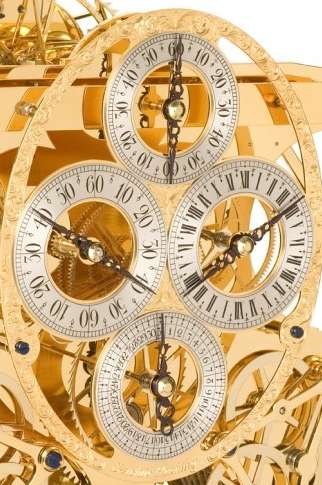
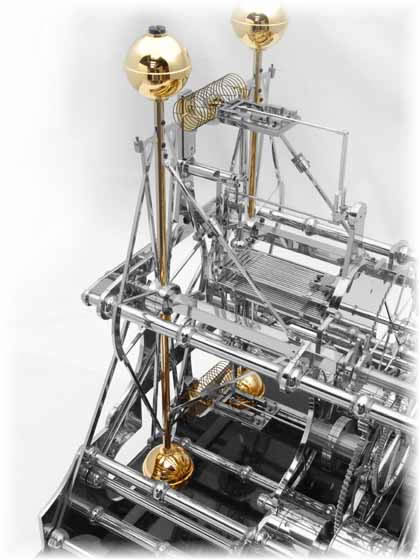
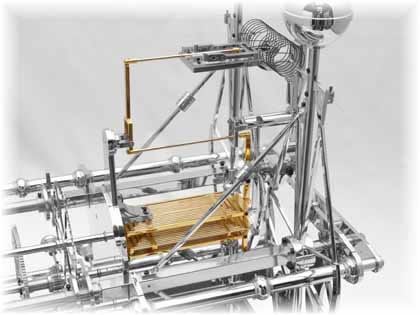
Of all Sinclair Harding's pieces, the H1 is the most celebrated. In 1999, Bob Bray began work on a clock in homage to John Harrison's first marine timekeeper of 1737. Nearly five years in development, the Sinclair Harding H1 is a working mechanical sculpture that captures the spirit and mechanics of the original in extraordinary detail.
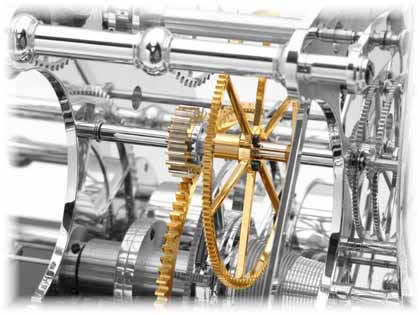
Where the original Harrison H1 used wooden wheels (lignum vitae, which exudes its own oils), Sinclair Harding chose polished brass and steel — creating a fascinating spectacle of reflections as the movement runs. All brass parts are protected with 23.5-carat gold plating. Even the parts you cannot see are hand-finished.
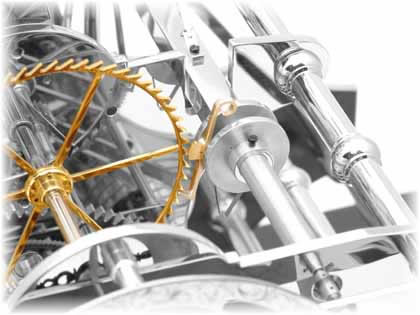
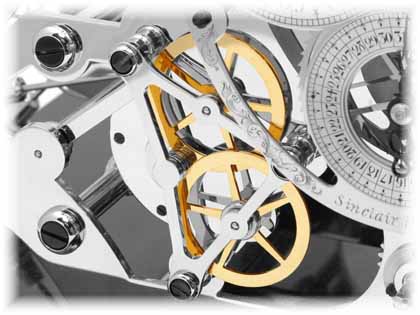
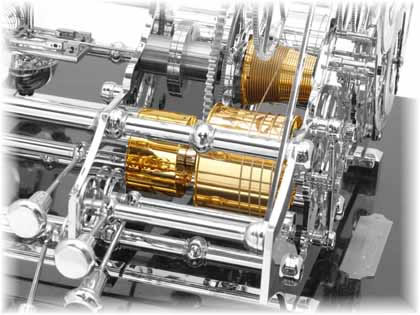
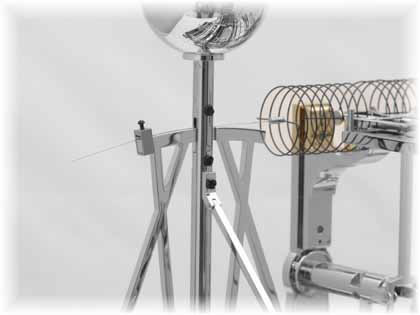
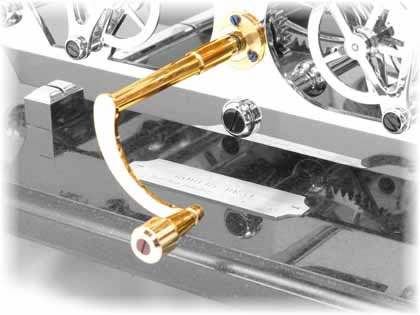
The Sinclair Harding H1 winds every seven days using a substantial cranked key — a 2:1 step-down gear ratio makes the winding "almost effortless." Maintaining power ensures the escapement continues to operate throughout winding. The complete piece sits under a bevelled glass shade on a French-polished wood or granite base.
The Pragnell Bray Origins Clock (2025)
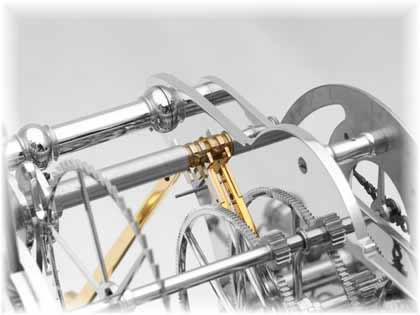
In 2022, at the AHCI's exhibition during Watches & Wonders in Geneva, Bob Bray met Charlie Pragnell, CEO of the renowned Stratford-upon-Avon jeweller Pragnell. The result was a three-year mission to build a full-size recreation of Harrison's H1 — as faithful as possible to the original.
The Pragnell Bray Origins Clock is mounted on a wooden hull modelled after HMS Centurion — the ship that carried the original H1 on its sea trial — itself on a table with an anchor pendulum that rocks the clock as it would at sea. Described by the horological press as "breath-taking" and "beyond reproach," it is perhaps the most ambitious piece of English clockmaking of the 21st century. Up to five further examples may be built for private clients.
The Three Train Skeleton Clock
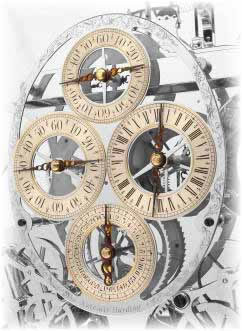
The Three Train Skeleton Clock is Sinclair Harding's signature piece. Each plate is individually cut from solid brass, edge-filed, papered smooth, burnished and gold or platinum plated before assembly. Every wheel, arbor, detent and lever is finished by hand.
Three separate mainsprings — each operating through its own fusee and chain — drive three independent trains. The chime train plays Westminster, Whittington or St Michael chimes on an octave of hand-tuned cast bells, while the striking train sounds the hours on a ninth tenor bell. An Invar pendulum rod gives exceptional temperature stability, its precise beat displayed on a subsidiary seconds dial.
John Harrison Sea Clocks
Sinclair Harding's Sea Clock range takes its inspiration directly from Harrison's longitude work. Each clock embodies at least three of the basic principles from Harrison's first sea clocks. The unusual seconds hand sweeps through 240 degrees — from 0 to 60 — before vanishing and reappearing instantly at zero.
The Moonphase variant is particularly sought after. Each moonphase dial is hand-painted, signed and dated by artist Keith Warrington, with a hidden initial and date on each unique dial. The painted moon symbolises the lunar distance method — the competing astronomical approach to longitude that Harrison fought against throughout his career.
La Colonne du Temps
La Colonne du Temps — "The Column of Time" — is one of Sinclair Harding's most original creations: the first mechanical sculpture to display time digitally using a column of rotating cylinders. Five cylindrical segments on a vertical axis rotate to reveal the current time in a form that is immediately legible but endlessly fascinating to watch. It is mechanical horology used as contemporary sculpture.
The SH Bray Watch — A New Chapter (2025)
For years, customers asked Bob Bray the same question: "Are you ever going to make a watch?" For just as long, his answer was the same: "No — the parts are far too small for our eyes." In 2025, that changed.
Since late 2024, Sinclair Harding has been developing their first wristwatch — the SH Bray Watch — built around the revered ETA 6498 movement. Described as "perfect in an imperfect way," it brings Sinclair Harding's horological heritage to the wrist for the first time. Available directly and through authorised retailers. See details at clockmakers.com →
Every Part Made In-House
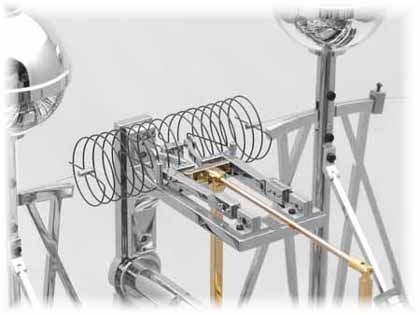
What sets Sinclair Harding apart from virtually every other clock company in the world is their insistence on in-house manufacture of every component:
- Precious metal plating — 23.5-carat gold and platinum applied in-house
- Fusee chain making — the tiny linked chains connecting spring barrel to fusee
- Bell casting and hand-tuning — each bell cast, turned and tuned to pitch
- French polishing — producing the deep gloss on wooden bases
- Dial engraving and hand-silvering — every dial treated individually
- Bluing of screws and hands — heat-treated to the correct blue-black colour
- Mainspring manufacture — even the driving springs are made on the premises
- CNC machining and wire erosion — modern technology in service of traditional design
What Customers Say
Visit Sinclair Harding
Workshop tours are available by appointment — a remarkable opportunity to see the full manufacturing process from raw brass to finished clock.
📍 Phillips House, Chapel Lane, Emley, West Yorkshire, HD8 9ST, England
Related Pages
- John Harrison & the Longitude Problem — with detailed H1 photographs
- Skeleton Pocket Watches
- Repeater Pocket Watches
- New Pocket Watches
- Pocket Watch Collecting