
American Waltham Pocket Watch Company
Look up your Waltham serial number →
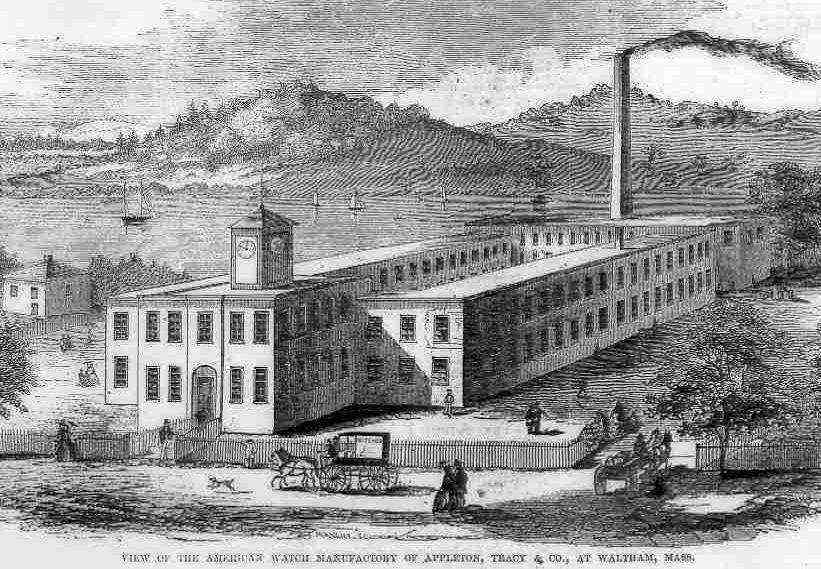
Origins — The World's First Watch Factory
The history of the American Waltham Watch Co can be traced to the original formation of a company by Howard, Davis & Dennison in 1850. They had the then-revolutionary idea of producing large quantities of pocket watches using machinery to mass-produce fully interchangeable parts — making watches more affordable than ever before. Before Waltham, every watch was hand-made by individual craftsmen; after Waltham, watchmaking was transformed into precision manufacturing.
The factory depicted above — on the banks of the Charles River at Waltham, Massachusetts — was the world's first purpose-built watch factory. Machines that had never existed before were invented within its walls, and the techniques pioneered there spread to every corner of the global watchmaking industry.
Company Timeline
| Year | Event |
|---|---|
| 1850 | Howard, Davis & Dennison form the first machine-watch factory in Roxbury, MA |
| 1853 | First watch sold — the "Warren." Company renamed Boston Watch Company |
| 1854 | Factory moves to Waltham, MA; sold to Appleton, Tracy & Co. |
| 1857 | Panic of 1857 forces receivership; reorganised as American Watch Company |
| 1859 | Renamed the American Watch Company; production accelerates rapidly |
| 1885 | Renamed American Waltham Watch Company |
| 1914 | Peak production years — national advertising campaigns in major publications |
| 1957 | Production ceases after over 35 million movements manufactured |
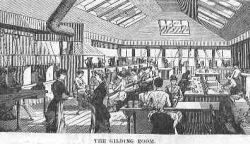
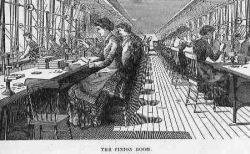
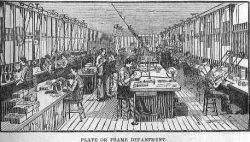
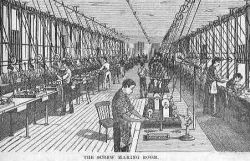
Inside the Waltham Factory — Victorian Engravings c.1881
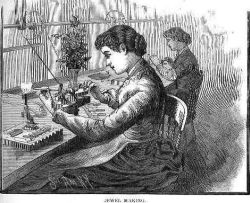
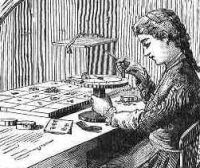
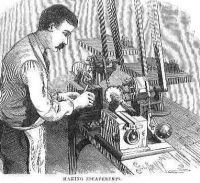
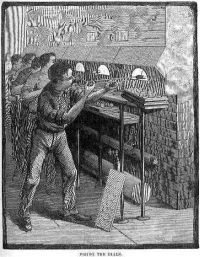
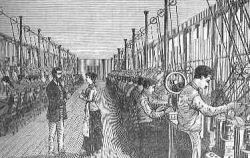
The following engravings were published in an 1881 illustrated account of the Waltham factory — then considered one of the wonders of American industrial enterprise. The factory employed hundreds of workers, the majority of them women, each performing a single highly-skilled precision task. The degree of division of labour astonished every contemporary visitor.
The Factory Exterior — Then and Now
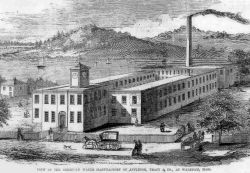
By 1881 the original factory had been greatly expanded. The engraving at right — a smaller version of the famous 1857 view — shows the building as it appeared when the illustrated accounts were published. The tall chimney stack, the clock tower, and the long multi-storey wing housing the production floors are all clearly visible.
At its Victorian peak the Waltham factory was producing over 1,000 complete watches every working day. The factory town that grew up around it — including workers' housing, a company store and eventually a complete municipal infrastructure — was a model of the industrial paternalism common to the great American manufacturers of the era.
Key Waltham Grades
| Grade | Size | Jewels | Notes |
|---|---|---|---|
| Appleton Tracy | 18, 20 | 7–15 | Early & rare — highly collectible |
| P.S. Bartlett | 18, 16 | 7–17 | Very common; affordable entry point |
| American Watch Co. | 18 | 11–15 | Standard mid-grade |
| Crescent Street | 16 | 21 | Railroad grade, adjusted 5 positions |
| Vanguard | 16 | 21–23 | Top railroad grade; most sought-after |
| Royal | 16 | 17–21 | High-grade dress watch |
| Bridge Model | 12 | 17–21 | Elegant 3/4-plate movement |
| Premier Maximus | 16 | 23 | Finest Waltham grade; scarce |
Dating Your Waltham — Serial Numbers
Every Waltham movement was stamped with a serial number on the pillar plate. Use our complete Waltham serial number table to find the approximate year your watch was made — the table covers all production from 1852 to 1957.