
Pocket Watch Repair — Tools & Techniques
Pocket watches are mechanical marvels — hundreds of tiny components working together with extraordinary precision. Inevitably, after decades of use or storage, they need attention. This guide covers both the question of when to attempt your own work and the complete toolkit required for anyone who wants to explore pocket watch servicing seriously.
Contents
Should You Attempt Your Own Repairs?
Unless you have watchmaking training, it is rarely wise to attempt repairs beyond careful cleaning and observation. Movement parts are extremely small and delicate — a dropped balance staff or bent click spring can render a watch unrepairable except at great expense. However, with the right tools and patience, a beginner can safely:
- Open the case to read the serial number and grade
- Clean the exterior of the case and crystal
- Wind the mainspring gently and test whether the movement runs
- Remove and replace the hands (with the correct tools)
- Identify what is wrong and decide whether professional help is needed
The very first step in any pocket watch work is opening the case safely. American pocket watches come in several case types — snap-back, screw-back, and hinged hunter — each requiring a different technique.
Case Opener / Case Knife
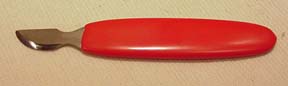
The case opening knife has a thin, flexible blade that is inserted into the small notch on the edge of a snap-back case. A gentle twisting motion pops the back open cleanly. Never use a screwdriver or penknife — the blade will slip and scratch both the case and your hand. A proper case knife costs just a few pounds and is indispensable.
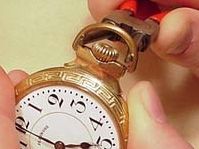
The bow opener tool (left photo) is used to grip and rotate screw-back cases and to remove the bow (the ring at the top of the watch through which the chain passes) when required for case disassembly.
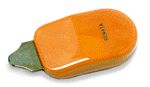
Rubber Ball Case Opener
The humble rubber ball case opener is one of the most useful tools on the workbench. Simply press the rubber ball firmly against the case back and twist — the high-friction surface grips the case back and provides enough torque to unscrew even a moderately tight screw-back without risking damage.
It works equally well for opening stiff hinged hunter case backs where the knife is already inserted but the back won't swing fully open. Essential, inexpensive, and virtually indestructible.
Working on a pocket watch movement without proper magnification is asking for trouble. The parts are tiny, the tolerances are measured in hundredths of a millimetre, and damage caused by working blind is very hard to undo.
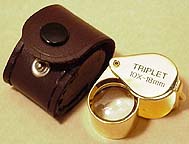
The Watchmaker's Loupe
A good loupe is the single most important tool for the pocket watch enthusiast — whether you're examining a potential purchase at a fair, reading a serial number, or inspecting a movement for damage. Buy a 10× triplet loupe (three-element lens) in a metal housing — the triplet design eliminates chromatic aberration and gives a flat, clear field of view.
To use a loupe correctly, hold it against your eye socket and bring the work up to the loupe rather than bending down to the work. This gives you a steady, controlled view. A loupe tucked in a leather case like the one shown is also useful when buying at auction or from dealers — it fits easily in a pocket.
Desk Magnifier & Head Visor
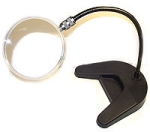
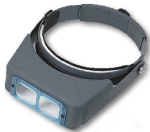
For bench work where you need both hands free, a clip-on desk magnifier or a head-mounted visor (OptiVisor) is invaluable. The desk magnifier clips to the bench edge and provides a hands-free magnified view over the work area — ideal for cleaning and inspecting parts laid on a movement tray.
The OptiVisor is worn like a headband and flips down over the eyes, giving 2× to 3.5× magnification across the entire work area. Professional watchmakers often use an OptiVisor for general bench work and a loupe for close examination of specific components. Together they cover every magnification need.
Watchmaker's Screwdrivers
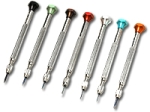
Watch screws are tiny and precisely cut. Using an incorrect screwdriver will burr the slot and potentially render the screw impossible to remove without drilling. A proper set of watchmaker's screwdrivers — typically six to eight graduated sizes with swivelling tops — is non-negotiable.
The swivelling cap on the top of each handle allows you to apply downward pressure with a fingertip while rotating with thumb and forefinger — essential for driving tiny screws with control. Keep your screwdrivers sharp by re-grinding the tips on an Arkansas stone when they become rounded. A blunt screwdriver is more dangerous to a movement than no screwdriver at all.
The colour-coded handles in the photograph correspond to different blade widths — a common and sensible convention that allows quick selection of the right size.
Watchmaker's Tweezers
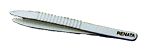
A good pair of anti-magnetic stainless steel tweezers is as essential as the loupe. Watch parts must never be touched with bare fingers — skin oils cause corrosion, and the grip of the fingers is far too coarse for parts measured in fractions of a millimetre.
The Renata and Dumont brands are widely used by professionals. Buy at least two pairs — one fine-pointed (Style 2 or 3) for picking up small parts, and one with a slightly broader tip (Style 7) for handling bridges and plates. Keep the tips clean and the points aligned — a crossed tip will drop parts at the worst possible moment.
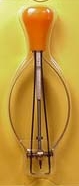
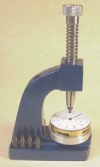
Hand Remover & Hand-Setting Press
Removing and replacing the hands are among the most common tasks in pocket watch servicing — and among the easiest to get wrong without the right tools.
The hand remover (also called a hand puller or hand lifter) uses two prongs that slide under the hand on either side of the cannon pinion. Gentle, even upward pressure lifts the hand straight off without bending it or stressing the pinion. Never lever a hand off with a screwdriver — you will bend it and likely damage the dial.
The bench-mounted hand-setting press uses a selection of hollow punches that fit over the hands and press them squarely and evenly onto the cannon pinion with controlled screw pressure. This ensures the hand seats at exactly the right height and without distortion — essential for the hands to clear each other properly as the watch runs.
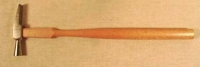
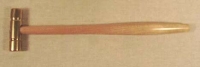
Watchmaker's Hammer & Mallet
A small watchmaker's hammer — typically with a steel head and a polished face — is used for driving movement holders, adjusting staking punches, and seating components that require a firm tap. The head is much smaller and lighter than any general-purpose hammer.
The mallet, with its rawhide or nylon face, delivers a softer blow that will not mark polished surfaces. It is used for closing snap-back case backs, seating bezels, and any task where the surface being struck must not be dented or scratched. Together the hammer and mallet cover every striking need on the watchmaker's bench.
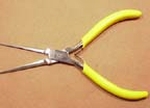
Long-Nose Pliers
A pair of fine-tipped long-nose (needle-nose) pliers is needed for tasks that require more grip than tweezers provide but more precision than standard pliers allow. Uses include bending click springs to shape, adjusting the set of the cannon pinion, gripping the winding stem during removal, and manipulating mainspring bridles.
Choose smooth-jawed pliers rather than serrated — serrated jaws will mark soft brass components. Watchmaker's pliers are typically thinner and more precisely made than electrician's pliers and are worth the small additional cost.
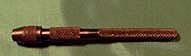
Pin Vise
The pin vise is a small hand-held chuck that grips pins, drills, broaches and pivot polishing sticks by their shank, allowing them to be rotated with fingertip precision. It is used for opening pivot holes to size, polishing pivots, driving small pins, and holding tiny parts that need to be worked on without direct finger contact.
A set of three or four pin vises in graduated collet sizes covers every need. The knurled barrel gives excellent grip, and the rotating handle at the top allows drilling action with one finger. An inexpensive but surprisingly versatile tool.
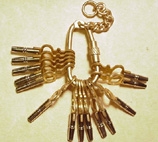
Pocket Watch Winding Keys
Before the introduction of keyless winding in the 1860s–1870s, every pocket watch was wound and set using a separate key. A key-wind, key-set watch has a square arbor at the back (for winding) and another at the front under the dial (for setting). The keys shown — a graduated set on a split ring — cover the full range of sizes used by American and European manufacturers.
If you acquire a key-wind watch, you will need the correct size key to wind it. Too small a key will round the arbor square; too large will not engage. The key should be a snug fit with no slop. A complete set like the one shown will cover virtually every key-wind pocket watch you are likely to encounter.
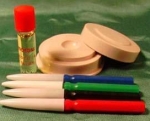
Watch Oil & Oiling Tools
Correct lubrication is one of the most critical — and most commonly neglected — aspects of pocket watch maintenance. A watch that has not been oiled for 10 or more years will run on dry pivots, wearing irreplaceable components with every tick.
Watch oils come in several grades for different parts of the movement:
- Moebius 9010 — thin oil for pallet stones and escape wheel teeth
- Moebius 9020 — medium oil for train wheel pivots
- Moebius D5 — grease for the keyless works and winding gears
- Moebius 8300 — mainspring grease for the barrel
Oiling is applied with a fine oiling stick or syringe — a single tiny drop at each pivot point, no more. Too much oil is as harmful as too little; excess oil migrates onto the balance spring and pallet stones, dramatically affecting timekeeping. The wooden holder shown keeps the oil bottles upright and the sticks organised on the bench.
A Complete Service — What's Involved
A proper overhaul of a pocket watch movement is a disciplined sequence of operations. Here is what a qualified watchmaker will do:
- Case opening — remove movement from case using case knife and bow openers
- Hands and dial removal — lift hands with hand remover; unscrew dial feet
- Keyless works disassembly — remove winding stem, crown wheel, setting lever
- Complete movement disassembly — let down mainspring safely; remove bridges, wheels, balance
- Ultrasonic or peg-wood cleaning — every part degreased and cleaned
- Inspection — check all pivots under magnification; replace worn parts
- Mainspring replacement — old mainsprings are often set or corroded
- Reassembly with correct lubrication — each pivot oiled as the movement goes back together
- Timing and regulation — test on a timing machine in six positions; adjust regulator
- Case cleaning and crystal replacement — return movement to a clean case
A quality overhaul typically costs £60–£150 in the UK or $80–$200 in the USA depending on the watchmaker and movement complexity. For a high-grade railroad watch worth several hundred dollars, this investment is always worthwhile and will add to the watch's value as well as its reliability.
Finding a Qualified Watchmaker
Look for a watchmaker certified by the British Horological Institute (BHI) in the UK, or the American Watchmakers-Clockmakers Institute (AWCI) in the USA. Members have passed rigorous practical examinations and follow professional standards. Always ask specifically about experience with antique pocket watch movements before entrusting a valuable piece.