
The Skeleton Pocket Watch
A skeleton pocket watch has had most of the material removed from its main plates and bridges — leaving only the structural skeleton — so that the movement can be seen working through a crystal on both the front and back of the case. They are where engineering becomes fine art, and among the most visually arresting objects in all of horology.
What Makes a Watch a Skeleton?
The term is sometimes loosely applied to any watch with a visible movement, but true skeletonisation is a specific process. It means cutting away every gram of metal that is not structurally necessary — not just exposing the movement through a sapphire caseback, but physically removing material from the plates, bridges, barrel cover and cocks until only a tracery of metal remains. Each remaining surface is then bevelled, polished and usually hand-engraved.
Related but distinct designs include the semi-skeleton, where only part of the dial is cut away to reveal selected components, and the open heart, where a single aperture — usually circular — frames the oscillating balance wheel. The open heart is especially popular with tourbillon watches, where the cage's rotation makes the most compelling possible display.
A Brief History
The skeleton watch was invented in Paris around 1760 by André-Charles Caron, a master clockmaker working at the court of King Louis XV. Influenced by the Enlightenment idea of making processes transparent and comprehensible, Caron began filing away the plates of his movements to expose the train. The result was not just technically interesting but immediately beautiful — and fashionable.
Caron's son-in-law was Jean-Antoine Lépine, whose later redesign of the movement architecture (the Lépine calibre, still the basis of almost every pocket watch made) made skeletonisation easier by reducing the depth of the movement and simplifying the bridge layout. The two men between them shaped the entire subsequent history of the form.
Abraham-Louis Breguet, the greatest watchmaker of the late 18th and early 19th century, produced some of the finest early skeleton pieces. His most celebrated commission — the Marie Antoinette pocket watch, ordered in 1783 — was a fully skeletonised grand complication in a gold case with a rock crystal dial, so complex that Breguet died before it was completed. It was finished by his son in 1827, forty-four years after the order was placed.
Skeleton watches fell somewhat from fashion in the early 19th century as precision timekeeping took precedence over display. They were revived in the 1860s when Patek Philippe produced a small series specifically for exhibition purposes — to demonstrate the company's finishing standards to judges and the public. These exhibition pieces are among the most sought-after antique pocket watches in existence.
The form remained a specialist pursuit through the early 20th century, then surged back into mainstream luxury watchmaking from the 1970s onwards as Swiss brands sought to differentiate themselves from quartz competition. Today skeleton movements appear across the entire price spectrum, from affordable Chinese pin-lever pieces to bespoke haute horlogerie costing six figures.
The Skeletonisation Process
Making a skeleton movement is one of the most labour-intensive tasks in watchmaking. The process typically begins with a standard finished movement, though the finest pieces are designed for skeletonisation from the outset with the remaining metal patterned into scrollwork or other decorative forms.
The plate is marked out, then pierced using a fine drill and jeweller's saw. The saw cuts follow the lines of the design exactly — any deviation will be visible in the finished piece. After piercing, every cut edge is bevelled with a file, a process called anglage, to remove tool marks and create the chamfered edges that catch the light. The bevels are then draw-filed and polished to a mirror finish. Finally, the remaining surfaces are engraved — typically with floral scrollwork, engine-turned (guilloché) patterns, or geometric designs — by a specialist engraver working under magnification with a graver and a steady hand.
A well-executed skeletonisation takes 40–80 hours of skilled labour on the movement alone, before any consideration of the case. The highest-grade pieces — where the engraving is both elaborate and precisely executed — represent weeks of work by multiple craftsmen.
The Tourbillon — Skeletonisation's Ultimate Expression
The tourbillon (French: whirlwind) was invented by Breguet in 1801 to defeat the effects of gravity on a pocket watch carried vertically in a waistcoat pocket. The escapement and balance wheel are mounted in a rotating cage — typically completing one revolution per minute — so that any positional error averages out over the cycle.
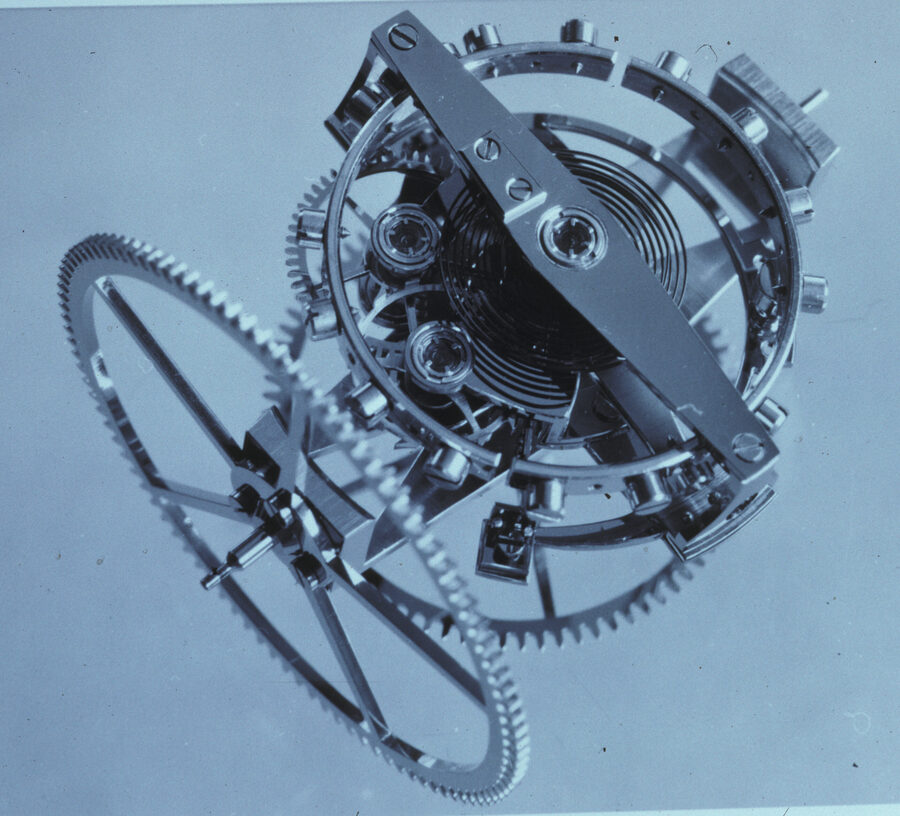
In a standard watch the tourbillon is hidden inside the movement. In a skeleton watch it becomes the centrepiece: a spinning cage of perhaps thirty components, each weighing fractions of a gram, turning continuously in plain view. The double-axis tourbillon — as shown in the image above — adds a second rotation in a perpendicular plane, defeating gravity from every orientation simultaneously. A triple-axis tourbillon adds a third. These complications are extraordinarily difficult to make and represent the apex of mechanical watchmaking.
Notable Makers
Breguet remains the pre-eminent name in early skeleton work. Signed examples in gold cases are among the most valuable antique pocket watches at auction. Patek Philippe's 19th-century exhibition skeleton pieces are equally rare and desirable. Among English makers, the London firm of Charles Frodsham produced skeleton tourbillons of extraordinary quality that regularly appear at specialist horological auctions.
For 19th-century Swiss examples, look for movements signed by Geneva ateliers rather than anonymous pieces — a signed movement from a named maker commands a significant premium. Unsigned Swiss skeleton movements were often produced as trade goods for the English market and fitted into silver or gold cases by London and Birmingham goldsmiths; these can still be excellent pieces but are harder to attribute.
At the more affordable end of the antique market, late-Victorian and Edwardian Swiss skeleton movements in silver open-face cases are collectible, approachable, and often beautifully made. Many were produced in the La Chaux-de-Fonds region of Switzerland specifically for the English retail trade.
What to Look For When Buying
- Quality of finishing — bevel and polish The chamfered edges of the bridges should be perfectly even, with a mirror polish, not a dull file finish. Run a loupe around the cut edges. Rough anglage is the first sign of a low-grade piece.
- Engraving — hand vs. machine Hand engraving has flowing, variable lines with depth and texture; machine engraving is uniform and slightly mechanical in character. Hand engraving commands a substantial premium and is the mark of a quality piece. Look closely at the scrollwork — does it have life and flow, or does it look stamped?
- Movement condition — no cracks in the plates Skeletonised plates are structurally weaker than solid ones. Inspect every bridge carefully for hairline cracks, especially around pivot holes. A cracked plate is very difficult to repair invisibly.
- Balance wheel — intact and free-sprung The balance wheel should swing freely and symmetrically. Check that the hairspring is not kinked, twisted or touching adjacent coils. In an exposed movement, the hairspring is vulnerable to damage from handling.
- Case quality Gold cases are preferable to silver for skeleton watches — the warm contrast with gilded or polished steel bridges is part of the aesthetic. Check the hinge, bezel fit and crystal condition. A cracked or fogged crystal detracts significantly.
- Originality — movement and case together Many skeleton movements have been re-cased. Check that the movement fits the case properly, that any hallmarks date consistently with the movement style, and that the dial (if present) matches the movement period.
- Signature A signed movement from a named maker — especially a London, Geneva, or Paris atelier — is worth significantly more than an equivalent unsigned piece. Look on the cock, barrel bridge, and dial for the maker's name.
Approximate Values
Skeleton pocket watches span an enormous price range. The table below gives rough guidance for the antique market; condition, provenance and current demand all affect actual prices significantly.
| Type | Period | Approx. Range |
|---|---|---|
| Late Victorian Swiss, silver case, unsigned movement | 1880–1910 | £150–£450 |
| Late Victorian Swiss, gold case, unsigned movement | 1880–1910 | £400–£1,200 |
| Swiss, named Geneva maker, gold case | 1860–1910 | £1,500–£5,000+ |
| English skeleton tourbillon (e.g. Frodsham) | 1860–1900 | £8,000–£30,000+ |
| Breguet or Patek Philippe exhibition piece | 1780–1880 | £50,000–£500,000+ |
For current asking prices and recent sold examples, the eBay pocket watch auctions page is a useful real-time guide to the lower end of the market. For serious collecting, the specialist auction houses — Antiquorum, Christie's, and Sotheby's — publish catalogues with detailed condition notes and pre-sale estimates.
Modern Skeleton Pocket Watches
Contemporary watchmakers produce skeleton pocket watches across the full quality spectrum. At the affordable end, Chinese-made pin-lever skeleton movements in base-metal cases are widely available for under £50; these are decorative items rather than precision instruments. In the mid-range, Swiss-made movements — often based on the reliable ETA 6498 or Unitas calibre — are skeletonised and cased in silver or gold-filled cases by various European ateliers.
At the luxury end, Jaeger-LeCoultre, A. Lange & Söhne, Roger Dubuis, and — above all — independent makers such as Philippe Dufour and Kari Voutilainen produce skeleton pocket watches to a standard that equals or surpasses anything made in the 19th century. See our page on New Pocket Watches for more on the contemporary market.
Related Pages
- Repeater Pocket Watches — skeleton and repeater movements are frequently combined
- Pocket Watch Values
- Pocket Watch Collecting Guide
- Pocket Watch Repair — skeleton movements need specialist care
- Current eBay Auctions