
The Repeater Pocket Watch
A repeater pocket watch does something magical — it chimes the time on demand. Push a slide on the case band and tiny hammers strike tiny gongs inside the case, sounding out the hours, quarters and sometimes even the individual minutes. In an era before luminous hands and electric light, this allowed the owner to know the exact time in complete darkness — in the theatre, in a carriage at night, or in the bedroom without disturbing a sleeping partner.
The repeater is the most complex of all standard pocket watch complications — a mechanical computer that reads the position of the hands and translates that information into an audible sequence of precisely counted chimes. Making one work correctly requires the highest level of watchmaking skill, and the finest examples represent the summit of Swiss and English horology.
Types of Repeater
Repeating watches are classified by the finest interval of time they can sound. Each successive type is more complex and valuable than the last:
| Type | What It Chimes | Example at 10:47 |
|---|---|---|
| Quarter Repeater | Hours + quarters | 10 low notes + 3 double notes (= 10:45) |
| Half-Quarter Repeater | Hours + quarters + half-quarters | 10 low + 3 double + 1 high (= 10:47½) |
| Five-Minute Repeater | Hours + quarters + 5-minute intervals | 10 low + 3 double + 0 high (= 10:45–10:50) |
| Minute Repeater | Hours + quarters + individual minutes | 10 low + 3 double + 2 high (= exactly 10:47) |
The Repeating Mechanism
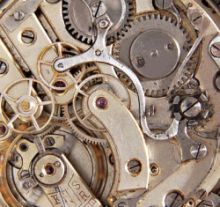
Inside a Repeating Movement
The repeating mechanism is entirely separate from the going train. This movement photograph shows the characteristic repeating components: the rack (the toothed lever that counts the hours), the snail cams (stepped discs that set the rack position according to the time), and the hammer and gong assembly. The all-or-nothing piece — a critical safety device — is also visible as a pivoted lever that prevents the mechanism activating unless the slide is pushed fully home.
When the slide on the case band is pushed, a train of levers and racks reads the current position of the hands through a set of snail cams — stepped rotating discs whose profile changes according to the hour, quarter and minute. The snail cam for hours has 12 steps; for quarters it has 4; for minutes (in a minute repeater) it has 14 steps (representing 0–14 minutes within each five-minute interval).
The rack falls against the snail and its depth of engagement determines how many times the hammer will strike. The all-or-nothing piece is a pivoted safety lever that physically blocks the mechanism unless the slide is pushed fully to its limit — this prevents the chime starting partway through and stopping, which would give an ambiguous reading of the time.
In a minute repeater, three separate hammers and gongs are needed:
- Hours — struck on a single low-pitched gong
- Quarters — struck on two gongs in sequence (a distinctive "ding-dong")
- Minutes — struck on a single high-pitched gong
The entire sequence runs automatically once triggered, driven by a small separate spring that is wound by the action of pushing the slide. The gongs themselves are coiled wire springs attached to the inner case wall — their precise length determines their pitch, and fine-tuning by filing is an art in itself.
Three Repeaters — Quarter to Minute
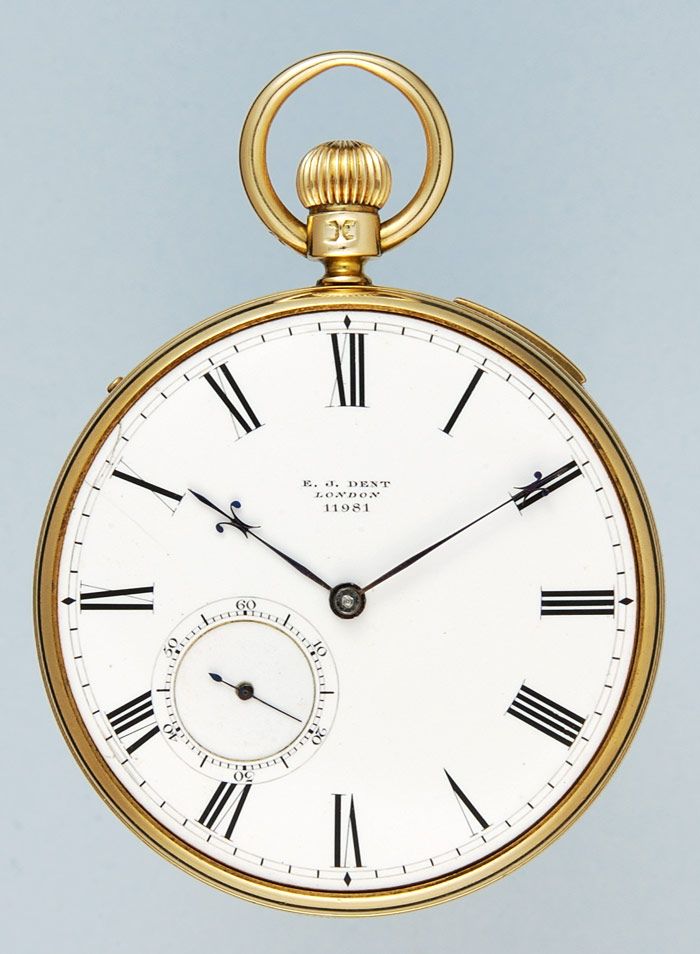
E.J. Dent, London — Quarter Repeater
Edward John Dent (1790–1853) was one of the most celebrated English watchmakers and clockmakers of the 19th century — his firm, E.J. Dent & Co, was responsible for the Great Clock of Westminster (the mechanism that drives Big Ben). The quarter repeater shown here — serial number 11981, in an 18-carat gold open-face case — is a fine example of high English watchmaking. The clean Roman numeral dial with blued steel hands and the simple elegance of the case are characteristic of the best English practice. A quarter repeater by Dent is both a significant collector's piece and a historically important object.
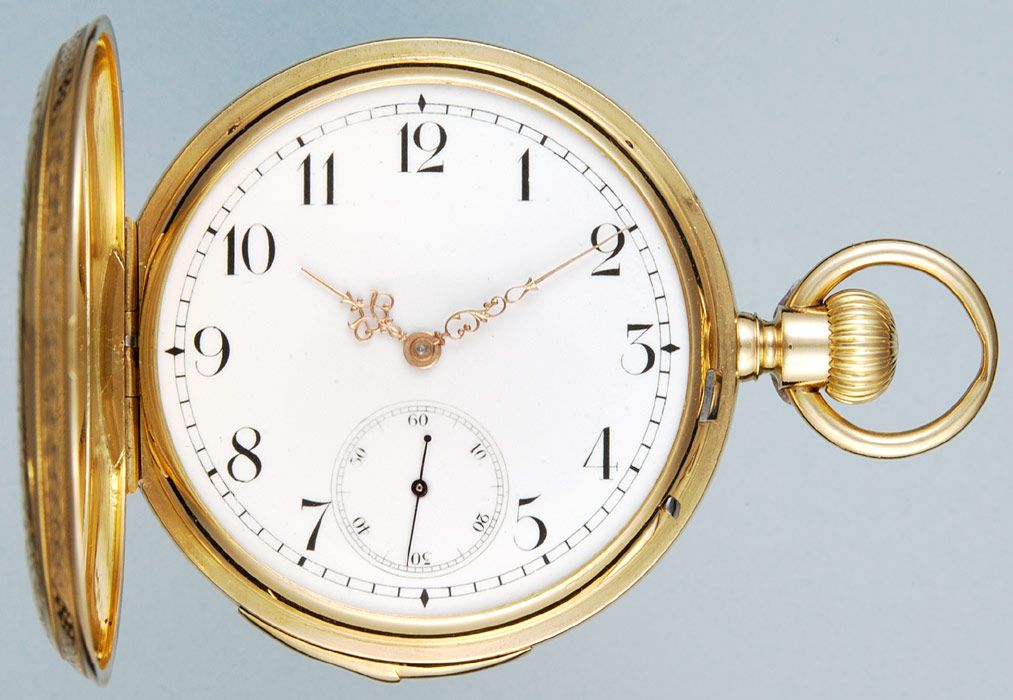
Anonymous Swiss — Five-Minute Repeater
The five-minute repeater in a gold hunter case represents the most common type of quality Swiss repeater found on the market today. In hunter cases the repeating slide is typically on the left band, accessible when the case is open. The ornate gold hands and engine-turned case back are typical of fine Swiss production from the 1880s–1910s. A five-minute repeater is significantly more affordable than a minute repeater while still delivering the essential pleasure of the chiming complication.
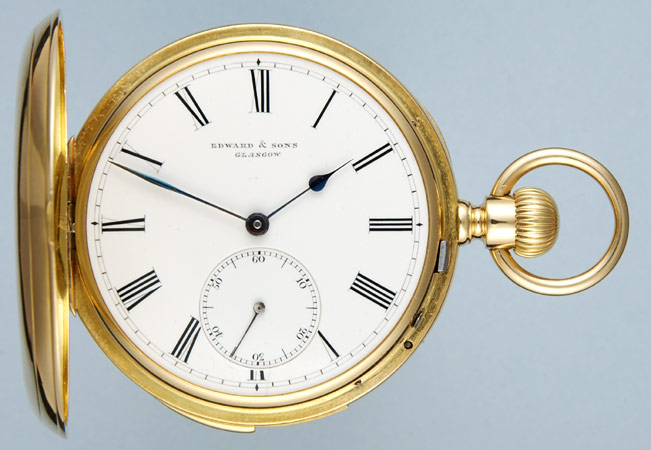
Edward & Sons, Glasgow — Minute Repeater
Minute repeaters signed by quality retailers such as Edward & Sons of Glasgow were typically made in Switzerland to the retailer's specification and cased in the retailer's gold cases before being sold. The Roman numeral dial and blued steel hands in a gold hunter case is the classic British market presentation for a fine repeater. Identifying the actual movement maker — usually one of the great Geneva ateliers — requires opening and examining the movement.
Famous Repeater Makers
Patek Philippe, Audemars Piguet, A. Lange & Söhne and Breguet produced the finest Swiss repeaters and their pieces command the highest prices. Nicole & Capt, Urban Jürgensen and E.J. Dent in London also produced superb examples. In the British retail trade, repeaters were often made by Geneva specialists and cased and sold under the names of leading retailers including Dent, Frodsham, Garrard and Edward & Sons.
Collecting & Values
| Type | Typical Price Range |
|---|---|
| Quarter repeater — simple, silver or gold-filled case | $300–$1,000 |
| Quarter repeater — 18-carat gold, good maker | $1,000–$4,000 |
| Five-minute repeater — gold hunter | $1,500–$6,000 |
| Minute repeater — gold, anonymous Swiss | $3,000–$10,000 |
| Minute repeater — named maker (Dent, Nicole & Capt) | $8,000–$25,000 |
| Minute repeater — Patek Philippe, Audemars Piguet | $25,000–$200,000+ |