
John Harrison and the Longitude Problem
Before John Harrison, sailors crossing the oceans had no reliable way to determine their east-west position — their longitude. Ships were regularly lost, crews died, and empires were frustrated. The solution lay in timekeeping — and it took one self-taught carpenter from Yorkshire to crack it.
The Problem of Longitude
Latitude (north-south position) is easy — the angle of the sun or stars above the horizon gives it directly. Longitude is different. To find longitude, you need to know the time at a known reference point (usually the Greenwich meridian) and compare it to your local time. Every hour of difference equals 15 degrees of longitude — roughly 1,000 miles at the equator. An error of just four minutes means a 60-mile error in position — enough to drive a ship onto uncharted rocks.
Keeping accurate time at sea was impossible with the technology of the early 18th century. Pendulum clocks were useless on rolling ships. Spring-driven clocks were affected by temperature changes and the varying pull of gravity. No clock yet made was reliable enough for the purpose.
The Longitude Prize
In 1714, the British government established the Board of Longitude and offered a prize of £20,000 — equivalent to several million pounds today — for a practical solution to the longitude problem. The full prize required accuracy to within half a degree over a voyage to the West Indies. The prize attracted every kind of astronomer, mathematician, and inventor for over 50 years — and generated some of the most extraordinary scientific controversy of the age.
H1 — Harrison's First Timekeeper (1737)
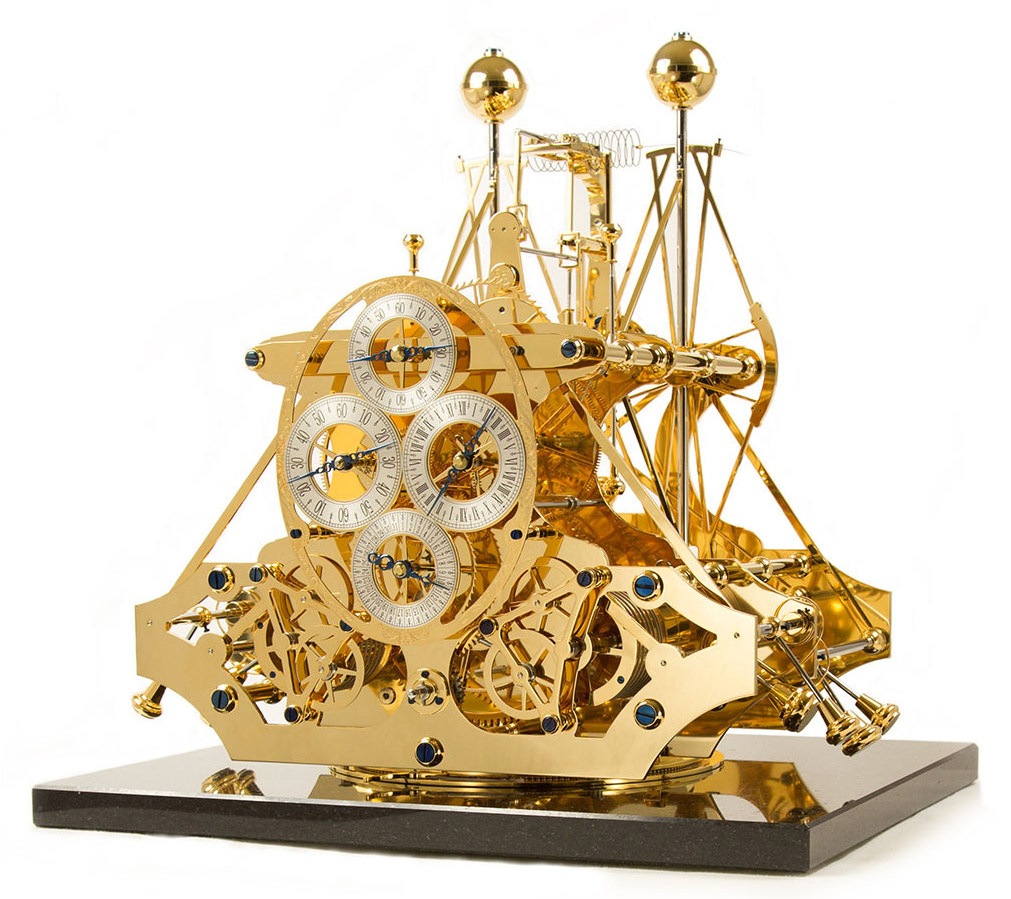
John Harrison, a Yorkshire carpenter with no formal scientific training, dedicated his life to solving the problem through precision clockmaking. His first marine timekeeper, H1, was completed in 1737 after years of painstaking work. It was a radical and original design, incorporating several inventions that had never been seen before.
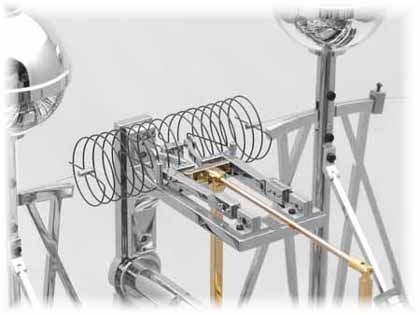
H1 uses no pendulum in the conventional sense. Instead, Harrison devised two linked balance arms — connected by wire springs — that swing in opposite directions, cancelling out the effects of a ship's rolling motion. The two brass-and-steel bar balances, visible rising above the top of the movement, are one of the most distinctive features of the clock and an immediately recognisable signature of Harrison's work.
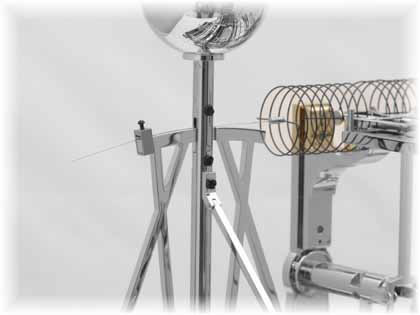
H1's Revolutionary Innovations
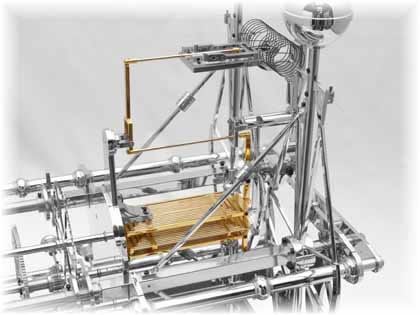
H1 contains a remarkable collection of horological inventions, many of which were entirely original to Harrison:
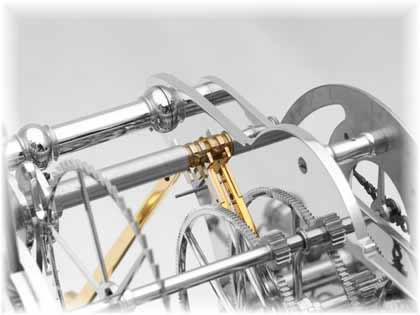
- Anti-friction rollers — instead of conventional pivots, H1 uses rollers to eliminate sliding friction entirely
- Gridiron temperature compensation — alternating rods of brass and steel, which expand at different rates, compensate automatically for changes in temperature that would otherwise affect the rate
- Grasshopper escapement — Harrison's own invention, a nearly frictionless escapement that requires no lubrication and therefore does not degrade with age or temperature changes
- Maintaining power — a device that keeps the clock running accurately during winding, so that the act of winding does not disturb the timekeeping
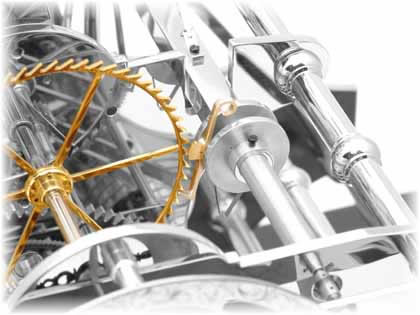
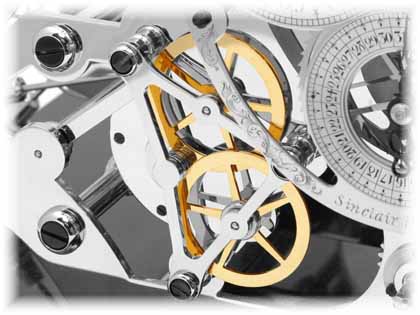
The Mainsprings and Fusee
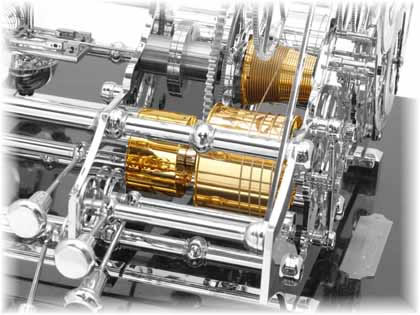
H1 is driven by two mainsprings arranged symmetrically, each connected to a fusee — a cone-shaped pulley that equalises the pull of the mainspring throughout its travel. A fully wound mainspring pulls harder than a partly wound one; the tapering fusee cone compensates for this, ensuring that the force driving the going train remains constant from the first minute of the wind to the last.
Harrison used two springs rather than one for balance — the symmetrical layout ensures that the forces within the movement are always equal on both sides, contributing to the stability of the timekeeping. The gold-coloured barrels visible in the photographs are among the most visually striking elements of the movement.
The Cranked Winding Key
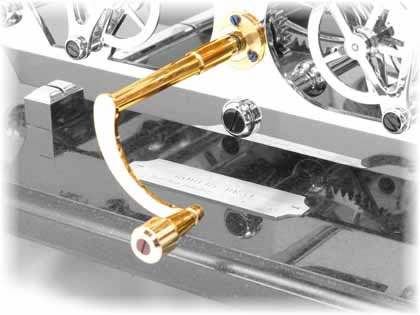
To wind H1, a specially made cranked key is used — an L-shaped brass instrument that engages the winding squares of the two mainspring barrels. The ivory label attached to the key is a period touch — in an era before standardised labelling, such tags prevented the wrong key being used on the wrong clock.
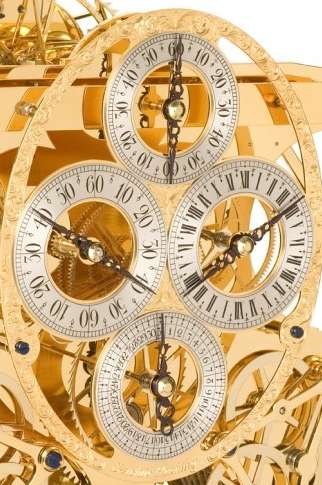
The level of finish evident in every component of H1 is extraordinary. Harrison was not merely solving a practical problem — he was demonstrating, to a sceptical scientific establishment, that a mechanical device could achieve accuracy previously thought impossible. Every surface is finished to exhibition standard, every component crafted with a perfectionism that goes far beyond what function alone would demand.
Harrison's Four Timekeepers
| Clock | Completed | Key Innovation | Sea Trial Result |
|---|---|---|---|
| H1 | 1737 | Twin balance arms, grasshopper escapement, anti-friction rollers | Successful trial to Lisbon — but Harrison was dissatisfied and withheld it |
| H2 | 1741 | Improved version of H1; heavier and more robust | Never used at sea — Harrison discovered a fundamental error |
| H3 | 1759 | 17 years in construction; bimetallic strip temperature compensation; first use of caged roller bearings | Never used at sea — superseded by H4 |
| H4 | 1759 | Radical departure — a large pocket watch, only 5 inches across | Lost only 5 seconds on voyage to Jamaica — far better than prize required |
The H4 — A Giant Leap
H4, completed in 1759 when Harrison was 66 years old, was a total departure from his previous work. Instead of a large clock, Harrison produced essentially a very large pocket watch — 5 inches in diameter, with a verge escapement and a fast-beating balance. On its sea trial to Jamaica in 1761, it lost only 5 seconds outward and was only 54 seconds off on the return. This was far better than the prize required.
But the Board of Longitude — dominated by astronomers hostile to Harrison's mechanical solution and wedded to the lunar distance method — refused to pay. They demanded further trials, imposed conditions not stated in the original Act, and treated Harrison with contempt. Harrison appealed to King George III, who personally tested H5 and declared it magnificent. Parliament finally awarded Harrison compensation of £8,750 in 1773 — a moral victory but less than the £20,000 prize. He died three years later, aged 82.
H1 Details — Gallery
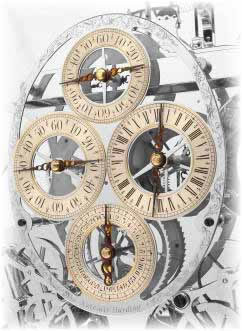
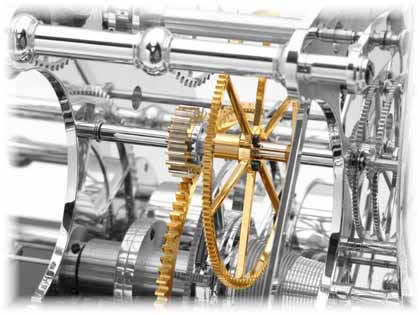
The photographs below show further details of the Sinclair Harding H1 working replica — each one illustrating a specific aspect of Harrison's extraordinary mechanical ingenuity.
Legacy
Harrison's work made the marine chronometer possible. Within 50 years, every naval vessel carried accurate timepieces, and the age of safe ocean navigation had begun. The techniques he invented — the bimetallic temperature compensator, the caged roller bearing, the grasshopper escapement — influenced clockmaking for generations. Without Harrison's persistence, the modern pocket watch itself might have been delayed by decades.
Further Reading
- Dava Sobel's Longitude — the definitive popular account of Harrison's story
- Jonathan Betts, Time Restored — the definitive technical account of H1–H5
- Sinclair Harding — makers of the H1 replica shown here
- Pocket Watch Parts A–Z — many of Harrison's inventions appear in modern pocket watches
- Pocket Watch Collecting