
Patek Philippe Pocket Watch
No other watchmaker commands the reverence, the prices or the collecting loyalty of Patek Philippe & Co. of Geneva. Their pocket watches — produced continuously since 1839 — represent the pinnacle of Swiss horology: supremely finished movements, complications of extraordinary ingenuity, and a provenance that reads like a roll call of European royalty and American industrial wealth. For serious collectors, a Patek Philippe pocket watch is not an acquisition; it is an inheritance.
History & Founding
The company that became Patek Philippe was founded in Geneva in 1839 by Antoni Norbert Patek, a Polish exile and nobleman, initially in partnership with François Czapek under the name Patek, Czapek & Cie. The partnership was productive but uneasy, and dissolved in 1845.
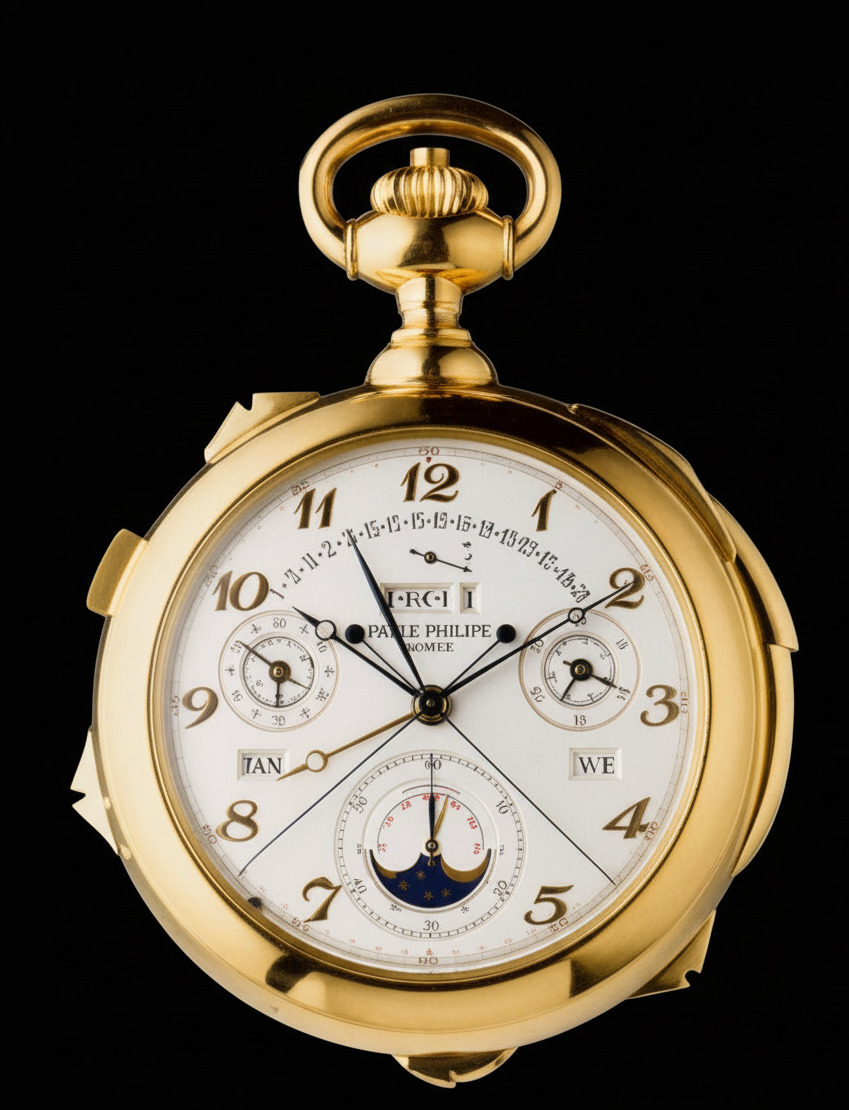
The same year, Patek entered into partnership with Jean-Adrien Philippe, a French watchmaker of exceptional technical gifts. Philippe had invented the stem-winding and pendant-setting mechanism — the keyless winding system that eliminated the need for a separate watch key and is now universal. The invention was so significant that Queen Victoria purchased one of the first Philippe-wound watches during the Great Exhibition of 1851, along with Prince Albert. The royal purchase established the firm’s reputation at a stroke.
The name Patek Philippe & Co. was adopted in 1851 and has remained unchanged since. The company has been in continuous family ownership since Charles Stern acquired a controlling interest in 1932 during the Depression, when financial difficulties threatened the firm’s independence. Today it remains the only major Swiss watch manufacturer still entirely family-owned — a distinction the Stern family regards as fundamental to the company’s character.
Throughout the 19th and early 20th centuries, Patek Philippe supplied watches to virtually every European royal house: Queen Victoria, Tsar Alexander II of Russia, King Farouk of Egypt, Pope Pius IX, and numerous others. The company’s archives contain the original order records for many of these commissions.
Key Milestones
- 1839 Patek, Czapek & Cie founded in Geneva. The firm begins producing lever-escapement pocket watches of exceptional quality for the export market.
- 1845 Jean-Adrien Philippe joins as partner. His stem-winding mechanism transforms the company’s product offering and, ultimately, the entire industry.
- 1851 Queen Victoria and Prince Albert purchase keyless-winding watches at the Great Exhibition, London. The firm adopts the name Patek Philippe & Co. The royal endorsement secures the firm’s international reputation.
- 1868 Patek Philippe makes what is widely regarded as the first Swiss wristwatch — a bracelet watch ordered by Countess Koscowicz of Hungary. The company’s pocket watch production remains its primary business for another half-century.
- 1889 The Calibre 89’s direct ancestor — a grand complication pocket watch with perpetual calendar, minute repeater and split-seconds chronograph — takes a gold medal at the Paris Universal Exhibition.
- 1898 Introduction of the gyromax balance wheel in certain models — a free-sprung balance that remains a Patek hallmark to this day.
- 1925 Patek Philippe produces the first perpetual calendar wristwatch. Complications previously reserved for pocket watches begin migrating to wrist format.
- 1932 The Stern family acquires control of the company during the Depression, ensuring its independence. Charles Stern’s descendants continue to own and run the firm today.
- 1933 Completion of the Henry Graves Supercomplication — the most complex mechanical watch of its era. Commissioned in 1925 by New York banker Henry Graves Jr, it took three years to design and five to build. 24 complications. See below.
- 1989 The Calibre 89 is unveiled to mark the company’s 150th anniversary — 33 complications, 1,728 parts, still the most complex portable timepiece ever made. Four examples were produced.
- 2014 The Henry Graves Supercomplication sells at Sotheby’s Geneva for CHF 23.98 million — at the time the most expensive timepiece ever sold at auction.
Landmark Complications
Patek Philippe’s pocket watch legacy is built on complications. The firm was producing minute repeaters, perpetual calendars, split-seconds chronographs and tourbillons before most of their Swiss competitors had mastered the lever escapement. Three pieces stand apart as the most significant in the company’s history.
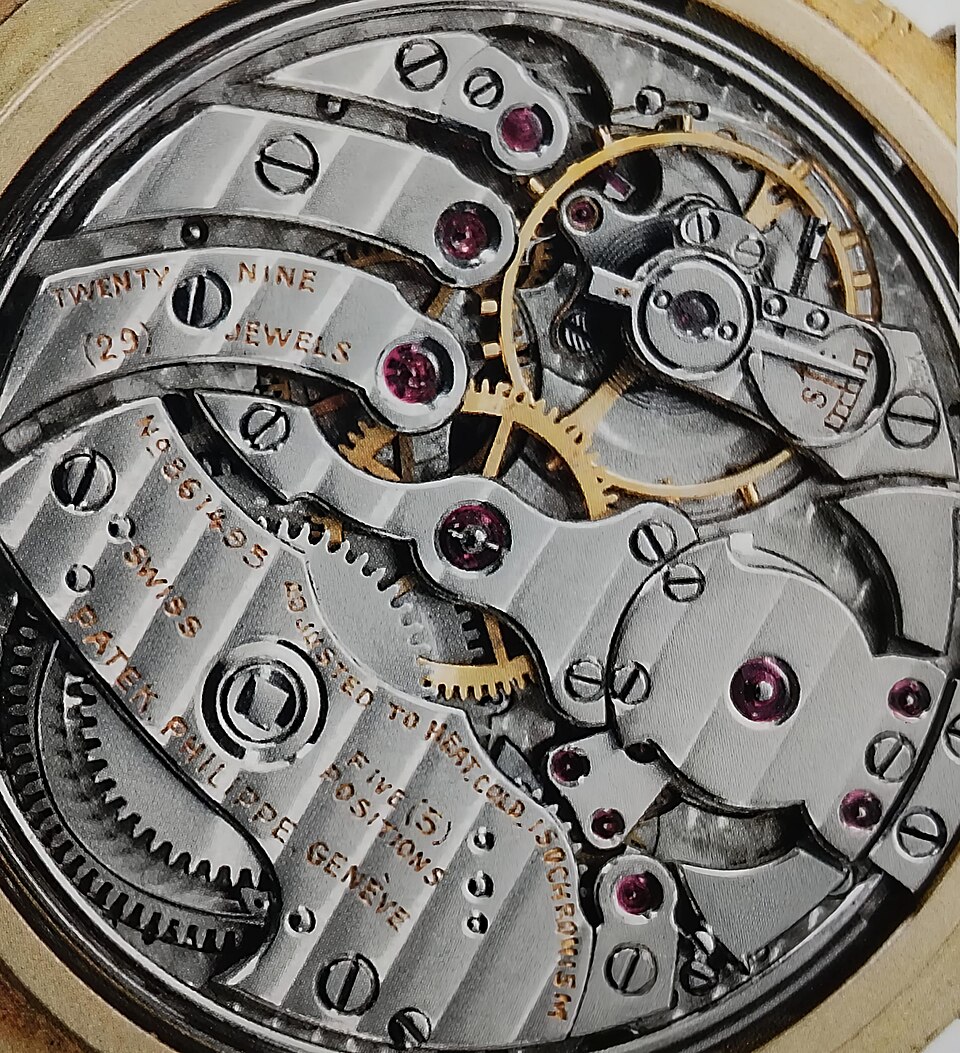
Image: EMore98, CC BY-SA 4.0, via Wikimedia Commons.

The Henry Graves Supercomplication (1933)
The most complex mechanical watch ever made at the time of its completion, the Graves Supercomplication was commissioned in 1925 by Henry Graves Jr, a New York banker and obsessive watch collector. The commission came in the context of an unofficial competition with automotive magnate James Ward Packard, who had ordered his own grand complication from Patek Philippe in 1916 (the Packard Watch, with ten complications, still exists and is in the collection of the Patek Philippe Museum in Geneva).
The Graves piece required three years of design and five years of construction. Its 24 complications include: perpetual calendar with leap year indicator, minute repeater striking hours, quarters and minutes on two gongs, split-seconds chronograph, equation of time, power reserve indicator, sunrise and sunset times for New York City, and a celestial chart of the New York sky. The movement has 920 parts.
Graves wore it daily until his death in 1953. It was sold at Sotheby’s in 1999 for $11 million — then a world record — and again in 2014 for CHF 23.98 million.
The Calibre 89 (1989)
Made in four examples to mark the company’s 150th anniversary, the Calibre 89 has 33 complications and 1,728 parts. Its complications include a tourbillon, minute repeater on cathedral gongs, perpetual calendar, secular perpetual calendar (correcting for century years that are not leap years), split-seconds chronograph, equation of time, sidereal time, sky chart, Easter date indicator, and a thermometer. The movement diameter is 88.2mm.
The four examples — in yellow gold, white gold, rose gold, and platinum — were sold at the 1989 Basel watch fair and are now in private collections and museums. The yellow gold example sold at auction in 2009 for CHF 5.12 million.
Exhibition Skeleton Movements (c.1860–1900)
During the second half of the 19th century, Patek Philippe produced a small series of pocket watches with fully skeletonised movements, expressly made for international exhibitions. These pieces demonstrated the company’s finishing standards to judges and the public — every bridge, plate and cock was cut to the structural minimum, bevelled, polished and engraved. They represent some of the finest surviving examples of 19th-century Swiss craftsmanship and are among the most sought-after antique pocket watches in existence. See our Skeleton Pocket Watch page for background on the skeletonisation process.
Key Reference Numbers
Patek Philippe began using systematic reference numbers in the 1930s. Earlier pieces are identified by movement number and description. The following are among the most historically significant and most collected pocket watch references.
Open-face and hunter-case pocket watches in 18ct yellow or rose gold with enamel dials, produced 1860–1914. Movements typically 20–22 lignes, lever escapement, bimetallic balance. These are the most accessible Patek Philippe pieces for collectors.
Pocket watch movements with striking work sounding hours, quarters and minutes on two gongs. Often paired with a split-seconds chronograph in a combined repeater-chronograph. Some of the finest surviving examples of 19th-century complication work.
18ct gold pocket watch with full perpetual calendar (date, day, month, moon phase, leap year indicator) in a clean open-face case. Produced from the 1940s into the 1980s. A landmark complication at a more accessible price point than repeater combinations.
An extraordinary late-20th-century pocket watch with a 10-day power reserve and a tourbillon visible through an aperture in the dial. Limited production. One of the most technically accomplished Patek pocket watches of the modern era.
Introduced in 2001, this double-faced pocket watch has a tourbillon, minute repeater, perpetual calendar, and a celestial map on the reverse dial. Considered the spiritual successor to the Graves Supercomplication for collectors of the modern era.
A small number of fully skeletonised movements made for international exhibitions in the 1860s–1890s, demonstrating Patek’s finishing standards. Extremely rare; auction appearances are major events in the horological calendar.
Serial Numbers & Dating
Patek Philippe serial numbers are stamped on the movement (not the case) and allow the year of production to be determined. The table below covers the main range of interest to pocket watch collectors. For precise dating of a specific movement, the Patek Philippe Museum in Geneva and the company’s service department can provide an extract from the original production records.
| Serial number range | Approx. year of production |
|---|---|
| 1 – 5,000 | 1839 – 1845 |
| 5,001 – 10,000 | 1845 – 1854 |
| 10,001 – 20,000 | 1854 – 1863 |
| 20,001 – 40,000 | 1863 – 1874 |
| 40,001 – 60,000 | 1874 – 1880 |
| 60,001 – 80,000 | 1880 – 1884 |
| 80,001 – 100,000 | 1884 – 1888 |
| 100,001 – 130,000 | 1888 – 1893 |
| 130,001 – 175,000 | 1893 – 1899 |
| 175,001 – 220,000 | 1899 – 1905 |
| 220,001 – 280,000 | 1905 – 1912 |
| 280,001 – 350,000 | 1912 – 1920 |
| 350,001 – 425,000 | 1920 – 1928 |
| 425,001 – 500,000 | 1928 – 1934 |
| 500,001 – 600,000 | 1934 – 1942 |
| 600,001 – 730,000 | 1942 – 1952 |
| 730,001 – 900,000 | 1952 – 1963 |
| 900,001 – 1,100,000 | 1963 – 1974 |
| 1,100,001 – 1,500,000 | 1974 – 1988 |
| 1,500,001 – 2,000,000 | 1988 – 1998 |
| 2,000,001 – 3,000,000 | 1998 – 2010 |
| 3,000,001+ | 2010 onwards |
These ranges are approximate — production was not strictly sequential and movement finishing times varied. Dates given represent typical production years and may vary by one to three years for individual pieces.
Auction Values
Patek Philippe pocket watches are at the absolute top of the collecting pyramid. The values below reflect recent results at specialist auction (Antiquorum, Christie’s, Sotheby’s, Phillips). Buyer’s premium (typically 20–25%) is additional to hammer price.
| Type | Period | Approx. auction range (hammer) |
|---|---|---|
| Simple time-only, 18ct gold, open face, enamel dial | 1870–1914 | CHF 3,000 – 15,000 |
| Hunter case, 18ct gold, enamel dial, signed movement | 1870–1914 | CHF 5,000 – 25,000 |
| Enamel portrait miniature case (signed enamel painter) | 1860–1900 | CHF 20,000 – 150,000+ |
| Single complication (perpetual calendar or chronograph alone) | 1880–1940 | CHF 30,000 – 150,000 |
| Minute repeater pocket watch (no chrono) | 1880–1930 | CHF 40,000 – 200,000 |
| Minute repeater + split-seconds chronograph | 1880–1930 | CHF 100,000 – 600,000+ |
| Grand complication (repeater + chron + perp. cal.) | 1880–1930 | CHF 500,000 – 3,000,000+ |
| Exhibition skeleton movement | 1860–1900 | CHF 200,000 – 1,000,000+ |
| Ref. 866 / 877 perpetual calendar | 1940s–1980s | CHF 50,000 – 180,000 |
| Henry Graves Supercomplication | 1933 | CHF 23,980,000 (Sotheby’s, 2014) |
Buying Guide & Authentication
The Patek Philippe name is one of the most counterfeited in horology. At the same time, genuine pieces are regularly misidentified, mis-described, and undersold by non-specialist vendors who don’t know what they have. Both problems make careful authentication essential.
- Movement signature must be correct for the period The movement should be signed Patek Philippe & Co., Genève on the cock or a bridge. Earlier pieces may be signed differently. Check the font, size and positioning against known genuine examples — forgeries often get these subtly wrong.
- Patek Philippe Seal Since 1998, movements carry the Patek Philippe Seal — the company’s own quality standard that exceeds the Geneva Seal. For earlier pieces, look for the Geneva Seal (Poinçon de Genève) on the movement, which guarantees the piece was made and cased in Geneva.
- Cross-check serial number with production date Use the serial number table above to confirm the stated production date is consistent with the movement’s style, case type, and dial format. An 1890s serial number with a 1930s-style dial is a warning sign.
- Hallmarks on the case Gold cases should carry Swiss gold hallmarks (or, on pre-1900 export pieces, English hallmarks from the London or Birmingham assay offices). The case should also carry the Patek Philippe extract number or retailer’s mark. See our English Hallmarks and How to Read Hallmarks pages.
- Movement and case originality Patek Philippe movements were sometimes cased by retailers in non-original cases. This is not fraudulent, but does affect value. A movement and case confirmed as original to each other — with matching extract records — is worth more than a “married” combination.
- Extract from the archives For any significant purchase, request an extract from the Patek Philippe archives. The company can confirm the movement number, complication, case material, dial description, and original purchaser for movements in their records. This costs a small fee and typically takes several weeks. It is the gold standard for authentication and provenance.
- Buy from specialist sources for significant pieces For any piece worth more than a few thousand pounds, buy through a specialist horological auction house or a reputable dealer in fine watches. The cataloguing, condition reports and guarantees offered by Christie’s, Sotheby’s, Antiquorum, and Phillips represent genuine protection that a private or non-specialist sale cannot provide.
Related Pages
- Skeleton Pocket Watches — context for Patek exhibition pieces
- Repeater Pocket Watches — how minute repeaters work
- Chronograph Pocket Watches — split-seconds complications explained
- Pocket Watch Values
- Pocket Watch Appraisal
- English Hallmarks — identifying Swiss export case marks
- All Watch Makers