
The Railroad Pocket Watch
Of all antique pocket watches, none carries a more dramatic back-story than the railroad grade. These are watches born of tragedy — their exacting standards written in the aftermath of one of the worst rail disasters in American history.
The Kipton Disaster — April 19, 1891
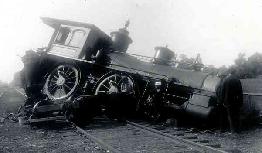
On the morning of April 19, 1891, a Lake Shore & Michigan Southern Railway express was running east from Toledo to Buffalo. Near the small town of Kipton, Ohio, it was due to pass a westbound mail train at a designated siding. The express engineer's watch had stopped for four minutes and then started again — losing those four critical minutes. The two trains met head-on at full speed.
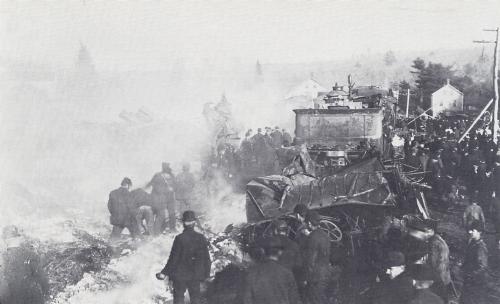
Nine people died, including both engineers. The subsequent investigation placed the blame squarely on the failure of the express engineer's watch. It emerged that across American railroads, there were no standard requirements for the timepieces carried by train crews — some engineers used cheap watches barely more reliable than a department-store novelty.
Webb C. Ball and the New Standards
In response to the Kipton disaster, the Lake Shore & Michigan Southern Railroad appointed Webb C. Ball of Cleveland, Ohio, as their Chief Time Inspector. Ball threw himself into the task with remarkable energy. He personally examined hundreds of engineers' watches and found the results alarming — timepieces of every grade, age and condition were being relied upon to keep trains safely separated.
Over the following two years Ball developed the General Railroad Timepiece Standards — a comprehensive set of requirements that every watch carried by a train crew member would have to meet. The standards were adopted by most American railroads by 1893 and transformed the pocket watch industry virtually overnight.
The General Railroad Timepiece Standards
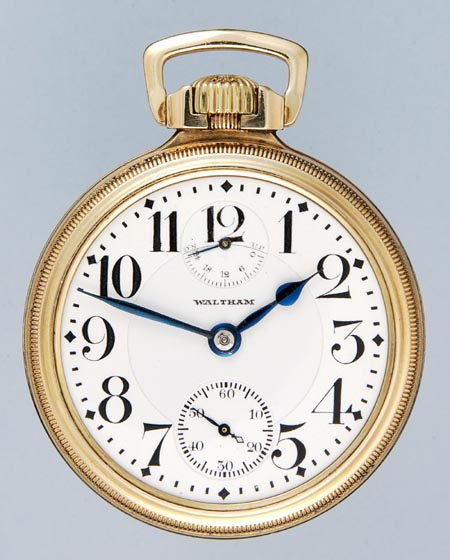
Ball's standards were precise and demanding. A watch had to meet every single requirement to be approved for railroad service — partial compliance was not accepted:
- Open-faced case only (no hunter cover over the crystal)
- Size 16 or 18 movement
- Minimum 17 jewels (21 or 23 for top grades)
- Adjusted to at least five positions
- Accurate to within 30 seconds per week
- Temperature compensated from 34°F to 100°F
- Double roller escapement
- Lever-set winding mechanism (prevents accidental setting while in the pocket)
- Stem at 12 o'clock position
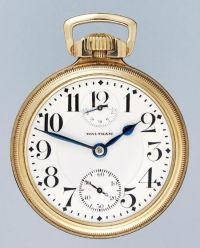
- White enamel dial with bold black Arabic numerals
- Blued-steel hands
- A regulator
The watch shown at right — a Waltham Vanguard — is a perfect illustration of these requirements in practice. Every element of its appearance was dictated not by fashion but by the imperative of legibility and reliability under operational conditions.
The Watch Inspection Regime
Ball's genius extended beyond writing standards — he also created the inspection system that enforced them. Approved jewellers in every railroad town were designated as standard time service providers. Every train crew member's watch had to be presented for inspection every 90 days. The jeweller would test accuracy, examine the condition of the movement and dial, and either certify the watch for continued service or withdraw it.
An engineer whose watch failed inspection had to have it repaired or replaced before being permitted to take out a train. This created a steady, guaranteed market for high-grade pocket watches that drove all the major manufacturers — Waltham, Elgin, Hamilton, Illinois and Ball himself — to produce their finest work.
Who Made the Great Railroad Watches?
Every major American manufacturer produced railroad-grade watches after 1893, but some stand out:
| Maker | Notable Railroad Grades | Collector Notes |
|---|---|---|
| Waltham | Vanguard (21–23j), Crescent Street (21j) | Most common RR watches; Vanguard is the benchmark |
| Elgin | B.W. Raymond (21j), Father Time (21j), Veritas (21–23j) | Largest total production; B.W. Raymond most collected single grade |
| Hamilton | 992/992B (21j), 950/950B (23j) | Fewer made than Waltham/Elgin; 992B regarded as finest RR movement |
| Illinois | Bunn Special (21–26j), Sangamo Special (23j) | Bunn Special with 26 jewels is exceptionally rare and valuable |
| Ball | Official Standard (21j), Commercial Standard (17j) | Movements made by Hamilton, Waltham et al to Ball's spec; complete Ball watches are desirable |
| Hampden | New Railway (21j), Special Railway (17j) | Good quality; undervalued relative to other makers |
Why Collectors Love Railroad Watches
Railroad pocket watches appeal for several compelling reasons:
- The quality of construction was exceeded only by marine chronometers
- Their plain, purposeful dials are handsome in a no-nonsense way
- They represent a vivid chapter of American industrial and social history
- Good examples in fine condition remain surprisingly affordable — $200–$600
- A complete collection of all Hamilton and Illinois railroad grades is achievable — fewer than 100 distinct grades exist across both companies
- They are robust — most will still keep excellent time after a service
Watch Sizes Explained
Watch size in the American system measures the movement diameter, not the case width. The system uses numbers from 0 to 23, each representing 1/30 of an inch above the base measurement. Railroad specifications required size 16 (roughly 1.7 inches diameter) or size 18 (roughly 1.77 inches) — both giving a substantial movement with room for high jewel counts and robust construction.