
The Chronograph Pocket Watch
A chronograph is a timepiece with a separate seconds hand — or hands — that can be started, stopped and reset independently of the regular timekeeping function. In other words: a stopwatch built into a pocket watch. The word itself comes from the Greek chronos (time) and grapho (to write) — a reference to the very first mechanism, which literally marked the dial with ink.
Among antique pocket watches, chronographs represent one of the most technically interesting collecting categories. The movement must solve a difficult mechanical problem: engaging and disengaging a second gear train from a running watch without disrupting the main timekeeping. The solutions developed over 150 years of watchmaking are ingenious, varied, and, when executed well, objects of considerable beauty in their own right.
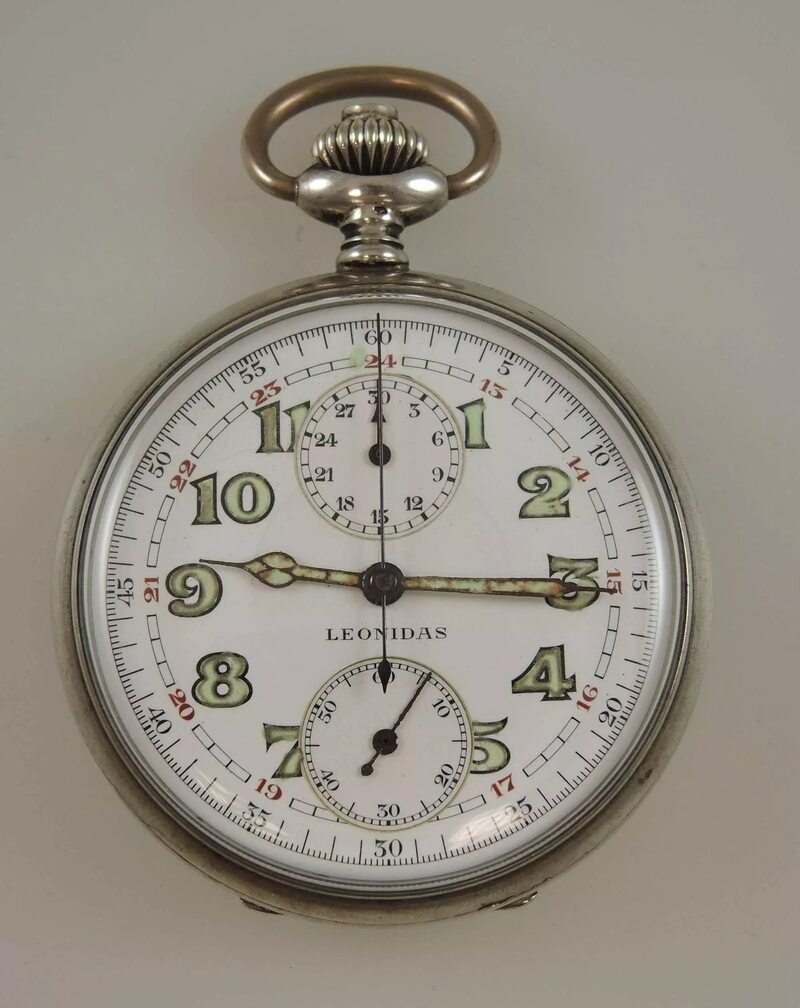
A Brief History
- 1821 Nicolas Rieussec demonstrates the first chronograph to the French Académie des Sciences. His device deposits a small dot of ink on the rotating dial to record elapsed time — hence chronographe, “time writer.” Rieussec made the device to time horse races for King Louis XVIII.
- 1844 Adolphe Nicole patents the column-wheel and horizontal-coupling mechanism, which becomes the basis for almost all subsequent chronograph design. Nicole’s mechanism uses a rotating wheel with alternating columns and slots to control the start, stop and reset sequence cleanly and positively.
- c.1860 The centre-sweep chronograph seconds hand replaces the ink-mark system entirely. A push-piece in the crown or case band starts and stops the hand; a second push or sliding piece resets it to twelve.
- 1877 Longines introduces the first integrated single-button chronograph movement — start, stop and reset all controlled by one push-piece. This becomes the dominant format for the next half-century and the direct ancestor of virtually every modern chronograph.
- c.1880s The rattrapante (split-seconds) chronograph appears. Two concentric centre-seconds hands allow two simultaneous times to be recorded — one hand can be stopped for a lap time while the other continues running. Among the most mechanically complex complications in watchmaking.
- 1910s–1920s Military demand during and after World War I drives volume production of robust, legible chronograph pocket watches. The flyback (retour-en-vol) function — which resets and immediately restarts with a single push, without the operator needing to stop first — is developed for aviators timing legs of a flight.
- 1920s–1930s Register chronographs with subsidiary 30-minute and 12-hour totaliser dials allow longer elapsed times to be recorded. These become the definitive format for serious timing instruments, used by doctors, athletes, scientists and military observers.
How a Chronograph Works
The central challenge is this: the chronograph seconds hand must be able to start from zero and stop precisely, without the operation disturbing the balance wheel or the running timekeeping train. Early solutions used a “stop-work” that physically halted the chronograph wheel; the better approach developed by Nicole uses a horizontal coupling — a friction clutch that engages the chronograph train with the running movement without any jolt to the going train.
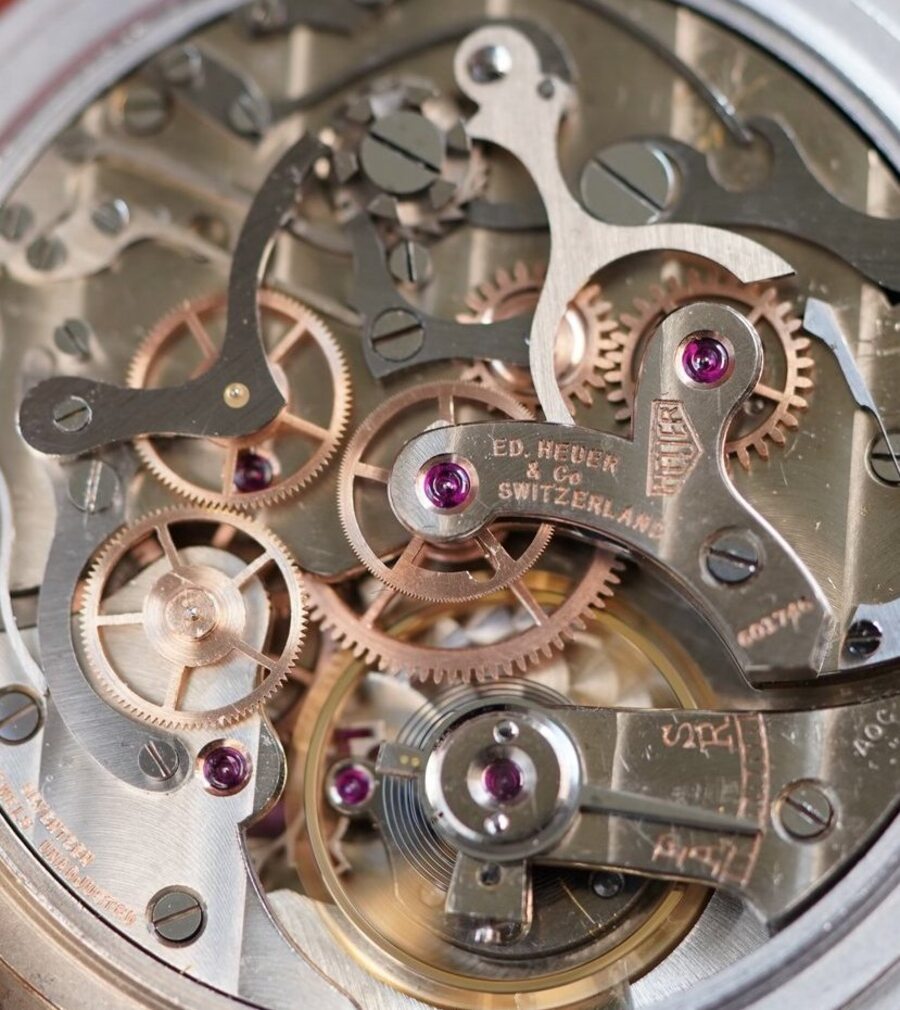
The column wheel (or roue à colonnes) is the control heart of a quality chronograph. It is a small wheel with alternating columns and slots around its rim. Each press of the push-piece rotates it one step; the levers that control the clutch, brake and reset mechanism ride against its profile, giving the smooth, positive actuation characteristic of a well-made piece. Simpler and cheaper movements substitute a cam-and-lever system, which is functional but gives a less precise feel.
The Four Main Types
One centre seconds hand, one push-piece or slide for start/stop, a separate reset. The most common antique type. Many have a subsidiary 30-minute register dial at 3 or 9 o’clock.
A single push-piece resets and immediately restarts the hand without stopping first. Developed for aviation. Saves the critical second or two needed in a sequential stop–reset–start sequence.
Two superimposed centre-seconds hands. One can be stopped independently for a lap or intermediate time while the other continues. The stopped hand “catches up” (rattraper) when released. The most complex and sought-after chronograph type.
Subsidiary dials — typically 30-minute and 12-hour totalisers — record elapsed time beyond 60 seconds. Standard on serious timing instruments from the 1920s onwards. Often combined with flyback function.
How to Read a Chronograph Dial
The main dial shows current time in the usual way. The centre chronograph hand — usually the longest, most prominent seconds hand — starts at twelve and sweeps round when the chronograph is running. A subsidiary 30-minute register (small dial, usually at 3 or 9 o’clock) accumulates elapsed minutes; a 12-hour register (often at 6 o’clock) accumulates elapsed hours for very long timings.
The running seconds of the watch — the small dial showing that the mainspring is wound and the movement is running — is separate from the chronograph hand and continues regardless of whether the chronograph is started or stopped. On some movements this is at 9 o’clock; on others it is incorporated into the chronograph layout. If the running seconds hand is stationary, the watch has stopped.
Notable Makers
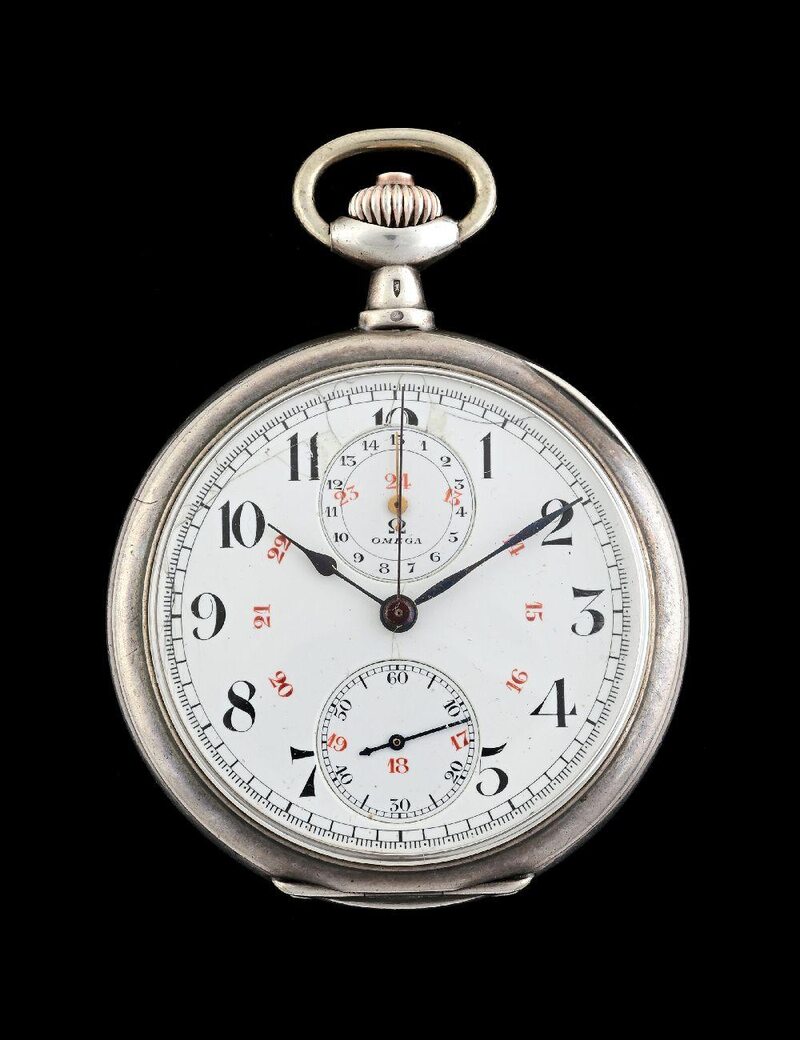
Longines was the dominant force in precision chronograph production from the 1870s through to the mid-20th century. Their ebauche movements — especially the calibre 13ZN and its successors — powered chronographs used at the Olympic Games, by international federations, and for navigation. Longines chronograph pocket watches are plentiful enough to be accessible and good enough to be genuinely useful as instruments; they represent excellent value.
Patek Philippe made chronographs of the highest quality, particularly rattrapantes and minute-repeater chronograph combinations that rank among the most complex pocket watches ever produced. Signed Patek Philippe chronographs command substantial premiums at auction.
Vacheron & Constantin, Le Coultre and IWC all made excellent precision chronographs in the late 19th and early 20th century. Of particular interest are the IWC cal. 82 and cal. 97 movements — robust, well-finished, and used in large-format cases with highly legible dials.
American makers occupy a smaller part of the chronograph market than their Swiss counterparts. Waltham produced chronograph movements (notably the model 1889), as did Elgin, but these were far outnumbered by Swiss imports. American railroad-grade movements were optimised for precision timekeeping rather than complications; Swiss ateliers had a century’s head start on complication manufacture.
At the more affordable end, Minerva, Excelsior Park and various anonymous Swiss ebauche makers produced large quantities of serviceable chronograph movements between 1900 and 1940. Many were sold under retailer names or as unsigned trade pieces. These can be excellent instruments at modest prices.
What to Look For When Buying
- Does the chronograph function work correctly? Start, run for 30 seconds, stop, check the hands are stationary, reset to zero. The chronograph hand should return exactly to twelve — a hand that resets to a few seconds past zero indicates a worn or out-of-adjustment heart-piece cam.
- Column wheel or cam? Look through the caseback for the column wheel. Its presence indicates a better-grade movement and typically a more positive, satisfying action at the push-piece.
- Condition of the push-piece(s) The push-piece is the most-handled component on a chronograph. Check it operates smoothly without sticking, and that the stem or slide is not bent or worn loose. A loose push-piece will produce erratic starts and stops.
- Register hands aligned at zero The 30-minute and hour register hands should sit precisely at zero when the chronograph is reset. Misalignment indicates a previous repair where the hands were refitted out of position — correctable, but worth noting.
- Dial condition Chronograph dials are complex and replacement or restored dials are common. Look for consistent printing colour, no ghosting of previous hand positions, and original lacquer or enamel condition. A hairline crack in an enamel chronograph dial reduces value significantly.
- Signature and provenance A movement signed by a named maker — Longines, Patek, IWC — is worth substantially more than an equivalent unsigned trade movement. Check the movement, dial and case all carry consistent signatures; mismatched signatures suggest re-casing or refurbishment.
- For rattrapantes: test both hands independently On a split-seconds chronograph, operate the secondary push-piece to split and re-join the hands. Both operations should be positive and the hands should reunite precisely. A rattrapante that misfires or leaves a gap between the hands needs specialist attention.
Approximate Values
| Type | Maker / Period | Approx. Range |
|---|---|---|
| Simple chronograph, unsigned Swiss | 1900–1940 | £150–£400 |
| Single-button chronograph, Longines | 1890–1930 | £300–£900 |
| Register chronograph (30-min + 60-min), named Swiss maker | 1900–1940 | £500–£2,000 |
| Flyback chronograph, named maker (IWC, Longines) | 1920s–1940s | £1,000–£4,000 |
| Rattrapante (split-seconds), unsigned Swiss | 1880–1930 | £1,500–£5,000 |
| Rattrapante, Patek Philippe / Vacheron | 1880–1930 | £8,000–£50,000+ |
Related Pages
- Repeater Pocket Watches — another major complication, often combined with chronographs
- Military Pocket Watches — many military issue pieces are chronographs
- Skeleton Pocket Watches
- Patek Philippe
- Pocket Watch Values
- Current eBay Auctions