
The Omega Watch
The story of the Omega watch started in 1848, when a young man by the name of Louis Brandt started a workshop in La Chaux-de-Fonds and began making precision pocket watches. Watchmakers and craftsmen from the local area would supply Brandt with the parts, and he would assemble the finished timepiece — the established Swiss établissage system, but done with unusual care for quality. Brandt continued his watchmaking activities for most of his life and passed away in 1879, when the business transferred to his two sons, César and Louis-Paul Brandt.
The brothers proved energetic stewards. They moved the operation to Biel/Bienne in 1880 to be closer to the rail network, built a proper factory, and by 1889 had become the largest watch producers in Switzerland, turning out over 100,000 pieces per year. The company was by this point making watches for militaries and government institutions across Europe, building the precision credentials that would define everything Omega did afterwards.
The name "Omega" came in 1894, when the brothers developed a new movement of exceptional quality — simple to maintain, reliable, and technically precise. The company's banker, Henri Rieckel, suggested the name: Omega, the last letter of the Greek alphabet, signifying the pinnacle of achievement. It stuck. The movement bearing that name won the first chronometer certification ever awarded to a wristwatch — bestowed by the Kew Observatory in London in 1910 — and by 1903 the company had renamed itself accordingly. The Omega Watch Co. was now a brand as well as a movement.
From Pocket Watches to Pilot's Timekeeper
The transition from pocket watchmaker to wristwatch specialist was, for Omega, driven by military demand. The British Royal Flying Corps chose the Omega as their official timekeeper during the First World War, followed by the U.S. Army in 1918. Pilots needed their hands free while reading instruments and operating controls — the wristwatch was not a fashion choice but a practical requirement — and Omega's precision made them the natural choice for a market that valued accuracy above all else. Omega chronometers continued through the following decades to win prizes at observatory timing competitions, gradually cementing a reputation that went beyond commercial watchmaking into the realm of scientific instrument.
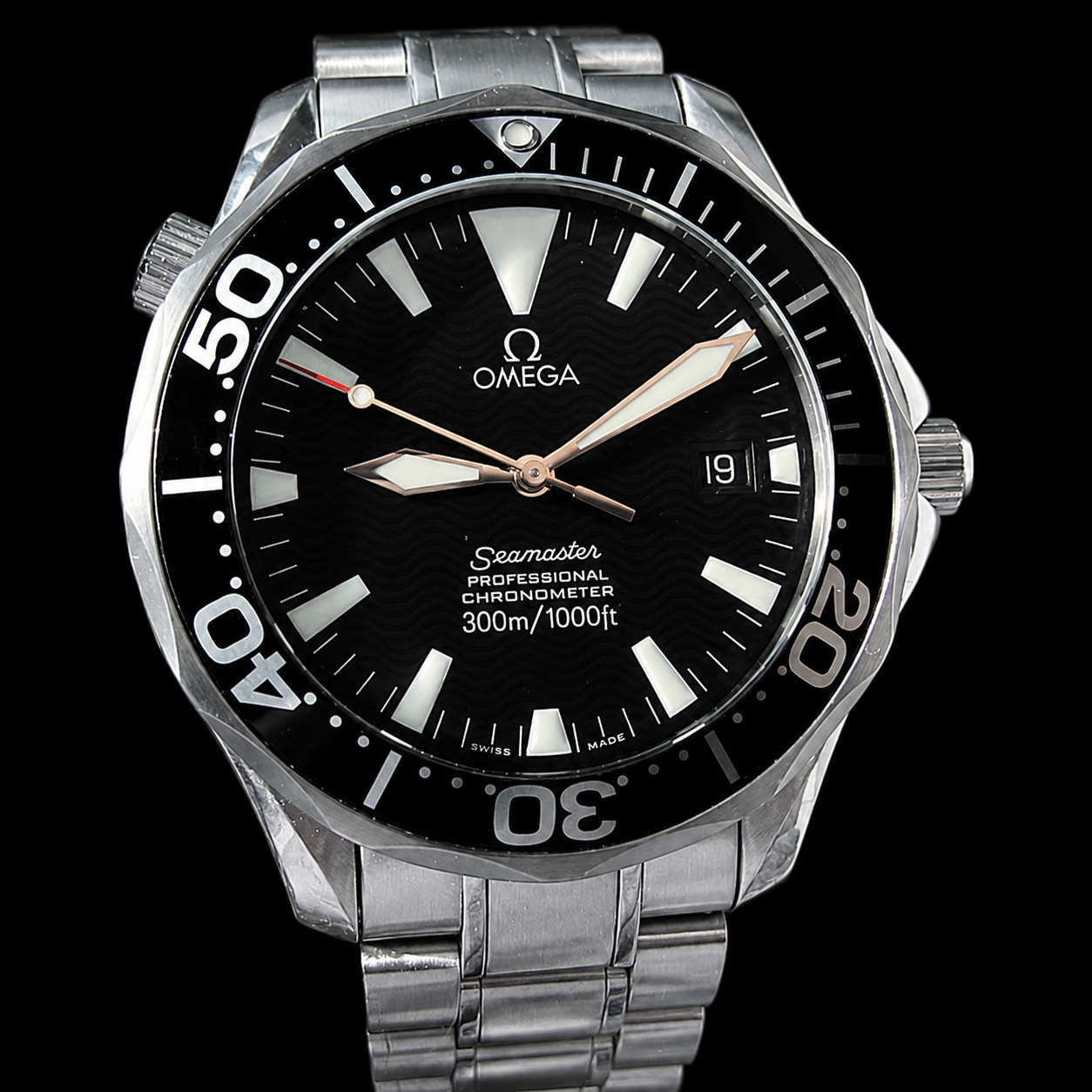
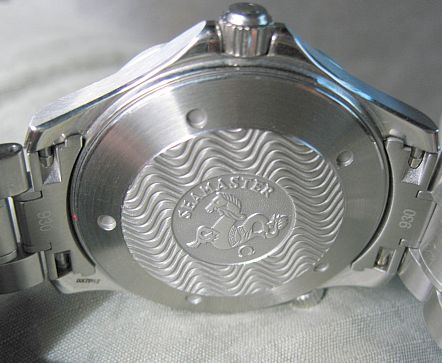
The Seamaster line, launched in 1948 to mark the company's centenary, became Omega's core professional range — elegant enough to wear at a dinner table, robust enough for real-world service. The Seamaster Professional illustrated here, with its 300m/1000ft water resistance rating and Professional Chronometer certification, represents the current expression of a design philosophy that began with those First World War pilot's pieces.
The Speedmaster and NASA
Of special note — perhaps the greatest single endorsement any watch company has ever received — is NASA's decision to select the Omega Speedmaster Professional as their official timekeeper for the Apollo programme. The selection process in 1965 was rigorous: NASA subjected several chronographs from different manufacturers to extreme temperature cycling, humidity, shock, vibration, vacuum and acceleration tests. Only the Speedmaster passed all of them. It became the standard watch for every American astronaut, worn on every manned mission.
On 20 July 1969, when Neil Armstrong became the first human being to walk on the moon, an Omega Speedmaster Professional was on Buzz Aldrin's wrist. The watch had been there for the entire flight, and it worked throughout. That single moment — perhaps the most watched television broadcast in history to that point — gave Omega a marketing position that no advertising campaign could have manufactured, and no competitor has ever been able to replicate.
Omega ventured into quartz in 1974 with the Megaquartz — an extraordinarily accurate timepiece that paved the way for a series of quartz watches and, like the Speedmaster, helped maintain the company's reputation for technical leadership at the exact moment the quartz crisis was forcing other Swiss makers into retreat or bankruptcy. Omega emerged from that difficult period as one of a small number of Swiss brands with the scale and reputation to survive intact.
The Omega brand has cemented itself in horological history with its highly regarded timepieces and unique styling. From the pocket watches of Louis Brandt's workshop to the Speedmaster on the Sea of Tranquility, the thread running through it all is the same: precision that can be trusted when it genuinely matters.
Omega Chronology
| Year | Event |
|---|---|
| 1848 | Louis Brandt starts his workshop in La Chaux-de-Fonds, assembling precision pocket watches |
| 1879 | Louis Brandt dies; the company passes to his sons César and Louis-Paul Brandt |
| 1880 | The brothers move to Biel/Bienne and build a centralised factory |
| 1889 | Omega becomes the largest watch producer in Switzerland, exceeding 100,000 pieces per year |
| 1892 | A partnership with Audemars Piguet produces a minute repeater wristwatch — a world first for the format |
| 1894 | The Omega calibre is developed — simple, reliable, and named at the suggestion of the company's banker Henri Rieckel. Omega is born as a brand name. |
| 1910 | Omega receives the first official chronometer certification ever awarded to a wristwatch, from the Kew Observatory, London |
| 1917 | The British Royal Flying Corps adopts the Omega as their official timekeeper |
| 1918 | The U.S. Army adopts the Omega as their official timekeeper |
| 1919 | Omega chronometers win at the Neuchâtel timing competition |
| 1932 | Omega serves as official timekeeper at the Los Angeles Olympics — the beginning of a long Olympic relationship |
| 1948 | The Seamaster is launched to mark the company's centenary |
| 1952 | The Constellation is launched — Omega's certified chronometer dress watch |
| 1957 | The Speedmaster, Seamaster 300 and Railmaster are launched as Omega's professional trio |
| 1965 | NASA selects the Omega Speedmaster Professional as their official timekeeper for the Apollo programme, after rigorous competitive testing |
| 1967 | Omega produces its one-millionth certified chronometer |
| 1969 | Neil Armstrong and Buzz Aldrin land on the moon; an Omega Speedmaster Professional is worn throughout the Apollo 11 mission |
| 1974 | Omega produces the Megaquartz — an exceptionally accurate quartz wristwatch |
| 1983 | Omega gains its 100,000th official rating certificate for its quartz chronometer |
| 1999 | Omega introduces the Co-Axial escapement in commercial production — the first new escapement design to reach series production in over 250 years |
Omega and James Bond: Since 1995, the Omega Seamaster has been the official watch of James Bond in the official EON Productions film series. The association began with GoldenEye and has continued through every subsequent Bond film, replacing the Rolex Submariner that had been worn in many earlier films. The Bond association has made the Seamaster one of the most recognisable watch designs in popular culture worldwide.
eBay Omega Watch Auctions
Search current eBay listings for Omega wristwatches and pocket watches:
Related Pages
- Longines Pocket Watch — another great Swiss maker with a comparable history
- Chronograph Pocket Watches
- Military Pocket Watches
- The Breitling Watch
- Wristwatches Index