
The Waltham Pocket Watch Company
“A Waltham pocket watch is a machine. It used to be supposed that its delicate parts could only be made by manual skill; and in a large portion of the world this notion still prevails. The idea that a machine can be made by machinery, much of which is automatic, is essentially American. In its application to the watchmaking industry it originated with Aaron L. Dennison, a Boston watchmaker, who began his experiments in 1848.
In company with Edward Howard and Samuel Curtis, a small factory was started, in 1850, at Roxbury, Mass., which was removed four years later to Waltham, ten miles from Boston, a place already famous for the first cotton mill started in this country.
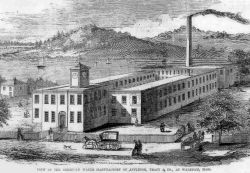
After struggling with numerous unforeseen obstacles, these pioneers in a new industry failed financially; and their property was bought, in 1857, by Royal E. Robbins, for Appleton, Tracy & Co., the corporate name being subsequently changed to that of the American Waltham Pocket Watch Company of Waltham, Mass. The original stock capital of $200,000 has been increased to $1,500,000, with an equally large surplus. The number of hands has grown from 75 to 2,500. And in place of the small factory existing in 1857, there was built a much larger one, that in turn gave way to the immense structure now in use, and that has been wholly built since 1878.
A few figures will perhaps convey an idea of the magnitude of the Waltham Pocket Watch Works in their present form. The factory itself is a brick building, with numerous long wings, several towers, and enclosing three ample inner courts, besides an elegant suite of offices at one end and an observatory at the other. The total length of the front is 646 feet. The floors cover nearly five acres. There are 3¼ miles of work benches, mostly made of cherry plank, 2 feet wide and 2 inches thick. There are 4,700 pulleys; 8,000 feet of wall rods; 10,000 feet of main shafting, and 39,000 feet of belting, varying in width from 2 inches to 2 feet. All this machinery is driven by a Corliss engine of 125 horse power.
When Mr. Robbins took hold of what was then regarded as a forlorn enterprise, only 5,000 watches had been made in all. Now over 2,500,000 have been made thus far at this one factory, of which 500,000 were made during the last eighteen months! The present capacity of the works is 1,250 Waltham pocket watches daily, which by recent improvements will soon be increased to 2,000. There have actually been sent out 30,000 in a single month, and 30,000 watches are needed all the time in the finishing rooms to enable the hands to work to advantage.
Out of the American Waltham Pocket Watch Company all the others have originated. Many have failed and others are starting. Taking no notice of cheap, inferior goods, there are made, on average, 3,650 watches a day by nine first class factories in the United States. According to Mr. Robbins’ estimate, the value of a year’s product of gold and silver watches in this country exceeds $16,000,000; and the business directly and indirectly furnishes employment for 100,000 persons.
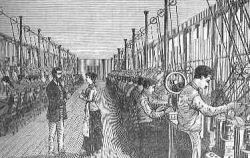
The factory at Waltham is located on an expansion of the Charles River, and is environed by parks maintained at the company’s expense. The rooms are thoroughly ventilated, and all the sanitary arrangements are excellent. Consequently the operatives are a remarkably healthy, cleanly and bright set of people, mostly young persons, whose unimpaired eyesight and steady nerves qualify them for the delicate work before them. Intelligence and integrity are also required in a business involving the handling of quantities of precious metals and jewels.
For certain kinds of work female operatives are preferred, on account of their greater delicacy and rapidity of manipulation; and it should be added that women get the same wages as men for doing the same kind and amount of work. All the apartments are lighted by large windows by daytime, and for night work there are 200 incandescent electric lamps and 3,500 gaslights, requiring over 22½ miles of piping. There are 38 furnaces using gas as fuel.
There are 25 distinct departments, each having its foreman, and all in telephone communication with the central office. Mr. Ezra C. Fitch is Superintendent. G.H. Shirley is Assistant Superintendent, E.A. Marsh is the Master Mechanic, and D.H. Church is Master Watchmaker, through whose kindness the writer had access to the various departments. Most of the foremen and a number of the hands have been in the employ of the company for from twenty to twenty-five years.
Probably very few persons realize how many distinct operations are required to produce a single Waltham pocket watch. The managers themselves did not like to make a statement until at my request the question was laid before the foremen: “How many distinct mechanical operations are required in order to construct one of the grade of watch movements described as an Appleton, Tracy & Co. stem-winder?” Each foreman made a list of the operations in his own department, and the startling sum total was 3,746; and the number would be considerably larger for some of the higher grades.
The Movement
It is evident that the mere finish of a watch is no test of its excellence. The greatest pains are taken by the American Pocket Watch Company in perfecting the original model. Every variety of design and appliance that human ingenuity can devise is sought for; and a staff of special artists, draughtsmen, and inventors is continually busy to make each part and process as economical and accurate as possible. The various machines are thoroughly and exquisitely exact. They are all made in the extensive machine shops belonging to the company. A great hue and cry has been raised in Europe against machine-made watches, as if necessarily clumsy; whereas the reverse is true.
In the anxiety to secure a high finish, many a hand-made watch is polished to death. The aim of the American Pocket Watch Company is to secure actual interchangeability of pieces. The corresponding parts of their watches will come within one ten-thousandth of an inch of being identically alike. A jewel hole should be two ten-thousandths of an inch larger than the pivot that works in it — a few turns of the polisher would make a change. Hence microscopic measurement has to be resorted to in fitting pivots to jewels.
Furthermore, automatism in tools is the coming necessity for cheapening labor. The American Watch Company already uses many automatic and semi-automatic tools, and is constantly inventing more. Should any part of a watch fail in actual use the owner need only send on the number of the movement to enable the factory to supply an exact duplicate of the part. The order could be sent by postal card, and filled by return mail. A systematic record is kept so that any part of a watch ordered could be located at any stage in its manufacture.
The “movement” of a watch is made up of two plates and the wheels between them. The plates are known as the pillar plate and the top plate. All Waltham watches have what is called a going barrel, instead of the fusee preferred in the English system. The going barrel contains the main spring, and drives the center wheel and pinion, which revolve once an hour, carrying the minute hand. The fourth wheel carries the second hand, revolving once a minute. The fourth wheel also drives the escape wheel, so called because it only lets one tooth escape at a time, bringing the machine to a dead stop five times every second.
All Waltham watches are “lever escapement,” universally accepted as best for pocket timepieces. The balance, to which the lever imparts motion through the medium of the roller jewel, regulates the whole watch. The balance is bimetallic, to correct the contraction or expansion of the hair spring so that the watch may run true regardless of temperature. The Waltham standard is 18,000 beats to the hour (5 to the second), called “quick train.”
The safety of the entire watch movement from any injury that might result from the breaking of the main spring is secured by a safety pinion screwing on to the arbor of the center wheel by a triple left-hand thread. Should the main spring break, the recoil would merely unscrew this pinion, and thus release the whole movement without any consequent damage.
The Departments
A volume would be needed to describe all the 3,746 operations required for the construction of an ordinary watch. But a general description of the main departments may meet the demands of the present article.
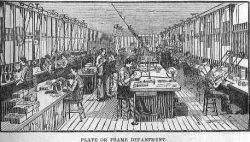
The Plate Room is where they manufacture the pillar and top plates. The material used is generally brass, although nickel is used for some of the finer watches. Eighty operations are required for the pillar plate alone. The parts being assembled are screwed together, several operations are performed, after which they are taken apart and finally distributed. During this process, at various times, the plates have to be boiled in soapsuds to clean them from dirt.
There are 157 operations in the plate room alone, as I made out my list going from bench to bench, each requiring great care and precision.
The Press Room — the first thing exhibited was a sort of cabinet, in whose glass jars and tiny drawers are myriads of parts of watches, each sort labelled — regulators, yokes, forks, clicks, lever springs, winding wheels, train wheels, gold and steel balances, hour hands, minute hands, second hands — everything in short that can be made by punching.
The effect is striking in seeing so many objects of a kind massed together — 10,000 second hands in one jar, the result of one day’s work, the monthly order calling for 100,000. The counting is done by weight. A box of center wheels was weighed in my presence, and found to weigh 146 oz. A single ounce was then weighed, and the wheels counted and found to number 136. Consequently there were 19,979 wheels in the box. Some idea of the multiplicity of operations in this department may be had on learning there are over 200 different sorts of hands now made. Many parts are so small as to be almost microscopic; many operations have to be verified to within ½,000 of a centimeter — 1/10 the thickness of a human hair.

The Pinion Room, in care of Martin Thomas (23 years with the company), has another cabinet of jars, boxes and drawers, with pinions of every sort and in every stage. Everything must be as exact as possible. The process begins with cutting the wires to be used in lengths, roughed out, and pointed. Five or six turnings follow, and then the leaves (or teeth) are cut. It has long been known that these should be epicycloidal in form; but under the old system it was difficult to effect this with desirable exactness. Here the superiority of machinery over handwork is visible. Machines have no prejudices nor aesthetic notions. The final result is that, when all the parts of the watch are assembled and set in motion, the action of the teeth of the wheels on the pinion is perfectly smooth and continuous — an end that cannot be secured in any other way.
After the leaves have been cut, the pinions are hardened and tempered, polished and finished ready for use. Seven barrels of flour a month are consumed in making dough for various uses, besides many barrels of pith, and quantities of rouge and Vienna lime. At the time of my visit, pinions for 100,000 watches were actually going through the works.
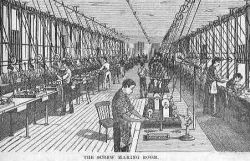
The Screw Department exhibits the perfection of automatic machinery more visibly than any other. Were it not for the necessity of hand-finishing some of the finest work, there would not be needed more than a dozen workmen to make the daily average of 100,000 screws. There are twenty-four automatic machines, each making from 3,000 to 4,000 screws a day, not including night work. There is also an automatic pin machine that makes 20,000 pins a day for use in fastening hair springs. All these machines were invented and made here.
The finest quality screws have to be finished and blued singly, and all counted, because done by the piece. To illustrate the possibilities of this department, Mr. Robbins assured me that from steel wire costing the company but $5.00 they could make 247,000 screws, weighing one pound, worth $1,715.00. Most of the screws, of course, are of a larger size than this.
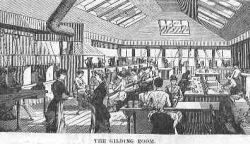
The Gilding Room — all the brass movements have to be gilded. The parts must first be stoned, then inspected, after which they are put through a bath of nitric, sulphuric, or muriatic acid. Having been rinsed, they are brushed with revolving wire brushes to prepare them for the gilding bath. They are then rinsed in alcohol, dried in sawdust, inspected, and such as are ready for the finishers are folded in tissue paper and sent to their rooms. The gilding is done both with electric dynamos and with old-style Daniell battery. From $40 to $50 worth of gold is put on the works of 1,000 watches in the process of gilding. An exhaust fan carries off all deleterious fumes.
Balance Making begins with a plain steel blank made of best steel. According to the foreman, J.L. Keyser, there are 85 operations in all required for making an expansion balance. The screws, 22 in number, are of different sizes, weights, and metals to conform to the varying strength of the hair spring.
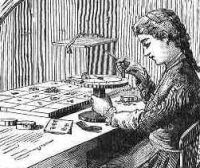
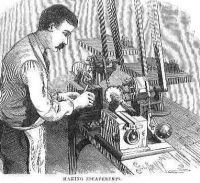
The Escapement includes the roller, roller jewel, pallet with its two jewels and arbor, fork and guard pin, screws, escape wheel and pinion — thirteen pieces in all — requiring the most exact precision. The escape wheel cutting is done by an automatic machine carrying six cutters, three steel and three sapphire. Fifty wheels are cut at a time, and it takes six cuts to make each of the fifteen teeth. The machine stops when they are done.
The garnet pallet stones are placed 30 or 40 together, on a steel block ground and finished on one side and then the other. They are then stacked on a graduated plate, and marked with a diamond to be broken off to a length. All are finished with diamond dust on ivory laps.
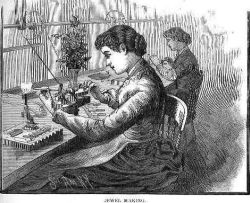
The Jewel Making Department — a safe was opened containing about $50,000 worth of precious stones. Diamond bort, in the rough, costs $1.50 a carat; the company requires about 12,000 carats a year. No watch jewels are made of diamonds, because they could hardly be drilled. Glass also is never used at Waltham, nor quartz crystal. The stones used are rubies, sapphires, garnets and occasionally chrysolite and aquamarine. A full-jewelled watch takes 16 jewels — balance, end stone, escape, pallet, third, fourth, and center jewels. Every watch has the same kind of jewels throughout: one will have all garnets, another all rubies.
There were made, in the month of June, 350,000 jewels, employing 255 hands, of whom 175 were males.
The Hair Spring is a tiny thing, but has a department of its own. The material is steel wire 0.022 of a centimeter in diameter. It comes in coils, and is drawn through ruby and sapphire dies down to 0.018 of a centimeter, then rolled flat between hardened steel rollers. It is then cut into lengths of 14 inches, wound in little boxes and hardened and tempered, cleaned by acid, and blued. The hair spring is then attached to a brass collet in the center and to a steel stud at the outer extremity.
Out of one pound (troy) of fine steel wire, worth from $2.70 to $5.40, may be made 17,280 hair springs, worth $7,152 at lowest wholesale prices — an illustration of how greatly raw material can be enhanced in value by skill.
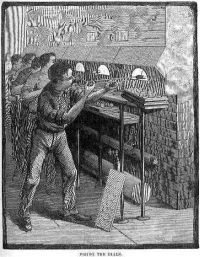
The Dial Making Room — the dial has a copper base, which is pressed and pierced at one operation. Pulverized enamel is laid both on the back and the face, and then fused on, or “fired.” Having been smoothed they are fired a second time, inspected, and sent to the Painting Room. Here the face is spaced into 12 equal divisions by lead pencil marks; two circles mark the length of the letters or figures. Dabs of enamel paint go on where the hours are to be. When dry, the tops and bottoms are cut off to the proper length; then, by suitable tools, straight spaces are cut through leaving the heavy lines of the “hours,” and the surplus paint carefully scraped off. After inspection, the dials go back for a third firing.
Time Regulation
Time regulation is, of course, very important. Two superior clocks are kept for this purpose; one for mean time and another for a constant rate. The Waltham observatory has a transit instrument, and an astronomical clock electronically connected to all the rooms where the timing of watches is an object. A chronographic record is kept, and a daily record of errors and variations of temperature and barometrical pressure. The clocks themselves are kept in a dark room whose temperature is maintained at 70 degrees Fahrenheit all the year round.
Silver Cases
Silver cases only are made at Waltham; the gold ones being all made at New York, in the Waltham Buildings, Bond Street. The silver comes in bars, which are first rolled down and pressed into shape. Then the material goes to the turning room, where the pieces are snapped together and fitted. After the turners are through, the jointing and soldering are done. The cases are milled for the joints, and the caps put on. In the opening room the winding crown is put on, and the joints fixed so that the case will open at right angles. It next goes to the springing room to receive the lifting spring and catch spring.
The case is then taken apart for polishing, and the backs sent to the engraver and engine-turner. There are 150 operations needed to manufacture an ordinary watchcase. The department produces 700 silver cases a day, employing 400 hands. At the time of my visit they had on hand $90,000 worth of silver, and about $10,000 in gold for joints. The washings of aprons and hands, and the sweepings of the floors, are all saved up to be reclaimed in the refining room; and thus a large amount of metal is saved monthly.
Conclusion
The Waltham Watch Company, besides its salesrooms at No. 5 Bond Street, New York, and at 403 Washington Street, Boston, has its own agencies at Chicago, London, and Sydney. Most of the watches made are sold in this country; yet their excellence is appreciated abroad, as is proved by their increasingly large exports.
Having inspected the shops at Waltham, a new delight was felt while looking at the finished watches as displayed to the public. My attention was especially directed to a newly invented case having no springs or hinges, all parts screwing together, thus making the watch secure from dust and moisture. Also to fine timers with chronograph attachment — a device for marking any particular moment to within a fifth of a second, without interfering with the general movement. By pressing a spring, the sweep second hand is stopped; by another pressure it is made to fly back to twelve; and by still a third pressure it is made to go again.
Justice to the writer requires me to add that this article lays not the slightest claim to merit as from an expert, and quite possibly is in need of indulgence for errors of a technical sort. Yet for the general reader it may possess a certain interest and value of its own as an impartial description and an unofficial tribute to the science, perseverance, and skill characterizing one of the finest, most praise-worthy, and truly wonderful of our manifold American industries.”