
The Dollar Pocket Watch & the Ingersoll Watch
Around the end of the 1870s — and perhaps even before — pocket watch manufacturing was not the most financially secure of industries. Pocket watches on the whole were expensive and therefore reserved for the more affluent members of society. A gentleman of the day would not be seen without his pocket watch; they were very much a status symbol, just like a prestige wristwatch is today.
What pocket watch manufacturers needed was to sell more watches — and to do that they needed to produce them in a much more efficient and cost-effective manner, make them accessible to the masses, and therefore make them much cheaper. So the first ideas of producing the so-called “Dollar Watch” were born.
Robert & Charles Ingersoll
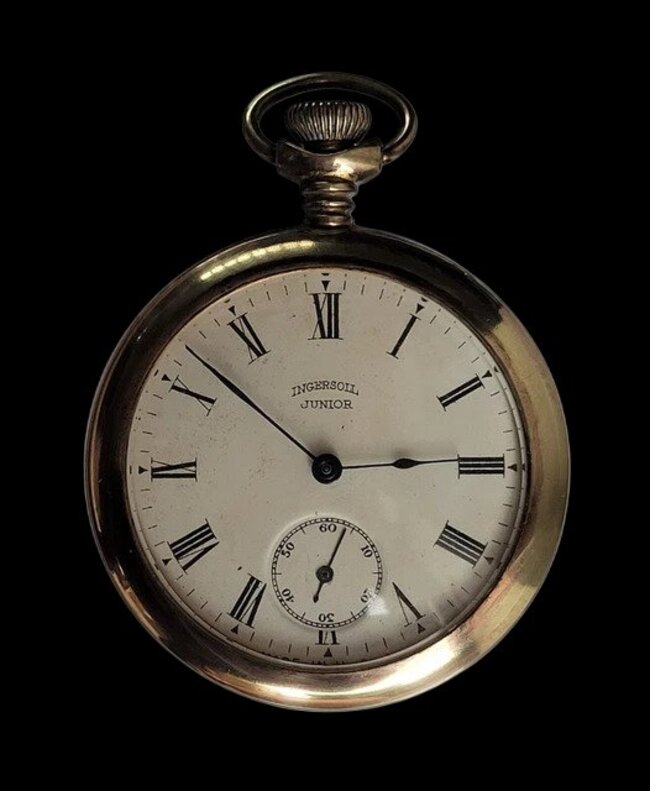
One company is famous for making the first genuine Dollar Watch: Ingersoll. They produced the first Dollar Ingersoll Watch in 1881 via a New York-based mail-order business set up by brothers Robert & Charles Ingersoll. The Dollar Watch proved so popular that by the mid-1890s they had sold one million Dollar Pocket Watches — hence the slogan “The Watch That Made the Dollar Famous.”
Other companies that also sold pocket watches costing only one dollar were Westclox, New Haven, Ingraham and Ansonia. But Ingersoll got there first and stayed the most visible name in the category for decades.
Ingersoll continued and expanded its operations to the UK market, opening a London store in 1904. Here it sold the Crown pocket watch for the princely sum of five shillings (25 new pence). The British operation traded as Robt. H. Ingersoll & Bro. of Audrey House, Ely Place, London E.C. — the address still printed on original patent license cards found inside surviving examples. See the Junior license card below.
Ingersoll was eventually bought out by the Time Corporation, and eventually the name was changed to that synonymous with timekeeping throughout the 20th century: Timex.
The Pin-Lever Movement
These watches were not the same as the more expensive makes of the era. They did not utilise jewels in their mechanisms; instead they used the so-called “pin-lever” method. Instead of a jewel being used as a bearing, a hole was drilled directly into the pocket watch plate and a pin attached to the gear sat inside the hole.
This was a simple but effective way to drastically reduce costs. Oiling was very important to reduce wear on the metal-to-metal contact surfaces, and the movements did eventually wear. But the goal was achieved: make a watch affordable for the everyday worker. At one dollar, an American labourer earning a dollar a day could own a watch for a single day’s wages — something that would have been unthinkable a generation earlier.
The pin-lever mechanism has a slightly rough action compared with a jewelled lever escapement, and experienced collectors can feel the difference immediately. But functioning examples, properly oiled, can keep reasonable time — and the simplicity of the design makes them surprisingly easy to service.
The Ingersoll Junior & the Patent License
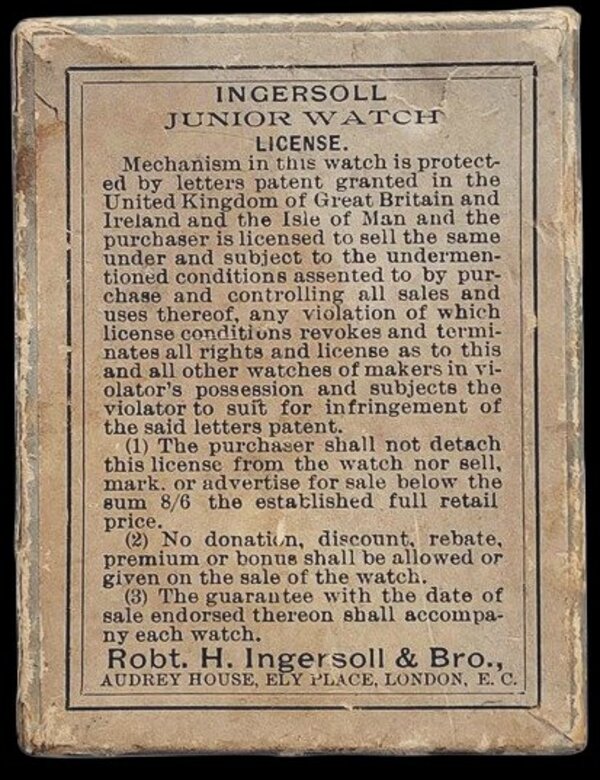
The original patent license card shown above is a genuinely rare survival. Ingersoll used these cards to protect their patent position and control retail pricing — the license explicitly forbids the purchaser from selling the watch below the established retail price of eight shillings and sixpence, and from offering “any donation, discount, rebate, premium or bonus.” Any violation would terminate all rights and expose the seller to suit for infringement.
Finding a Junior with its original license card intact is relatively unusual. Most were discarded when the watch was first sold or lost over the century since. When one does turn up, it adds immediate provenance and historical interest — and confirms without any doubt that the watch is a British-market Ingersoll from the Audrey House period.
The Mickey Mouse Watch — Ingersoll’s Masterstroke
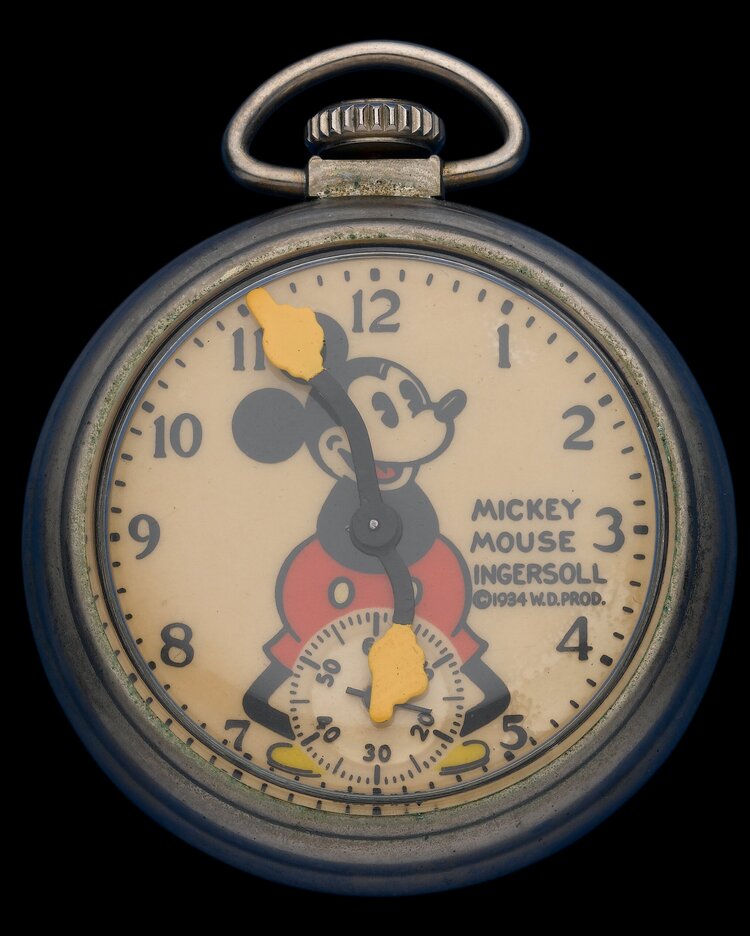
If the Dollar Watch democratised timekeeping, the Mickey Mouse watch turned it into popular culture. Introduced in 1933 in partnership with the Walt Disney Company — at a time when Disney was still a relatively young operation and Mickey Mouse barely five years old — the Ingersoll Mickey Mouse watch became a phenomenon almost immediately.
The watch was launched at the 1933 Chicago World’s Fair. Ingersoll sold 11,000 units on the first day, and within two years had shifted two and a half million. The order book is widely credited with saving Ingersoll from bankruptcy during the depths of the Depression; one account holds that it also helped stabilise the Walt Disney Company’s finances at a critical moment.
The design is simple and inspired: Mickey’s outstretched arms serve as the hour and minute hands, his yellow-gloved fingers pointing to the numerals. A conventional subsidiary seconds dial sits at 6 o’clock, leaving Mickey’s whole figure visible on the dial. The case shown above — marked ©1934 W.D.Prod. — is the second year of production, and already shows the green verdigris typical of surviving chrome-case examples.
The Mickey Mouse watch launched an entire industry of character watches and has never really gone away. Subsequent versions were produced through the 1940s, 1950s and beyond, with the character evolving through several artistic styles along the way. Early examples — particularly from 1933 and 1934 — are among the most actively collected Ingersoll pieces and command significant premiums in good condition.
The British Ingersoll — Triumph and the London Years
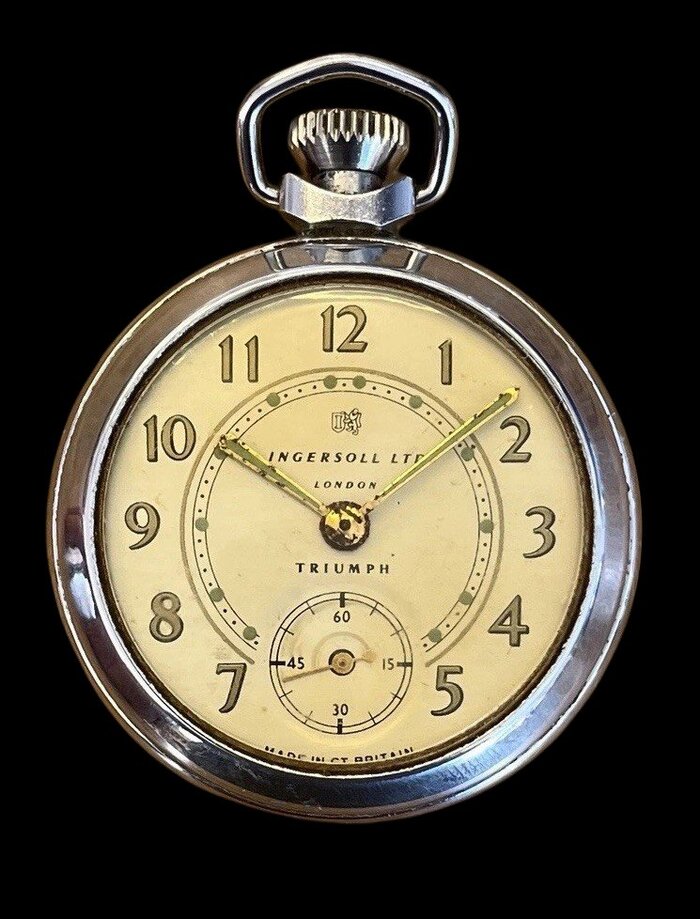
The British arm of Ingersoll — trading as Ingersoll Ltd., London — became a significant operation in its own right. The Triumph model shown earlier in this page is a good example of mid-range British Ingersoll production: chrome open-face case, cream dial with gilt Arabic numerals, gold-tone spade hands, subsidiary seconds at 6, and the legend “Made in Gt Britain” at the base of the dial.
The Triumph and similar British models represent a step up from the basic Dollar Watch in finish and appearance, though they retain the pin-lever movement. They were sold through jewellers, chemists and department stores across Britain from the 1920s onward and are still readily found today — often in functional condition. The chrome-on-brass case construction makes them susceptible to moisture damage at the joints, so check carefully around the caseback seam and pendant for any green verdigris.
British Ingersoll pieces marked “Ingersoll Ltd London” date from the period after the company established its own British manufacturing and distribution. Those marked simply “Ingersoll” or bearing the Robt. H. Ingersoll & Bro. name were imported American-market watches sold through the London store from 1904 onward.
Collecting the Dollar Watch Today
For collectors, the Dollar Pocket Watch is a highly collectible item, and although many people are of the opinion that these watches have no real “antique” value, I disagree. If you can find one in mint condition, it still won’t cost you an arm and a leg to acquire it — but over time, as collectors begin to realise the importance that the Dollar Watch played in the development of timepieces in general, these will become more collectable and hence more valuable.
The category also has one great advantage for the new collector: it is genuinely affordable. You can build a representative collection of Ingersoll types — a Junior, a Triumph, a Crown, and a Mickey Mouse — for less than the cost of a single mid-grade American railroad watch. And unlike the railroad category, where value is concentrated entirely in the movement, Ingersoll watches have character, history, and visual appeal in equal measure.
| Model / Type | Period | Approx. value (working, good condition) |
|---|---|---|
| Basic Dollar Watch (Reliance, Yankee etc.) | 1890s–1920s | £15–£50 / $20–$65 |
| Ingersoll Junior, with original license card | 1910s–1930s | £40–£100 / $50–$130 (card adds premium) |
| Ingersoll Triumph (British, chrome) | 1930s–1950s | £25–£70 / $30–$90 |
| Mickey Mouse — 1935–1940s | Mid-1930s–40s | £80–£200 / $100–$250 |
| Mickey Mouse — 1933–34 original | 1933–1934 | £200–£600+ / $250–$750+ |
| Any model in original box | All periods | Add 50–100% over equivalent unboxed example |
Related Pages
- All Watch Makers
- Mickey Mouse Pocket Watches
- Pocket Watch Collecting Guide
- Pocket Watch Values
- Pocket Watch Repair — servicing a pin-lever movement
- Current eBay Auctions
- Waltham · Elgin · Hamilton