
The Hampden Pocket Watch Company
Look up your Hampden pocket watch serial number here.
The Hampden Watch Company was known for its high quality watches while it was in business. Today, many of the watches made by this company are collector's items. If you collect Hampden watches — or are thinking about starting — knowing the company history makes them considerably more rewarding to own. Read on.
Company Origins
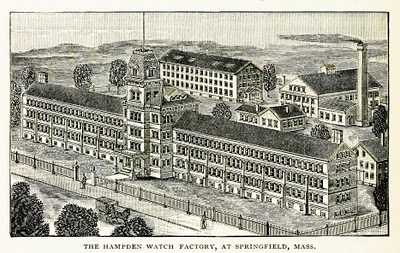
The Hampden Pocket Watch Company began its existence as the Mozart Watch Company in 1864. Established by Donald J. Mozart, the company was originally located in Providence, Rhode Island. After several setbacks, Samuel Rice joined Mozart and the name was changed to the New York Watch Company. It moved to Springfield, Massachusetts in October 1867, where they produced two grades of watches: the 18-size, ¾-plate Springfield and the 16-size, ¾-plate State Street. In 1877, the company changed its name to the Hampden Watch Company, taking the name from Hampden County, the Massachusetts region where the Springfield factory stood.
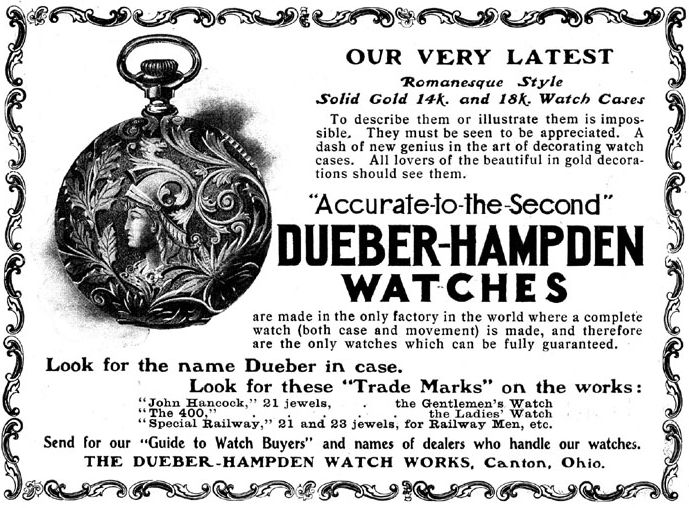
Meanwhile, in Newport, Kentucky, John C. Dueber had established a company making watch cases — the Dueber Watch Case Manufacturing Company. In 1886 he bought a controlling interest in Hampden in order to protect his business from the Watch Case Trust. By 1888 he had moved the whole operation from Massachusetts to Canton, Ohio, where the watch company and the case company were housed in separate factories right next door to each other. Advertisements listed it as the Dueber-Hampden Watch Works, although the two companies were not formally merged until around 1925.
The Watch Trust
The Watch Trust included many different watchmaking companies who had banded together to restrict trade — specifically, to ensure that watch movements could not be sold without cases sourced from their members. It was common practice at the time for the case and the movement to be made by different companies, as was the case with Dueber's watch case operation and Hampden's movements. The Trust also made it difficult for jewellers to purchase movements and cases from any company outside their circle. Dueber suffered from this and sued the companies involved, claiming they were attempting to form a monopoly and prevent his company from competing in the open market. Dueber won after several months' deliberation. By 1896 the Trust was close to re-forming, but the Sherman Anti-Trust Act proved decisive — the government filed suit against the member companies, and the Watch Trust was broken up.
Railway Watches
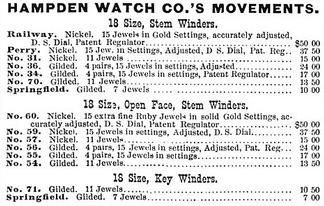
Railroad pocket watches were an important staple for most American watch companies of the period. Standards had to be met before a watch could be used by railroad personnel: it had to be open faced, keep accurate time and display clear Arabic numerals in black on a white dial. In its previous incarnation as the New York Watch Company, Hampden had an 18-size, 15-jewel Railway grade that was among its highest offerings. It remained at the top of the Hampden line after the reorganisation. A new model was soon introduced that used the stem to wind the watch, first made only as a hunting case. The same movement was later offered open face, though instead of being listed as a Railway grade it was listed as grade 60. After the move to Ohio, Hampden began making a proper open-faced Railway grade. Years later this grade was discontinued when Dueber introduced his new line of 17-jewel watches, at which point the railway models became known as the Special Railway and New Railway grades.
A Note on Jewels
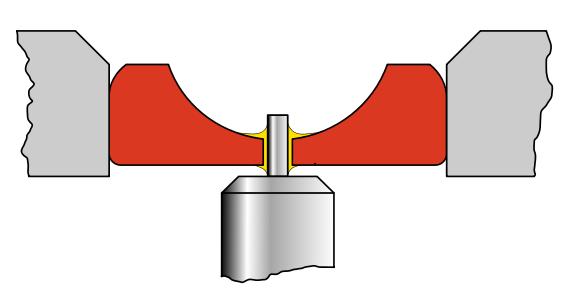
You may hear of a 17-jewel or a 23-jewel watch and wonder what it actually means. The jewels are not decorative — they are fitted into the movement as bearings for the gear pivots. Unlike metal grinding on metal, jewel bearings don't wear away, which improves both accuracy and the working life of the movement. A watch with no jewels at all won't remain accurate for long. The jewels most often used are synthetic rubies and sapphires: each wheel shaft is threaded through a doughnut-shaped jewel that dramatically reduces friction at that point. A lesser quality watch might use only a handful of jewels; a serious railroad movement would use 17 as a minimum, with top grades running to 21 or 23.
The Hampden pocket watch started with 15-jewel models in their early railroad grades — 15 being the minimum standard at the time — and progressed steadily to 17, then 21, then 23 jewels for their top-of-the-line pieces. It is also worth knowing that some manufacturers added false jewels to give an ordinary watch an undeserved quality tag. With Hampden, the jewel count stamped on a genuine movement is reliable; just be alert to any watch where the number seems inconsistent with everything else about its grade.
Special Grades
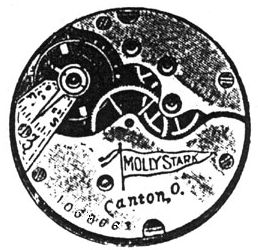
Hampden gave its higher grades proper names rather than catalogue numbers, and several of those names carry a local story worth knowing.
The William McKinley was a thin, 16-size watch introduced in 1902 or 1903, available in 17 or 21-jewel versions. It was named after President McKinley, who had been assassinated shortly before. He was laid to rest in Canton, Ohio — the city where the watch factory stood — which made the tribute a natural one.
The Dueber Watch Company grade was made in both 16 and 18-size, in 15, 17 and 21-jewel versions. Company advertisements claimed it passed inspection on all roads, which leads one to suspect it may not always have been accepted everywhere without some discussion.
The Molly Stark was a 3-size, 7-jewel gilded ladies' watch, introduced in 1896. Another grade named after her husband, General Stark, was a 16-size, 17-jewel nickel movement available in both open-face and hunting-case versions. General John Stark was a hero at Bunker Hill during the Revolutionary War. Since the watch factory was located in Stark County, Ohio, the company had good reason to honour both the General and his wife.
Hampden Pocket Watch Sizes
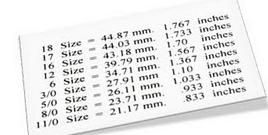
American pocket watch movements were sized using the Lancashire Gauge — a numbering system that runs from the smallest practical pocket watch (size 0) up to the large full-sized railroad movement (size 18). The table below shows the sizes Hampden produced, with their measurements in both inches and millimetres. Knowing the movement size of your watch is a useful first step in identifying the grade, particularly for the smaller ladies' pieces where several grades overlap.
| Watch Size | Inches | mm |
|---|---|---|
| 11/0 | 0.833 | 21.17 |
| 8/0 | 0.933 | 23.71 |
| 5/0 | 1.033 | 26.11 |
| 3/0 | 1.100 | 27.91 |
| 6 | 1.367 | 34.71 |
| 12 | 1.567 | 39.79 |
| 16 | 1.700 | 43.18 |
| 17 | 1.733 | 44.03 |
| 18 | 1.767 | 44.87 |
The End of the Hampden Pocket Watch Company
In 1925 the company was sold to Walter Vrettman, who went bankrupt in 1927 and sold all the watchmaking equipment to Amtorg, a Soviet trade agency operating in the United States. It took almost 30 boxcars to remove all the equipment when it finally left Canton in 1931, along with 21 former Dueber-Hampden employees who had been contracted for a year to teach the craft of watchmaking to the workers who would be operating the transplanted machinery in Russia.
While little is known about the machinery's subsequent history — the closed borders of the Soviet Union made it difficult to track — horology professor Henry Fried of New York University reported seeing Dueber-Hampden machinery still in use in 1986, in China. The equipment had evidently travelled further than anyone in Canton could have imagined when it left Ohio in those 30 boxcars.
The Hampden name was not sold along with the equipment. The brand was purchased by the Clinton Watch Company, owned by the Wien family of Chicago. They apparently retained the name, operating a facility in the Virgin Islands under the Hampden Watch Company name.
Collecting Hampden Watches
Hampden pocket watches are highly collectible, though you may find that they don't command the same prices as the bigger, better-known names like Elgin and Waltham. That's not a reflection of quality — Hampden was known for making a genuinely good watch — but rather of market size and collector awareness. Because they came from a smaller company, Hampdens can be an excellent place for a new collector to start. The quality is real, the history is interesting, and the entry price is reasonable.
The case material will affect value — gold cases fetch more than gold-filled, which fetch more than base metal — but the movement itself is ultimately the most important factor. Many excellent railroad-grade Hampden movements were put into relatively inexpensive cases, so don't be put off by an ordinary-looking exterior. Learn the grade names and what they mean, research the serial numbers, and try to find out the personal history of any individual watch that interests you. That history — its provenance — adds both interest and value, and having a written record of it makes a real difference when it comes to appraisal.
Happy Collecting! — If you're just getting started with Hampden, the serial number table is your best first resource. Cross-referencing the serial number against the known production dates and grade listings will tell you far more about your watch than the case or dial alone ever could.
Hampden Pocket Watches on eBay
Search current listings for Hampden pocket watches:
Related Pages
- Hampden Serial Number Look-Up
- Railroad Pocket Watches — the standards every railroad watch had to meet
- Ball Watch Company — the inspector who set those standards
- Pocket Watch Values
- Buyers Guide
- Pocket Watch Makers Index