
Fake Pocket Watches
You might not have given much thought to the subject — I mean, who would really want to fake a 100-year-old pocket watch that may be worth only a few hundred dollars? Well, years ago, when pocket watches could cost a month’s wages, forgery was a fairly common way to earn a living for certain unscrupulous people. Most of the fake pocket watches came from Switzerland, and because literally millions of movements were being made there, it became profitable to add a well-known maker’s name to a watch in order to increase its resale value.
The general theme was for the manufacturer to add a name similar, but not exactly the same as a reputable maker. A watch marked “Hampton Watch Co” would fool the layperson into thinking they had a genuine Hampden. “Rockville Watch Co” was derived from the Rockford Watch Co. Another method was to use initials only — which for the untrained eye made spotting a fake almost impossible. The forgeries were not crude; they were produced by skilled Swiss craftsmen who knew exactly what they were doing and what they were copying.
The 1871 Law — and How Forgers Responded
Most of the fake pocket watches were produced before 1871, after which life became increasingly more difficult for the forger. In that year, the US Congress passed a law making it compulsory for all watch mechanisms to have the country of origin engraved on the movement. For the Swiss forgers, this meant adding the word “Swiss” or “Switzerland” — a direct signal to any informed buyer that the watch was not of American manufacture.
The forgers, however, were nothing if not resourceful. They tried to circumvent the new law by making the country name extremely small — engraved in a font barely readable without a loupe — and by hiding it in a heavily engraved area of the movement where it would be difficult to spot. Over the following fifteen years the quality of these fakes actually increased, and they were being produced in greater quantities than ever. But as pocket watch prices fell and the genuine American makers became more widely known, the commercial logic of faking eroded. It became too difficult to get away with it, and by around 1910 fake pocket watches were almost non-existent.
A Case Study: Recordon, London
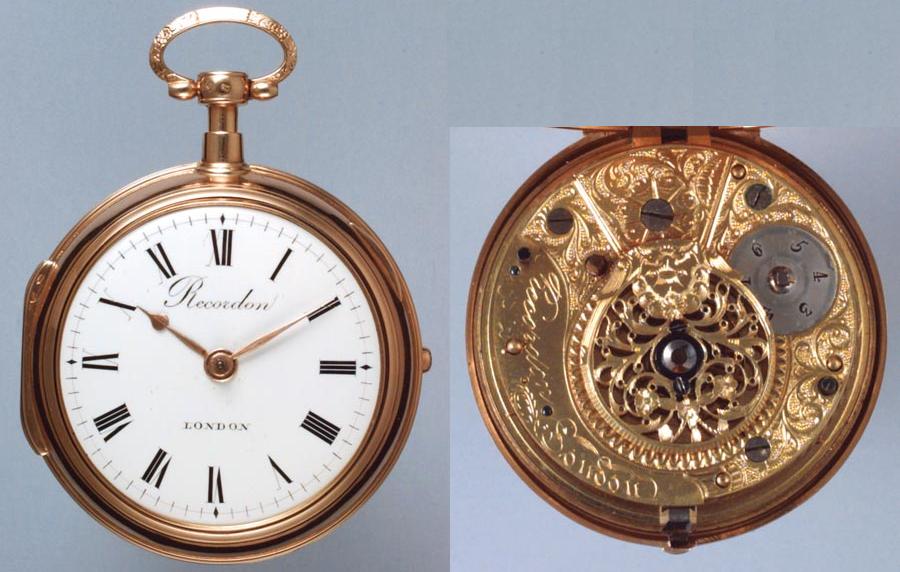
The watch above is an excellent illustration of the forgery trade at its most accomplished. It is a late 18th-century continental verge with the following specification:
- Full-plate gilt movement with signed gilt dust cover
- Pierced and engraved masked cock, garnet end stone, silver regulator disc
- Plain three-arm gilt balance, blue steel spiral hairspring
- Verge escapement with screw adjustments for depth and centre
- Signed white enamel dial with Roman numerals, gilt hands
- Plain gold pair cases, maker’s mark JC
The dial and movement are both signed for a London maker — “Recordon, London” — and the craftsmanship is genuinely fine. The movement is beautifully finished; the cock is a piece of decorative engraving in its own right. But the watch does not bear English hallmarks on the case, and the construction of the movement is characteristic of Swiss, not English, practice of the period.
It was almost certainly produced in Switzerland — or possibly France — and signed for a London maker specifically to deceive a buyer who believed that London watchmaking was superior to Continental. At the time, this was not an unreasonable belief: the best London makers of the late 18th century — Mudge, Earnshaw, Arnold — were producing work of extraordinary precision, and the London name carried a premium. The forger was simply capturing that premium. A piece like this is worth approximately US$1,300 — and that value has been rising steadily as collectors recognise the historical interest of high-quality fakes.
Known Fake Names to Watch For
Below is a selection of names encountered on counterfeit movements, with the genuine maker they were designed to mimic. The resemblance was always close enough to deceive at a glance, but never exact enough to constitute direct impersonation under the law as it stood. The list is not exhaustive — there were dozens of variations in circulation between roughly 1860 and 1900.
| Name on fake movement | Genuine maker being mimicked | Notes |
|---|---|---|
| Hampton Watch Co. | Hampden Watch Co. | One of the most common fakes; the single letter change fooled many buyers |
| Rockville Watch Co. | Rockford Watch Co. | Rockford was a well-regarded Illinois maker; Rockville appeared on Swiss movements |
| Elbridge Watch Co. | Elgin National Watch Co. | Less common; the “El” prefix was sufficient to suggest Elgin |
| Walton Watch Co. | Waltham Watch Co. | Waltham was the largest American maker and a frequent target |
| Illinois Watch Co. [incorrect grade] | Illinois Watch Co. | Some fakes used the correct maker name but claimed a higher grade than the movement actually was |
| Columbus Watch Co. | Various American makers | A legitimate-sounding name with no specific maker to mimic — implied American quality |
| Initials only (e.g. “A.W.Co.”) | American Waltham / various | Initials were the hardest to challenge legally; the suggestion was enough |
| Continental verge, signed London maker | English verge pocket watches | As illustrated above: Swiss or French movement, signed for a London firm, without English hallmarks |
How to Identify a Fake
Period fake pocket watches have a fairly consistent set of characteristics, partly because they were produced in volume by the same Swiss manufacturers working to a common formula. The following points are a good starting framework. None of them is conclusive on its own, but several occurring together is a strong indicator.
-
Key-wind or stem-wind — both types were faked Unlike some forgery categories where one format dominates, fake pocket watches appeared in both key-wind and stem-wind versions. Do not assume a key-wind watch is immune.
-
18-size and Roman numerals on the dial The large majority of fakes were 18-size — the dominant men’s size of the era — with Roman numerals on a white enamel dial. This was the format buyers expected, so the forgers supplied it.
-
Blue jewels, noticeably large Most Swiss-made fakes used blue jewels (coloured glass rather than ruby or sapphire) that were larger than American practice. On a genuine high-grade American movement the jewels are smaller, more precisely set, and ruby or garnet-coloured. Large, bright blue jewels are a warning sign.
-
The name is close to, but not exactly, a known maker This is the most reliable single indicator. If the movement is signed with a name you almost recognise — something that sounds like Hampden, Waltham, Elgin or Rockford but isn’t quite — you are very likely looking at a fake. Look the name up before bidding. If it appears in no reference book and has no traceable factory history, treat it as suspect.
-
Country of origin mark: very small, or hidden in engraving After 1871, genuine Swiss imports were marked with their country of origin. On fakes this mark was made deliberately difficult to find — engraved in tiny script in a corner of the movement, or buried in a decorative border. Finding a minute “Swiss” or “Switzerland” mark on a movement signed for an American company is confirmation of forgery.
-
Absence of English hallmarks on a “London” watch For earlier Continental fakes signed for English makers, check the case for English assay-office hallmarks. A genuine English watch will have them; a Continental fake claiming English origin almost certainly will not. See our English hallmarks guide and how to read them.
-
Mismatched finishing quality Genuine American railroad-grade movements have specific finishing standards: consistent damaskeening on the pillar plate, correctly jewelled pivot holes, a particular style of regulator. Fakes often got the signature right but the finishing wrong — the damaskeening pattern is different, or absent, or the pivot holes are plain-drilled where the genuine grade used jewels. Open the back and compare against reference images for the stated grade.
Fakes as a Collecting Category
The point of this article is not to make you wary of fakes and leave it at that. On the contrary — period fake pocket watches are a separate collecting category in their own right, and they are beginning to take on real value. A well-made Swiss forgery from the 1870s or 1880s, clearly identified as such, is a genuine historical artefact: evidence of a sophisticated counterfeit trade that operated for decades across two continents. The craftsmanship is often excellent; the movements run; and the historical context is, if anything, more interesting than a plain commercial movement from the same period.
The key is knowing what you are buying, and paying the right price for it. A piece that is clearly and correctly described as a period Swiss fake — with a note explaining its provenance and the name it was faking — is a perfectly honest transaction and potentially a shrewd purchase. The value of these pieces will only increase as collectors move beyond the obvious American grades and begin to explore the wider history of the pocket watch trade.
Make sure the seller knows they are selling a fake — a seller who believes the piece is genuine will be asking far too much. A correctly priced period Swiss fake from the 1860s–1900s should reflect its interest as a historical curiosity, not the value of the maker it was impersonating. When you find one, document what you know: the name on the movement, the maker being mimicked, the country-of-origin mark (and where it is hidden), the estimated date, and the condition. That documentation is part of the piece’s value.
Related Pages
- eBay Scams — fake and misrepresented watches online
- Buying Pocket Watches — the full inspection and authentication guide
- English Hallmarks — confirming English vs Continental origin
- Waltham Serial Numbers — verify a claimed Waltham
- Hamilton Serial Numbers
- Pocket Watch Values
- Pocket Watch Collecting Guide