English Hallmarks on Antique Pocket Watch Cases
The word "hallmark" derives from Goldsmith's Hall in London, where precious metals were brought to be tested and stamped. It originally referred only to a mark guaranteeing the purity of the metal, but over the centuries the system expanded to include the maker's mark, the assay office, and the year of testing — making a fully hallmarked piece a remarkably complete historical record.
The assay process involves scraping a small amount of metal from the item, weighing it, melting it to obtain pure metal, then re-weighing to establish the exact proportion of precious metal. Any item that tests slightly below a recognised standard — say 13.9 carat instead of 14 — is marked at the next standard down.
A Brief History of English Hallmarking
In 1327 King Edward I decreed that every silver item should carry a mark confirming it had passed a purity test at 92.5% silver. The gold standard followed under King Edward III, when he granted a Royal Charter to the Worshipful Company of Goldsmiths. Forging a hallmark originally carried the death penalty; this was reduced to 14 years' transportation in 1773, and today stands at 10 years' imprisonment.
Early marks used a leopard's head (technically a lion — the word leopart in the old French of medieval Acts of Parliament was mistranslated as "leopard"). Around 1360 a maker's mark was added, initially as a symbol, later as initials. Around 1480 a third mark was introduced to record the year of assay — a letter from A to U (omitting J), redesigned every 20 years. In 1544 a new purity mark, the lion passant, superseded the leopard's head as the sterling silver standard, and the leopard's head became London's assay office mark. During 1784–1890 a sovereign's head duty mark was added to indicate tax had been paid. In 1973 the system was simplified and standardised across all offices.
The Five Marks
A fully hallmarked English case carries up to five separate marks, each inside a shaped cartouche (shield):
- Maker's Mark — The initials of the manufacturer or silversmith
- Standard Mark — Indicates the metal and its fineness (purity)
- Assay Office Mark — Shows where the piece was tested
- Date Letter — An alphabetical letter denoting the year of assay
- Duty Mark — A monarch's head (used 1784–1890), indicating duty had been paid

Assay Office Marks
Each assay office used a distinctive symbol. The ten offices that handled watch cases most frequently are shown below:

Anchor

(closed 1962)

Hibernia

Castle

(closed 1882)

Tree, Fish & Bell

(closed 1884)

(closed 1702)

Crown

(closed 1857)
Note: London's leopard's head assay mark is shown in the "Standard Mark & London Assay Mark" section above — crowned before 1821, plain thereafter.
The Standard Mark & London Assay Mark
Two marks appear on virtually every hallmarked English watch case made after 1544. The lion passant (a lion walking left) is the sterling silver standard mark, guaranteeing at least 92.5% pure silver. On gold cases the equivalent is a crown plus the carat number. The leopard's head is London's assay office mark — crowned before 1821, uncrowned thereafter.

Sterling silver standard

London assay, pre-1821

London assay, 1821 onwards
Gold Standards
Purity is measured on two scales: parts per thousand (a percentage, where 1,000 = pure metal) and carats (for gold only, where 24 carat = pure gold). Pure gold is too soft for practical use, so other metals are added to form a harder alloy. Only five gold standards are recognised in the UK: 9ct, 14ct, 15ct, 18ct, and 22ct.
| Parts per 1,000 | Carat | Mark | Notes |
|---|---|---|---|
| 999 | 24 carat | — | Pure gold bars only; too soft for practical use |
| 916 | 22 carat | Crown + 22 | Highest practical gold standard in UK |
| 750 | 18 carat | Crown + 18 | Most common fine jewellery standard |
| 625 | 15 carat | Crown + 15 | Used 1854–1932; common in Victorian watch cases |
| 585 | 14 carat | Crown + 14 | Common in American watches; UK standard from 1932 |
| 375 | 9 carat | Crown + 9 | Most common UK standard for antique watch cases |
Silver Standards
For silver only the parts-per-thousand scale is used — there is no carat equivalent. Two purities are recognised in the UK:
| Parts per 1,000 | Standard | Notes |
|---|---|---|
| 925 | Sterling Silver | Standard since 1300; marked with lion passant |
| 958 | Britannia Silver | Introduced 1696; marked with Britannia figure |
Date Letters
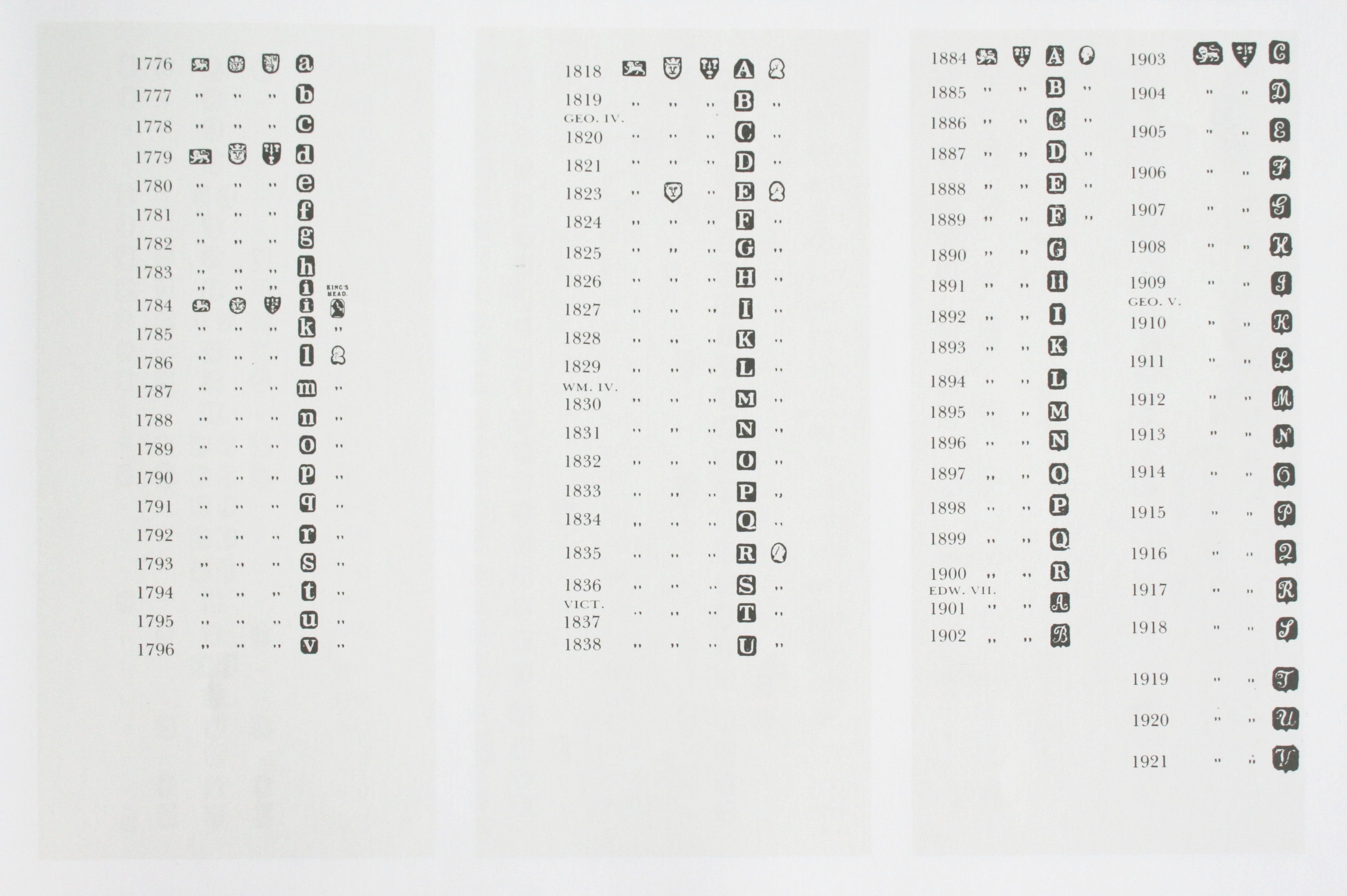
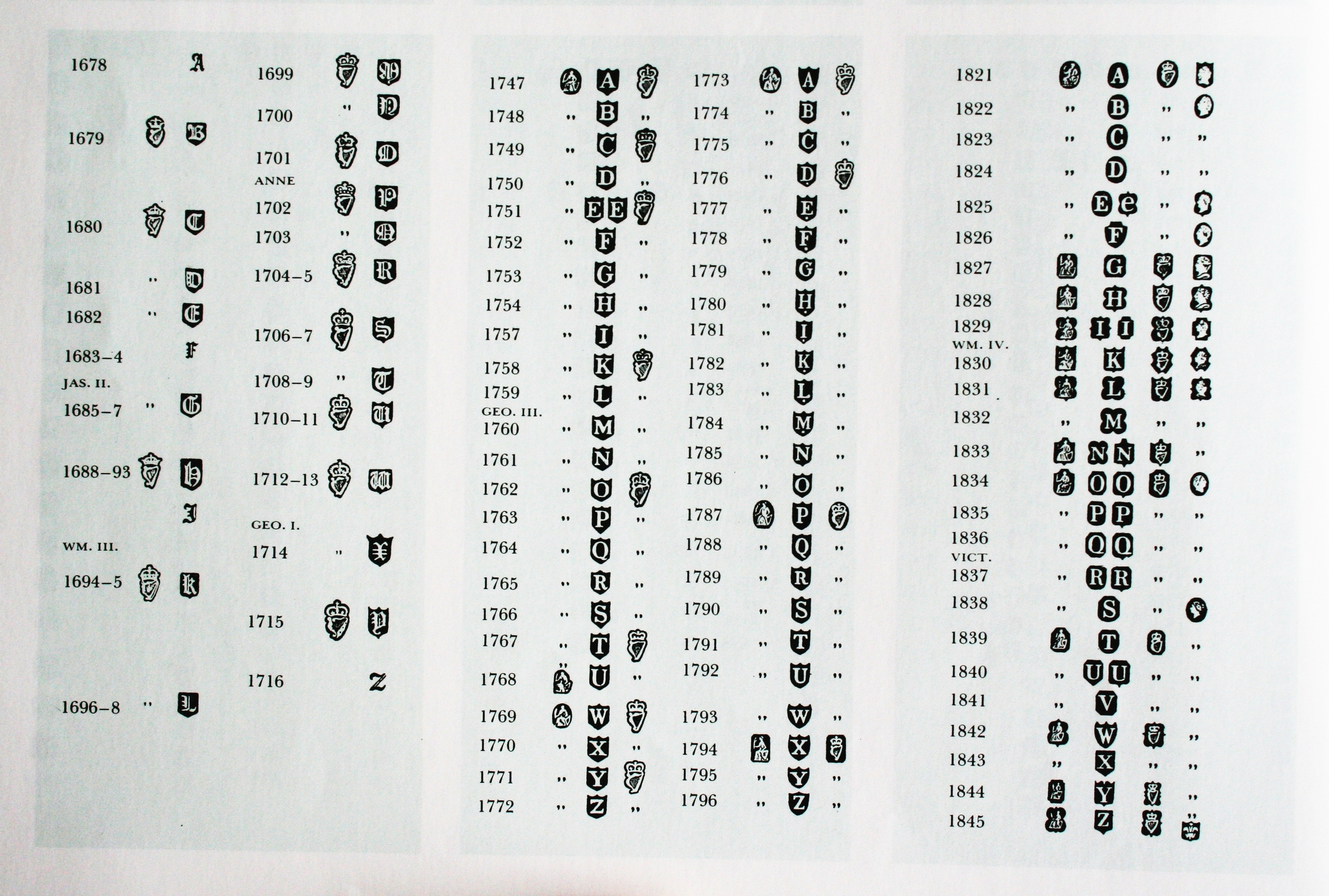
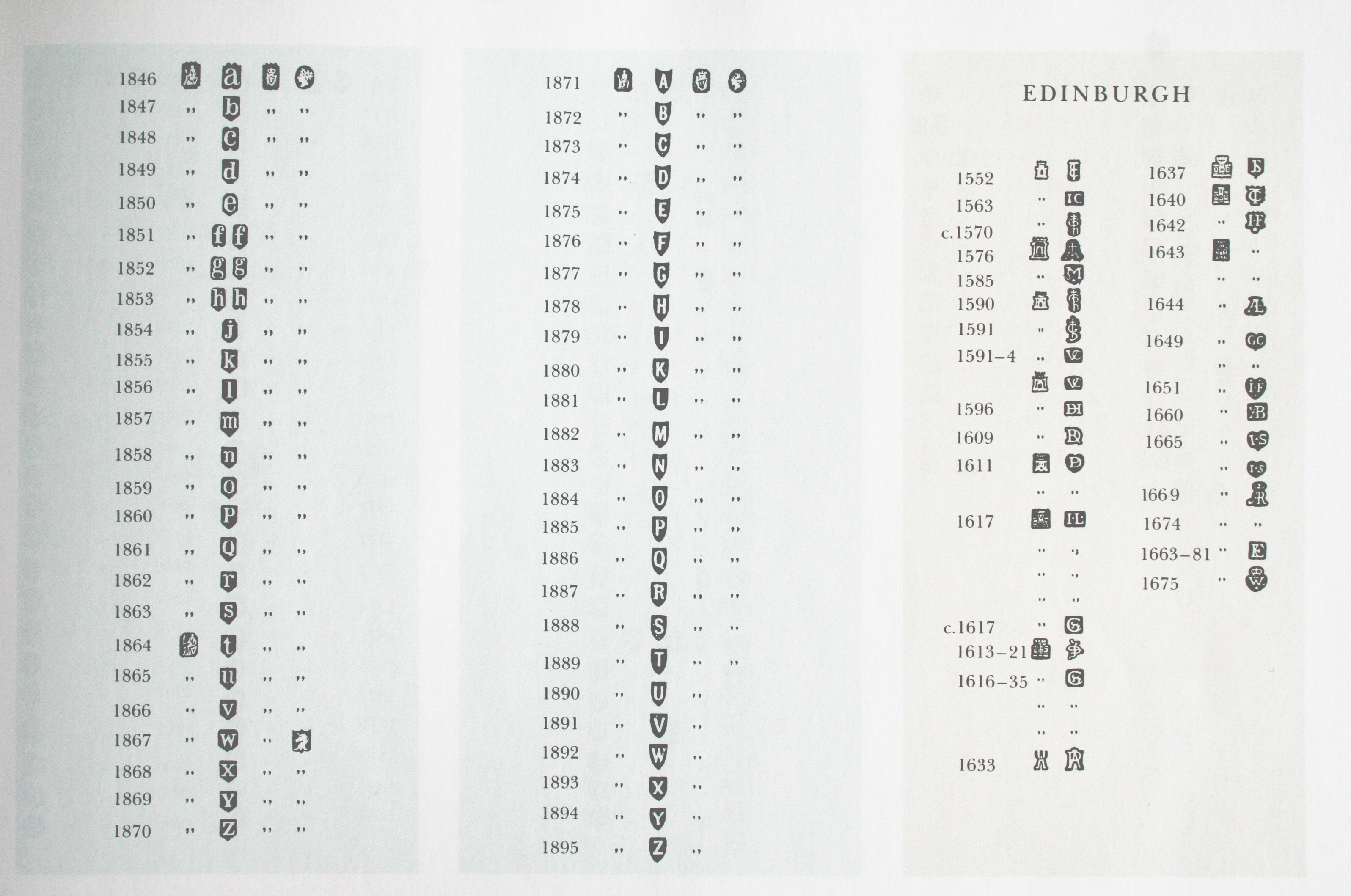
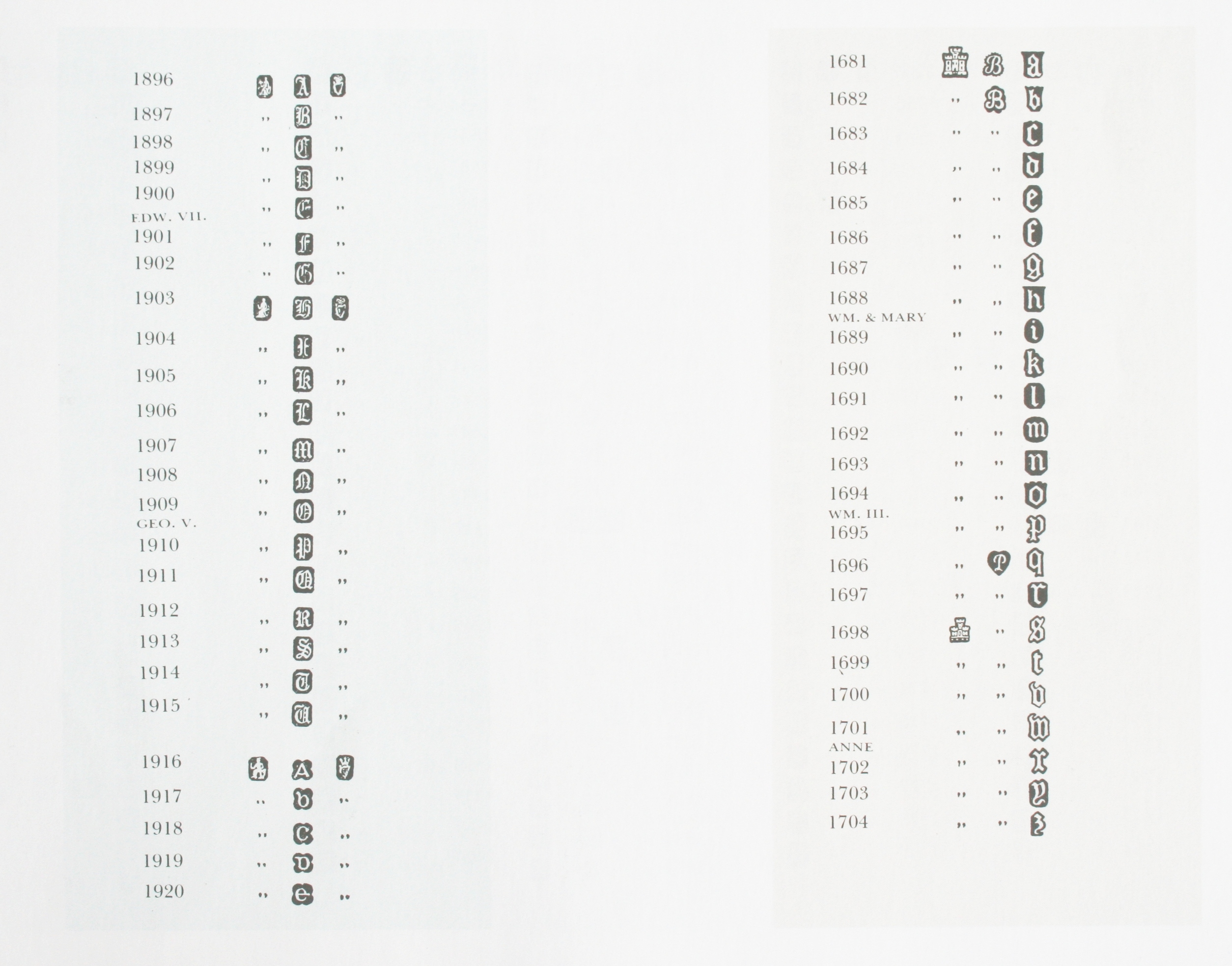
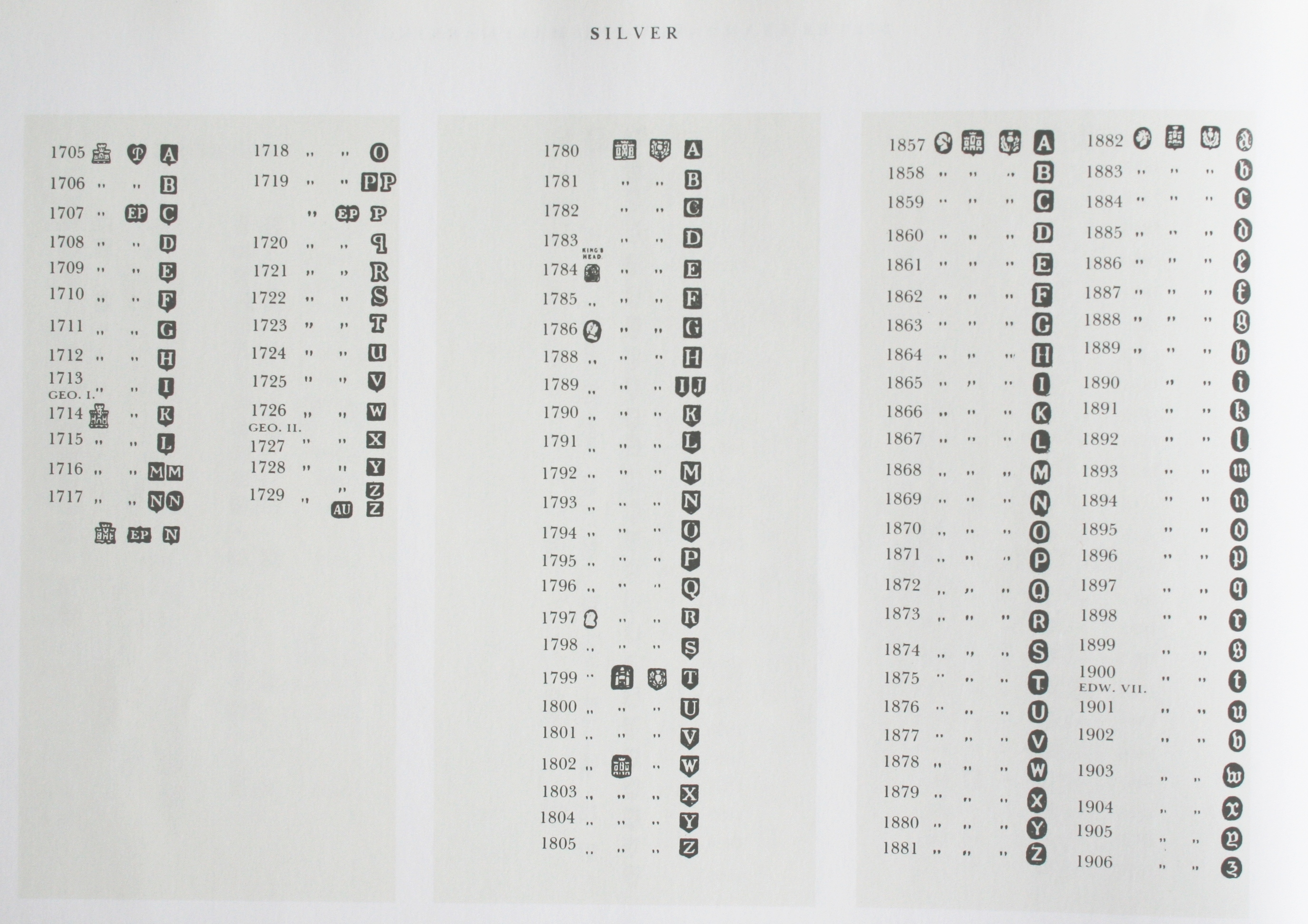
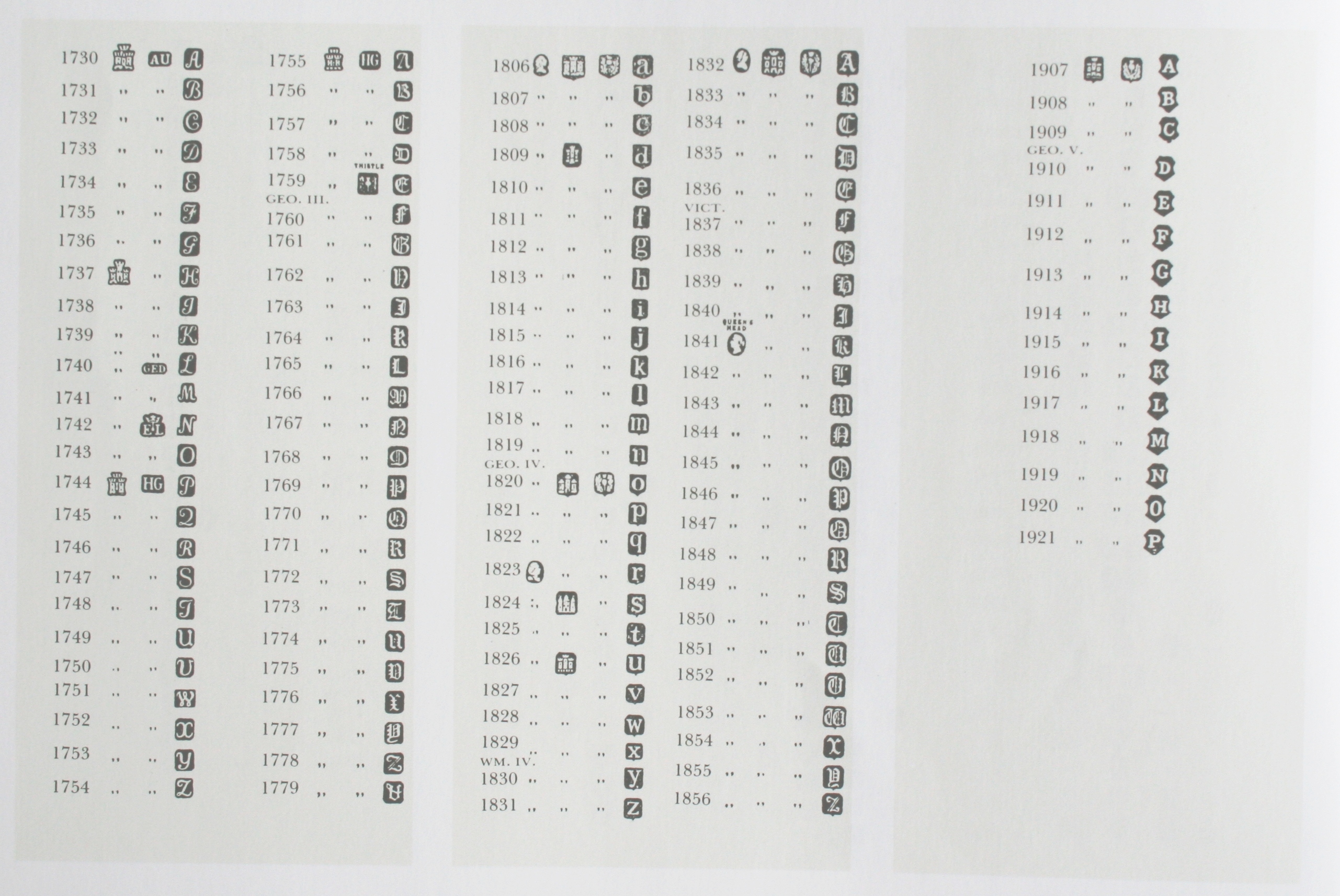
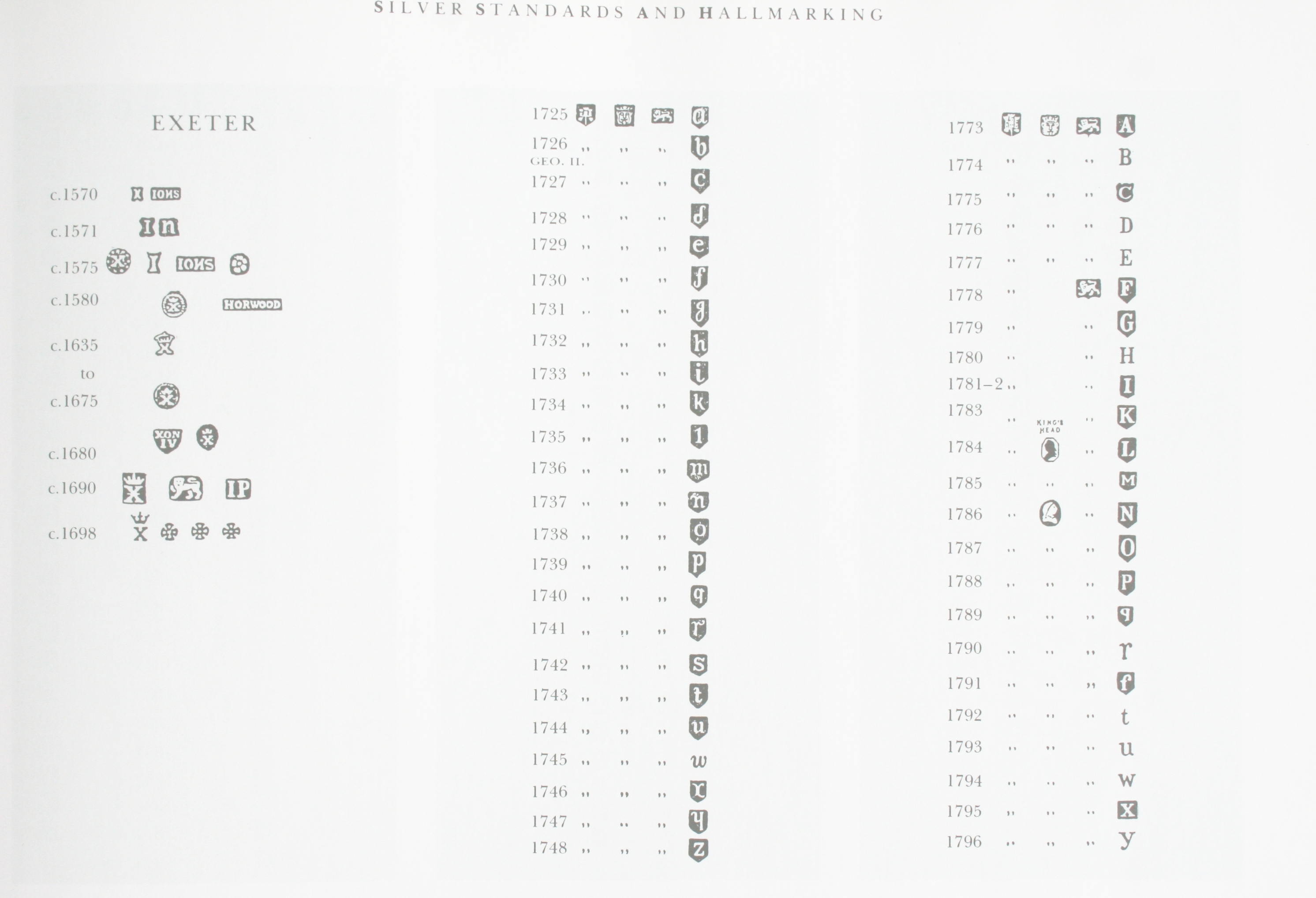
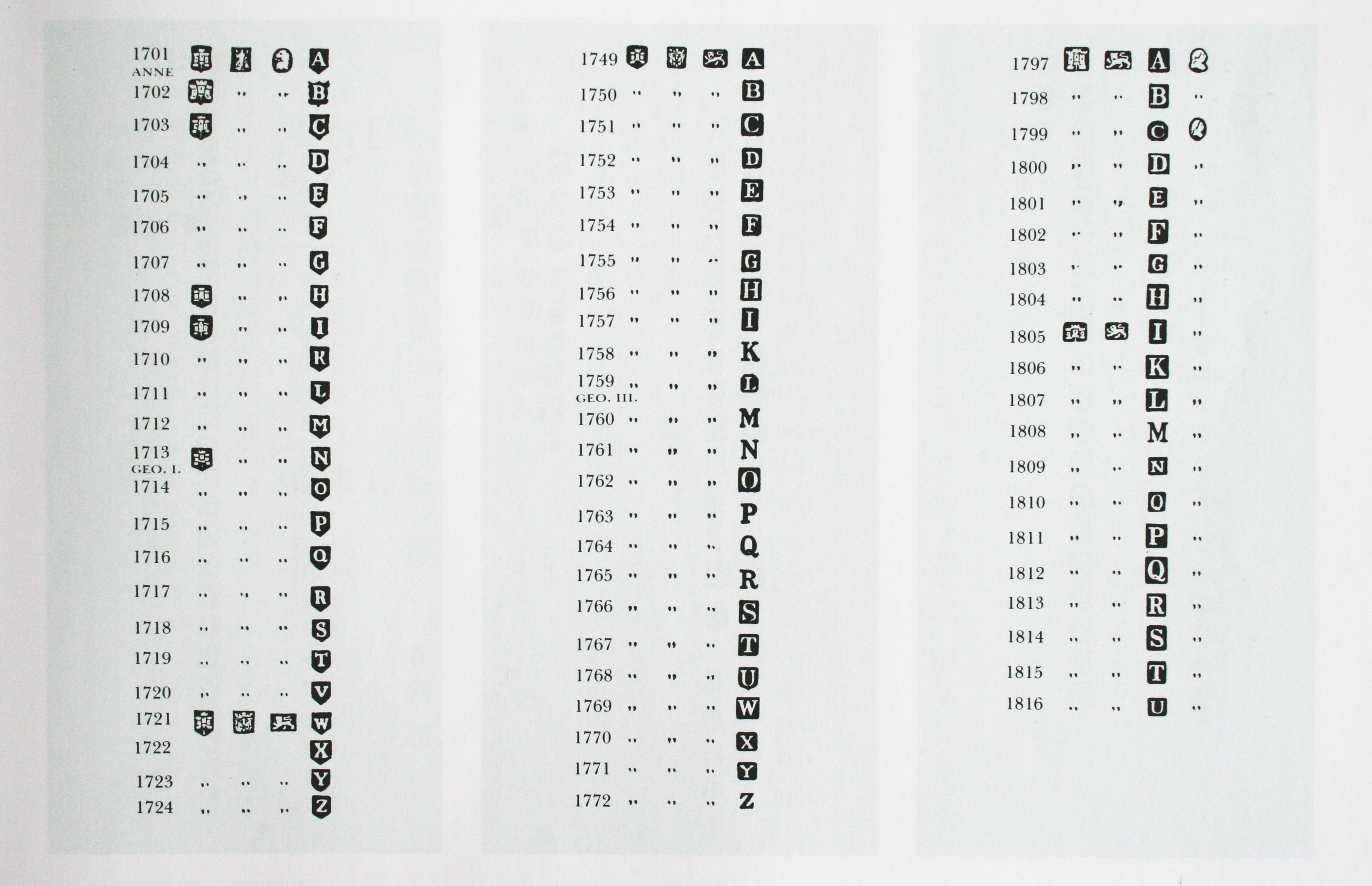
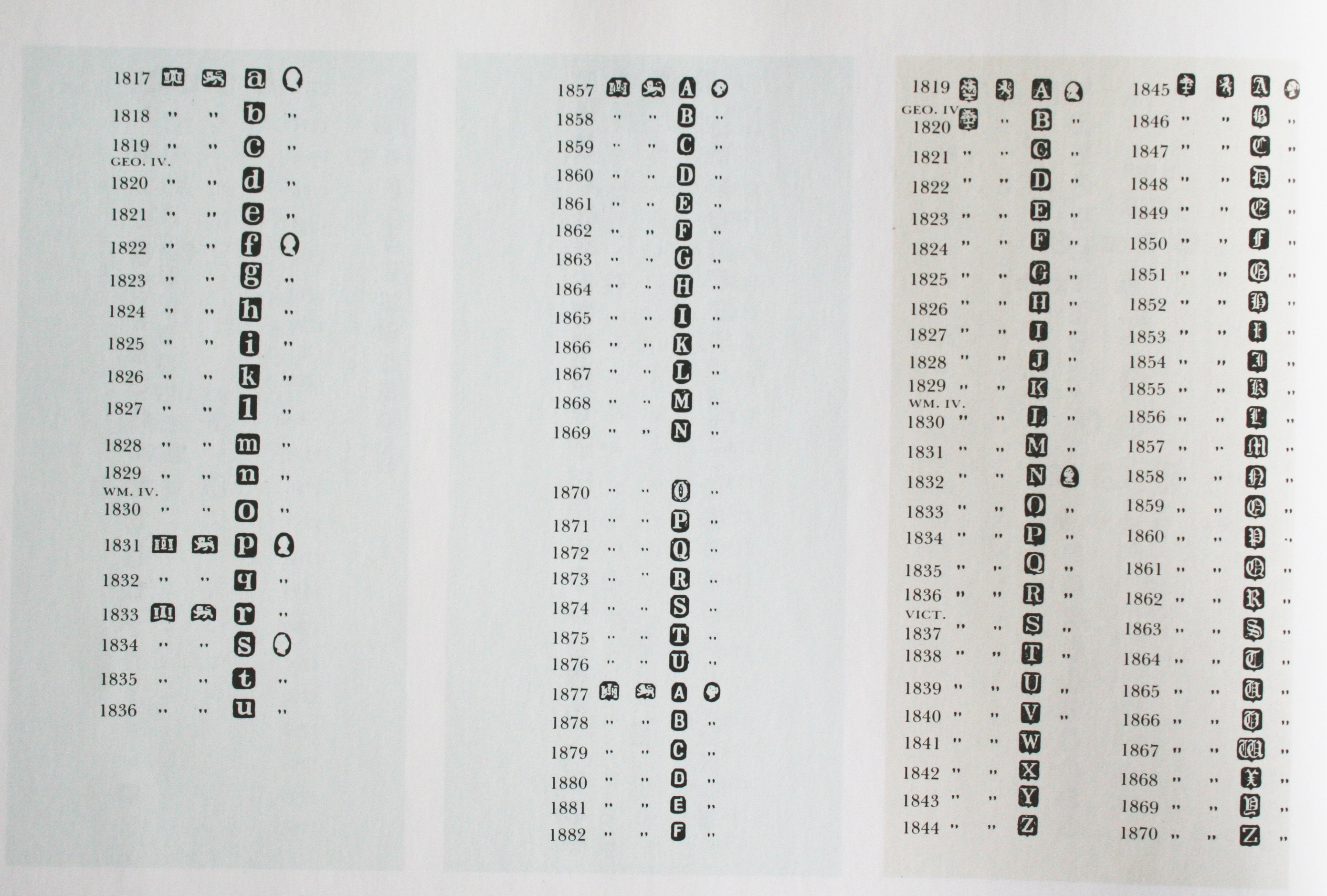
Each assay office used a different series of letters, shapes and typefaces to indicate the year. The most commonly encountered series are the London cycles, which run from A to U (20 letters, omitting J) repeating every 20 years, changing in May each year. A specialist reference such as Jackson's English Goldsmiths and Their Marks is essential for precise dating.
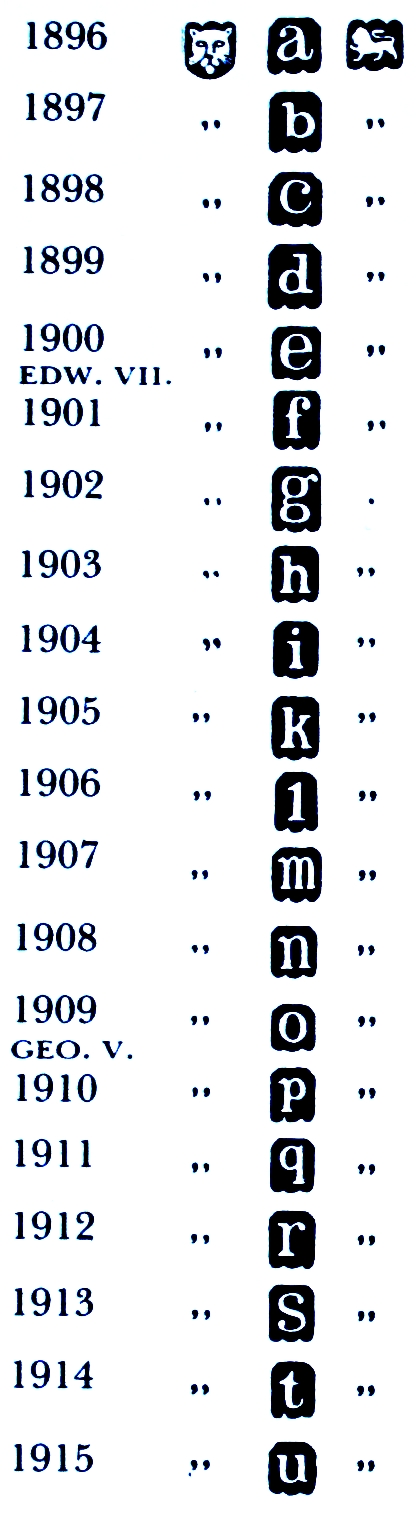
The two tables below show London date letters for the late Victorian and Edwardian periods — the years most relevant to antique pocket watch collectors. The leopard's head (assay) and lion passant (standard) marks are shown alongside the date letter for each year.

How to Read English Hallmarks
Once you know what each mark represents, dating a hallmarked item becomes straightforward. Work through the marks in sequence: first identify the standard (confirming it is genuine silver or gold), then the assay office town, then the date letter, and finally check for a duty mark. Makers often stamp their mark twice, and you may encounter different monarch's heads on the same item — don't let these confuse you.
The table below shows the four key marks to identify, with examples from watch cases:
| Step | Mark to Find | Example | What it Tells You |
|---|---|---|---|
| 1 | Sterling Silver Standard Lion passant (lion walking left) |
|
Confirms the item is at least 92.5% pure silver (Sterling Standard). Introduced 1544. |
| 2 | Assay Office (Town Mark) Leopard’s head = London; Anchor = Birmingham; Crown = Sheffield, etc. |
|
Identifies where the item was tested and stamped. See the assay office grid above for all office symbols. |
| 3 | Date Letter A letter A–U in a shaped shield |
 |
Indicates the year of assay. The shield shape and letter font identify the cycle. Different offices used different cycles — always check against the correct office’s table. |
| 4 | Duty Mark (if present) Sovereign’s head in profile |
|
Present 1784–1890 only. Confirms tax was paid. Often omitted on small items such as pocket watch cases. |


Note how similar the letter form is between these two dates — the different stamp background is the key to telling them apart. Start by learning all the town/city marks first (they are the most distinctive), then build up your confidence with date letters using the reference tables below.
For a fuller guide, see our dedicated page: How to Read English Hallmarks.
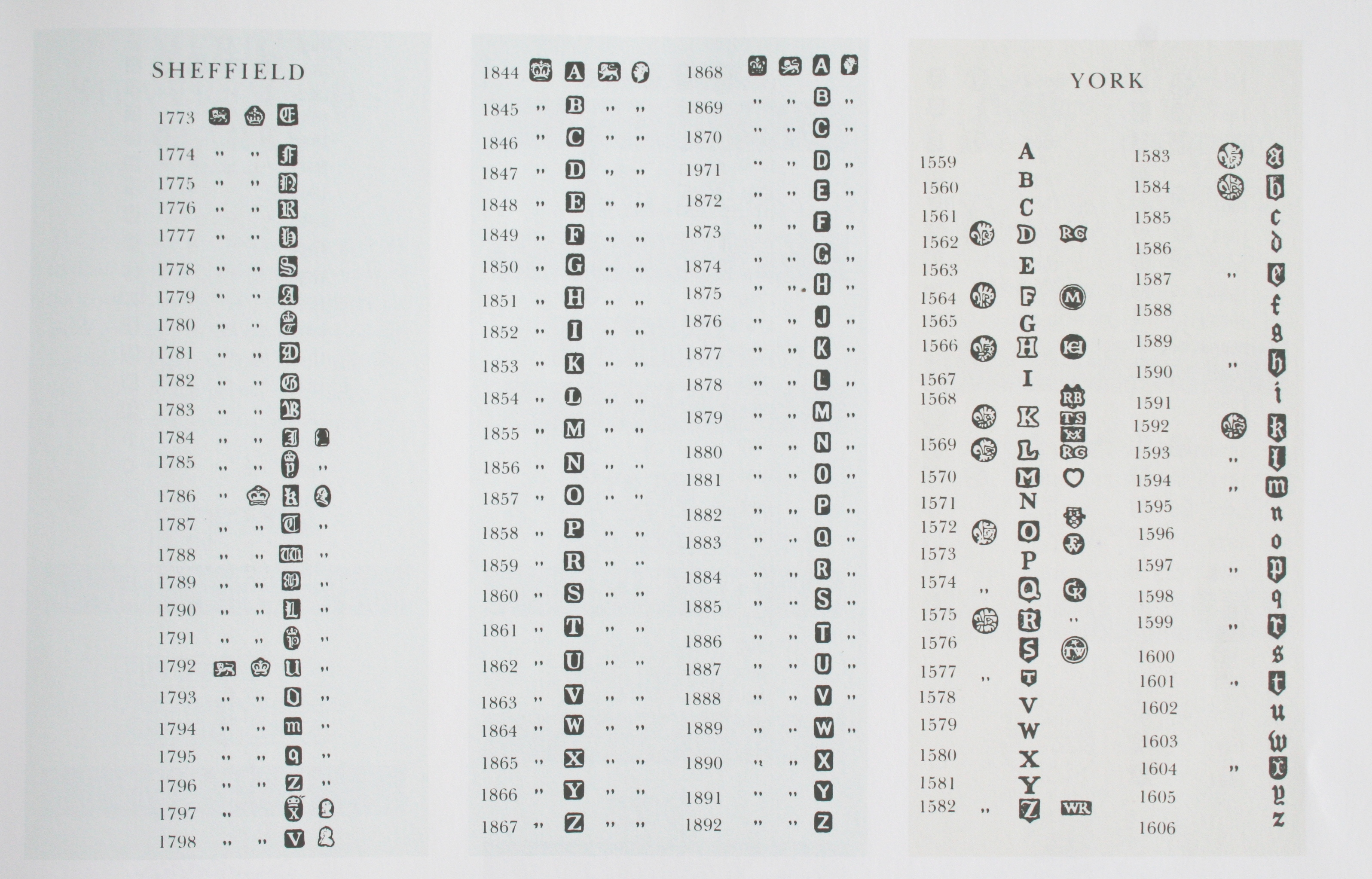
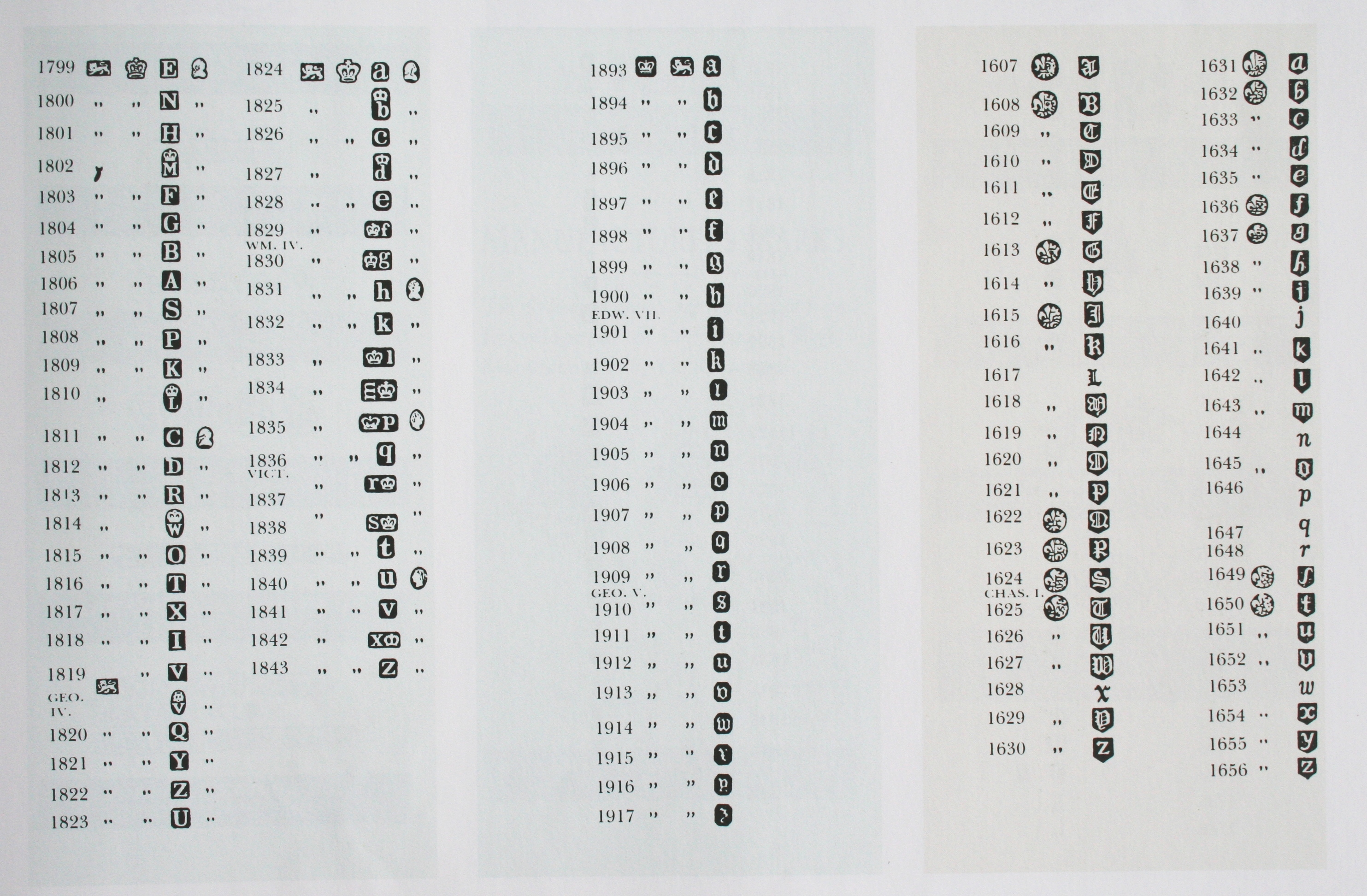
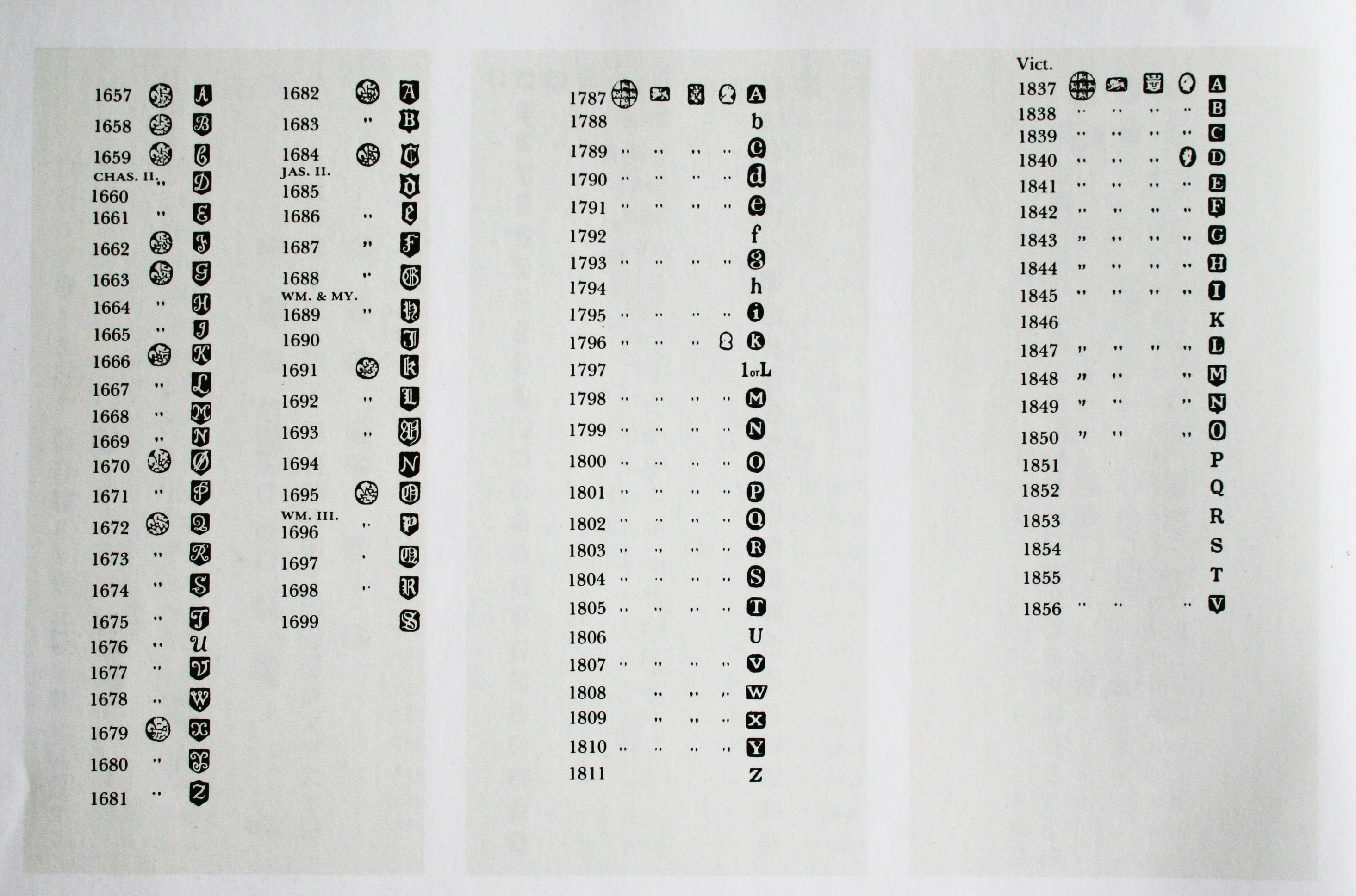
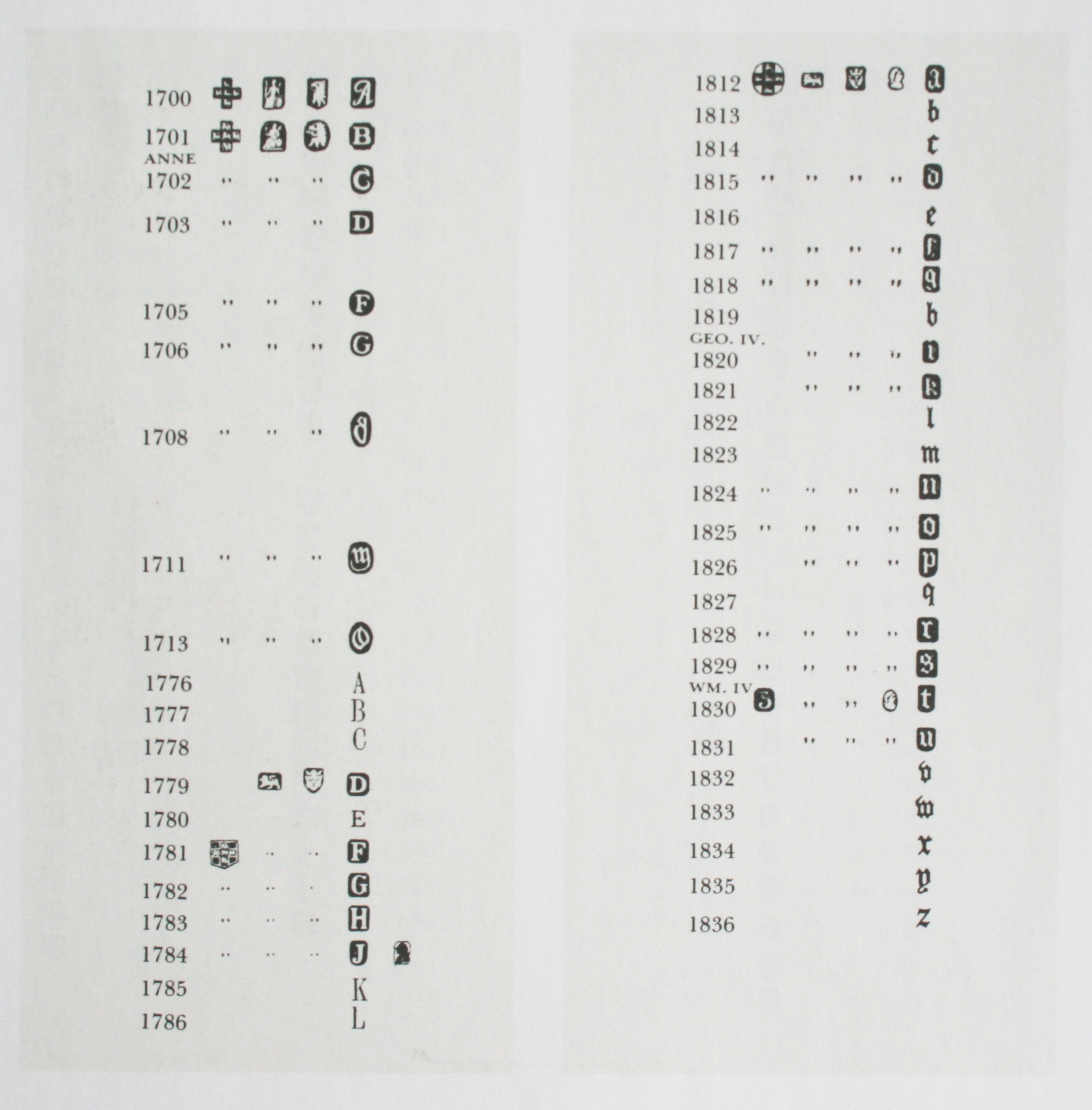
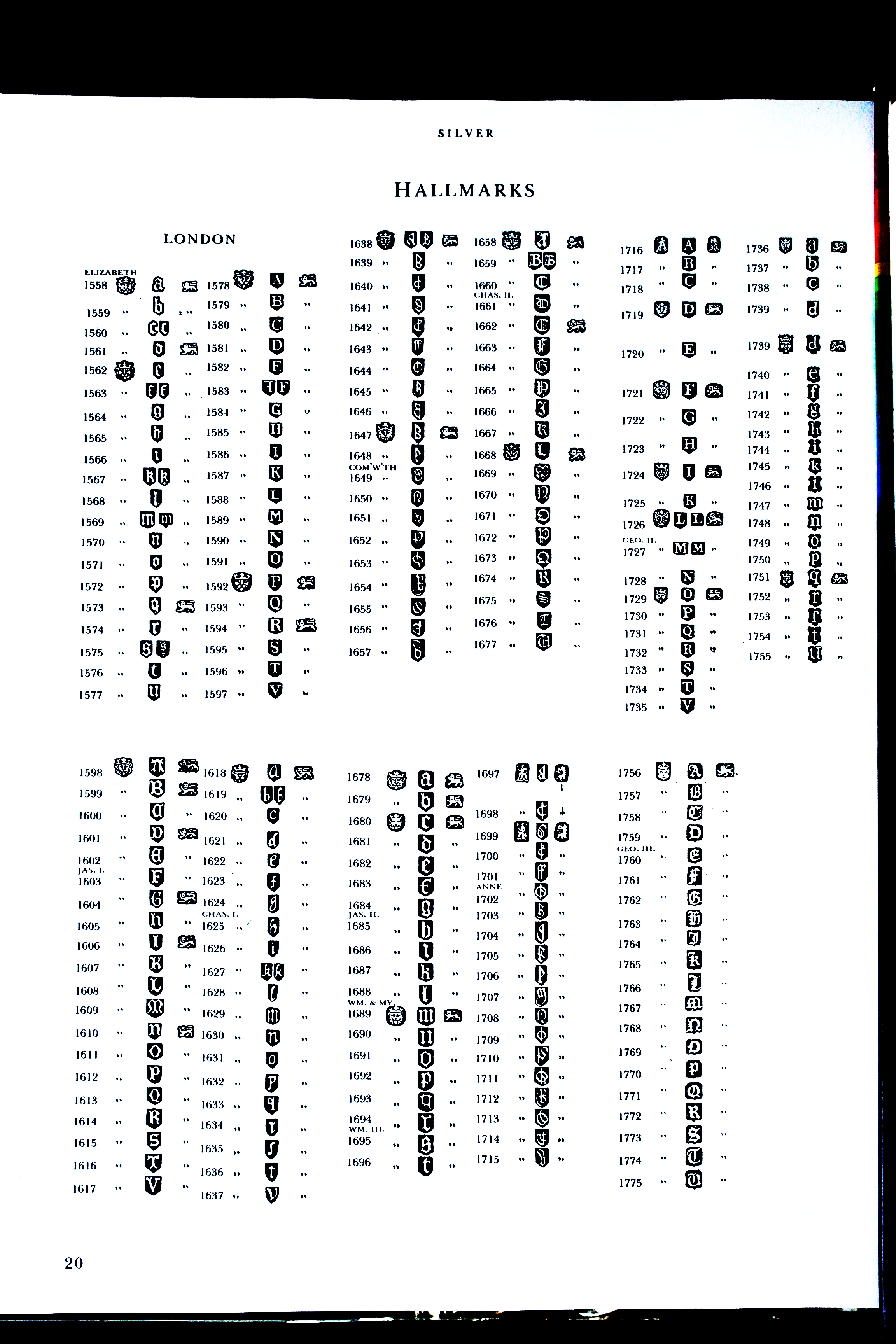
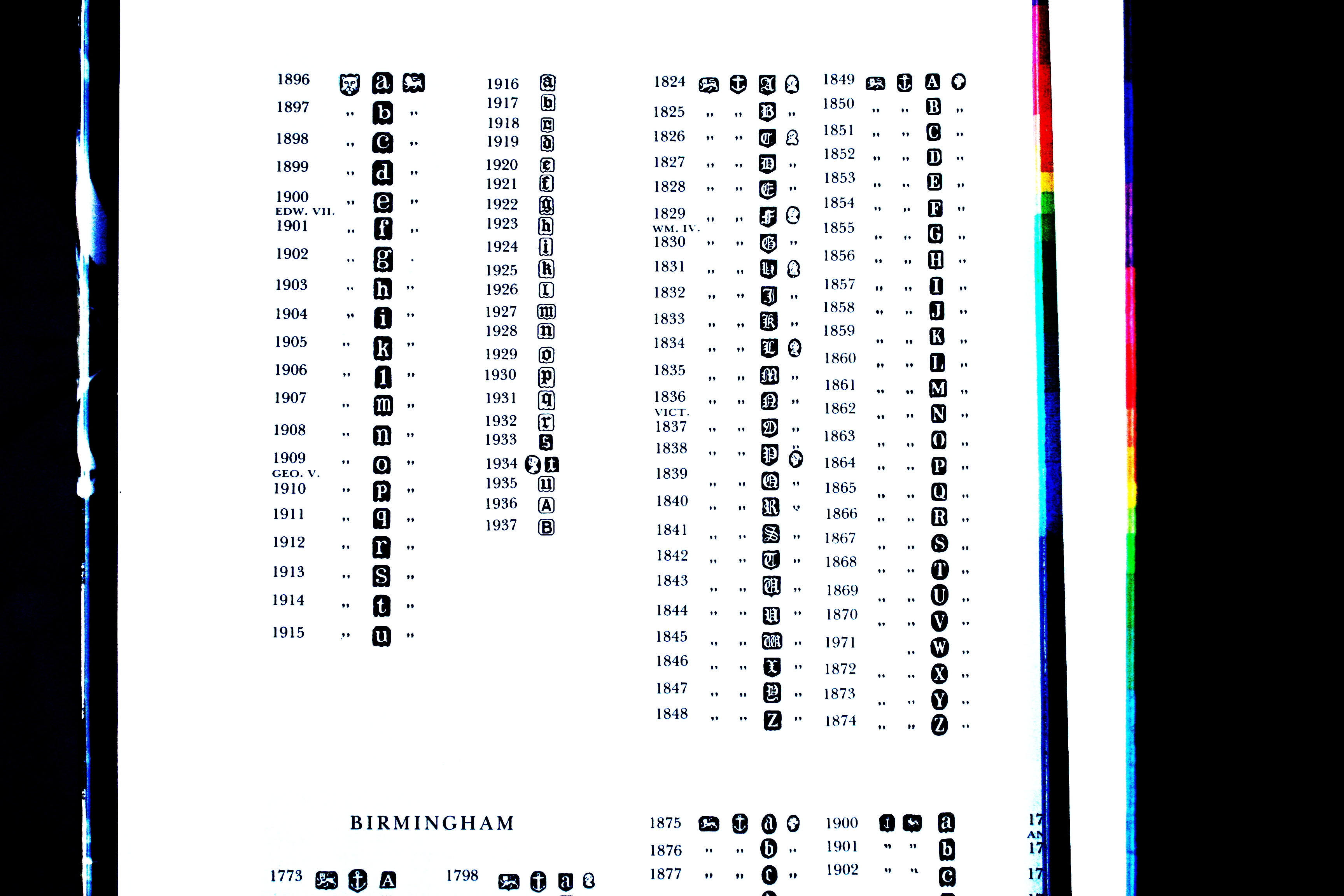
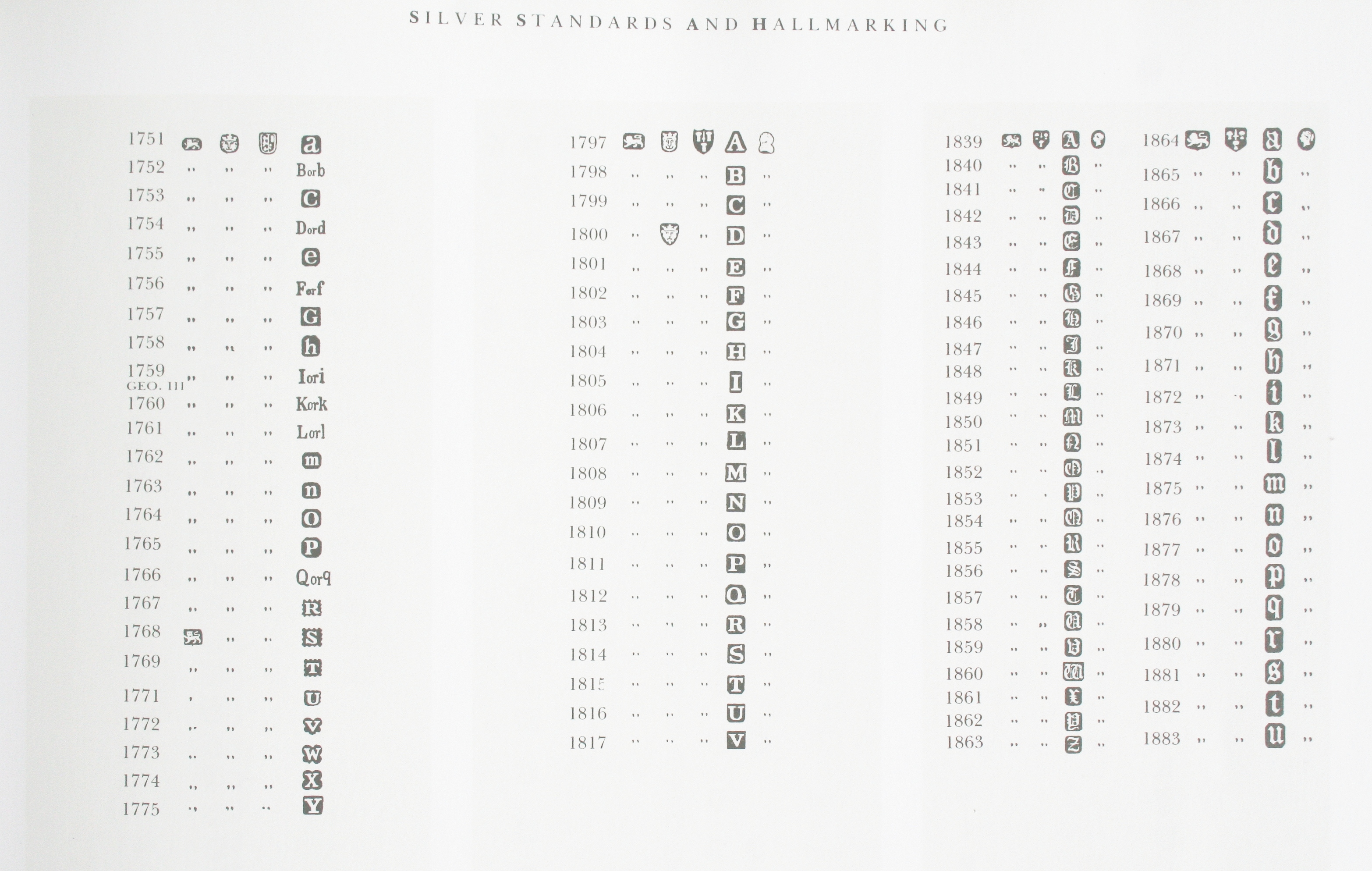
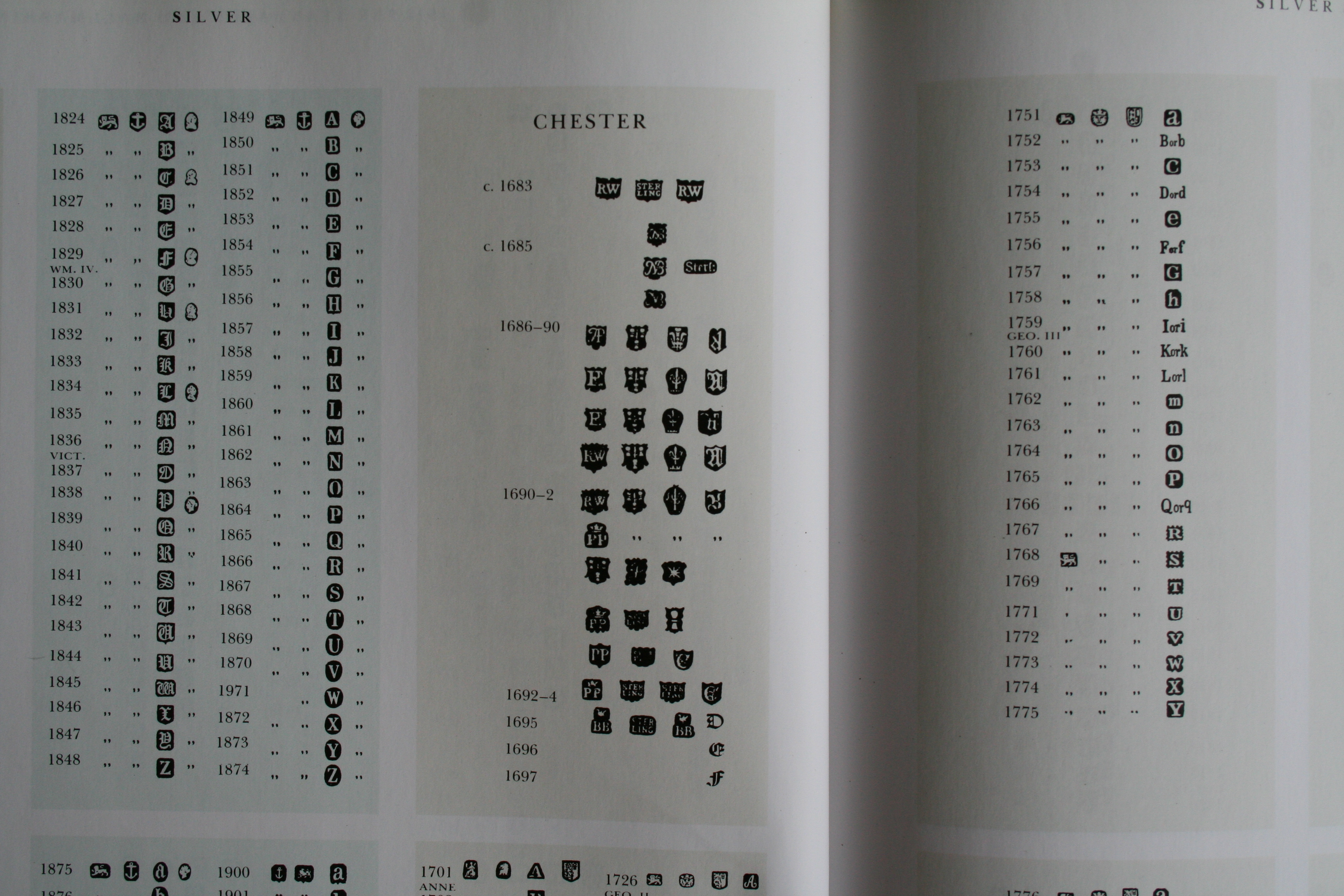
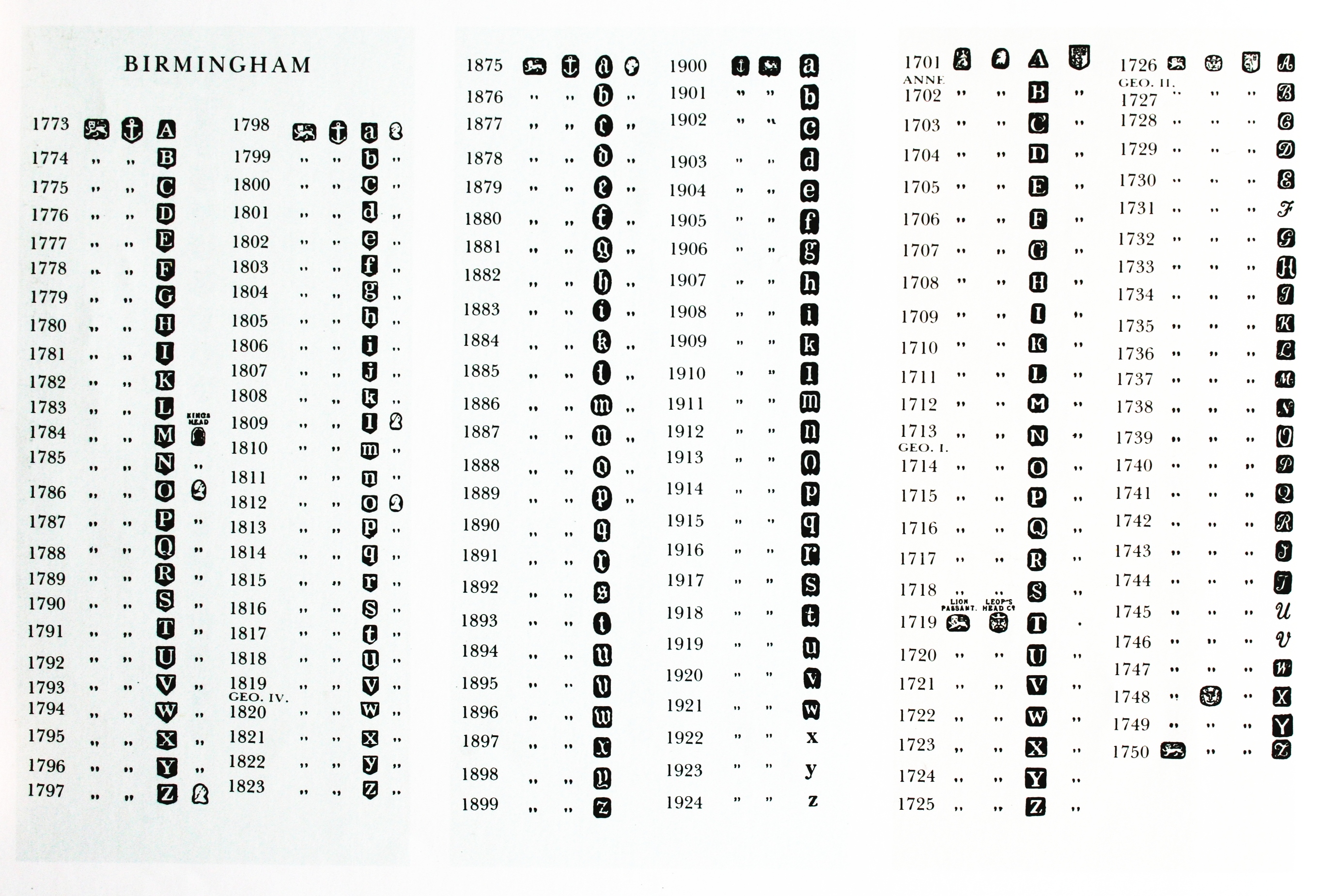
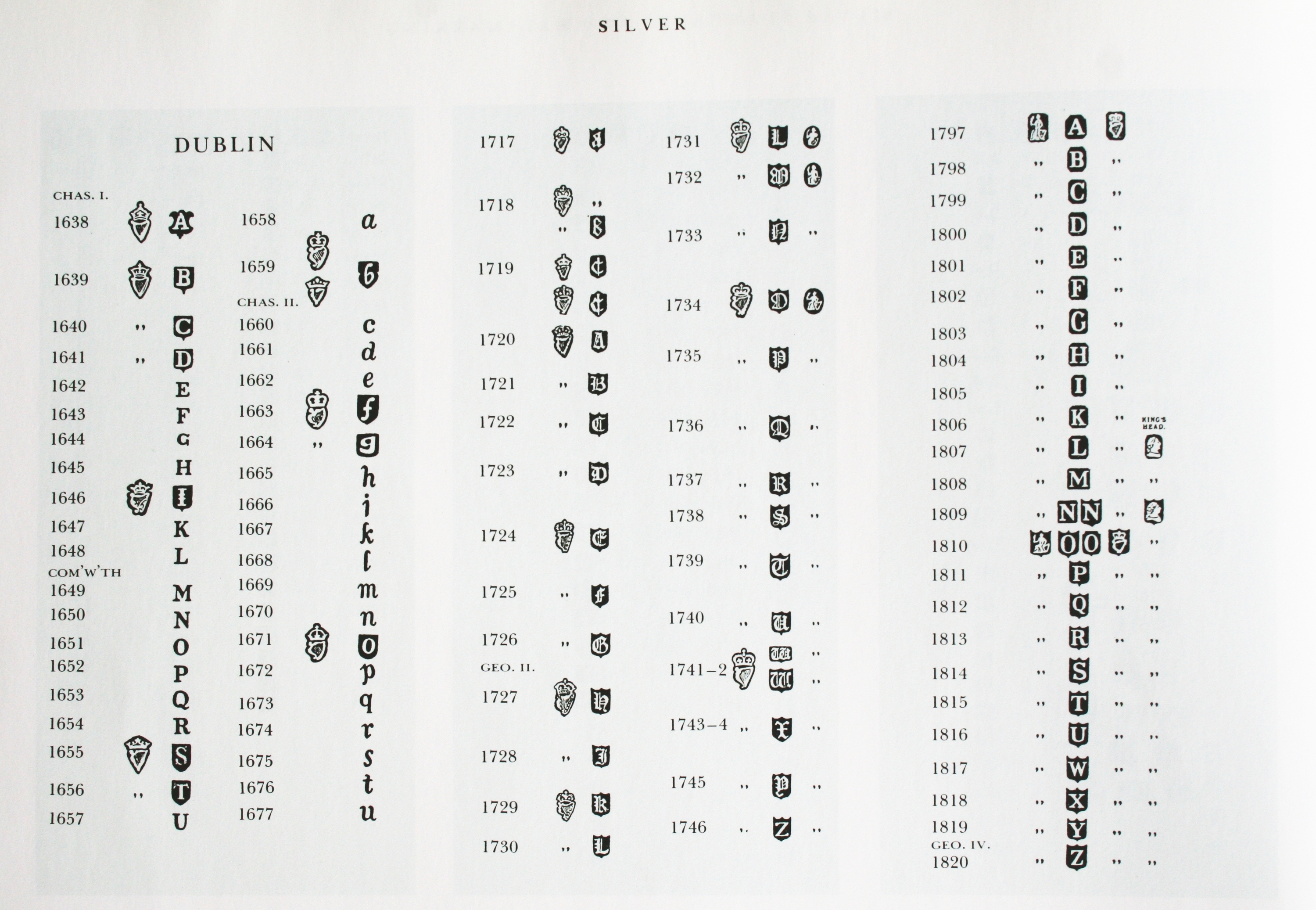
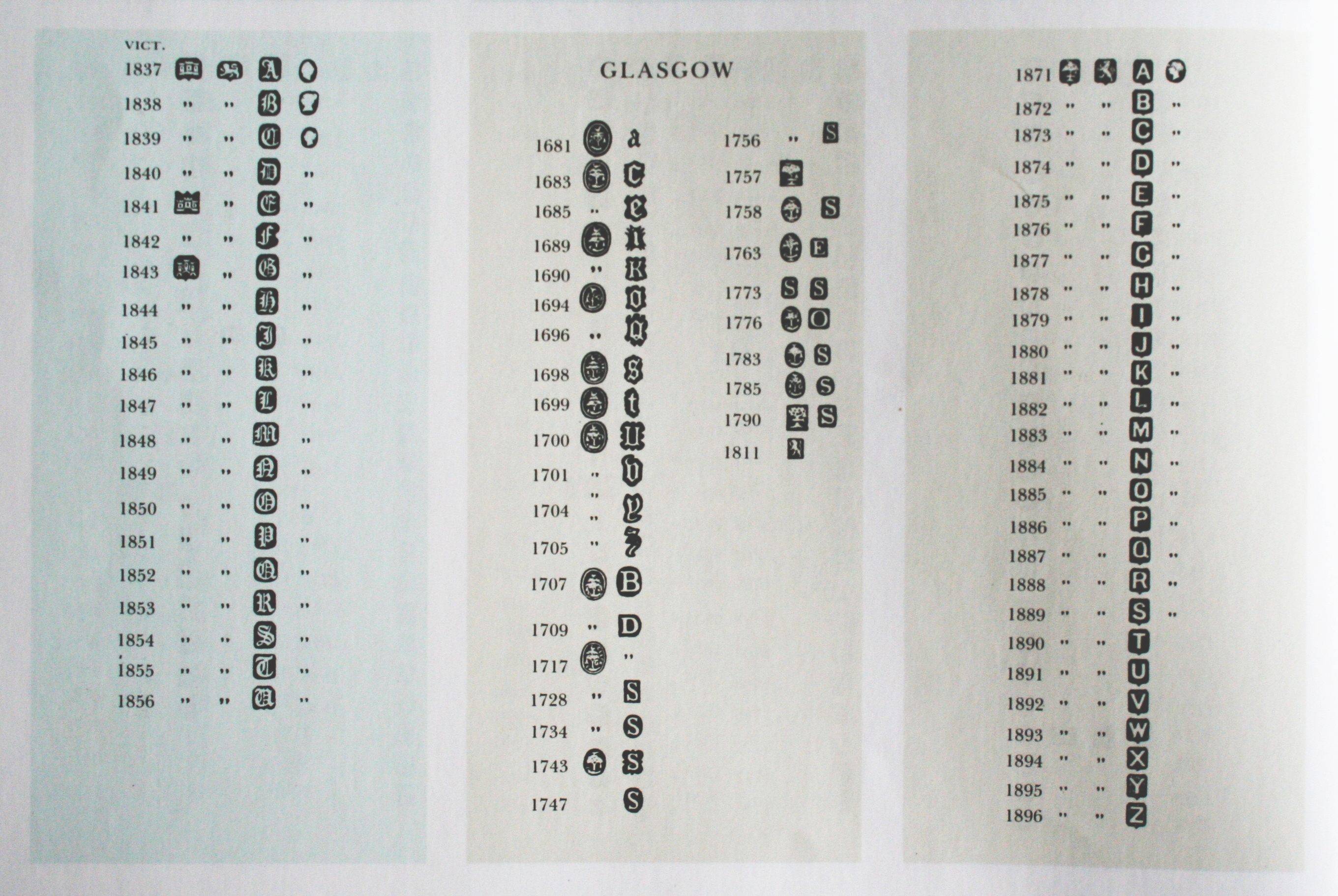
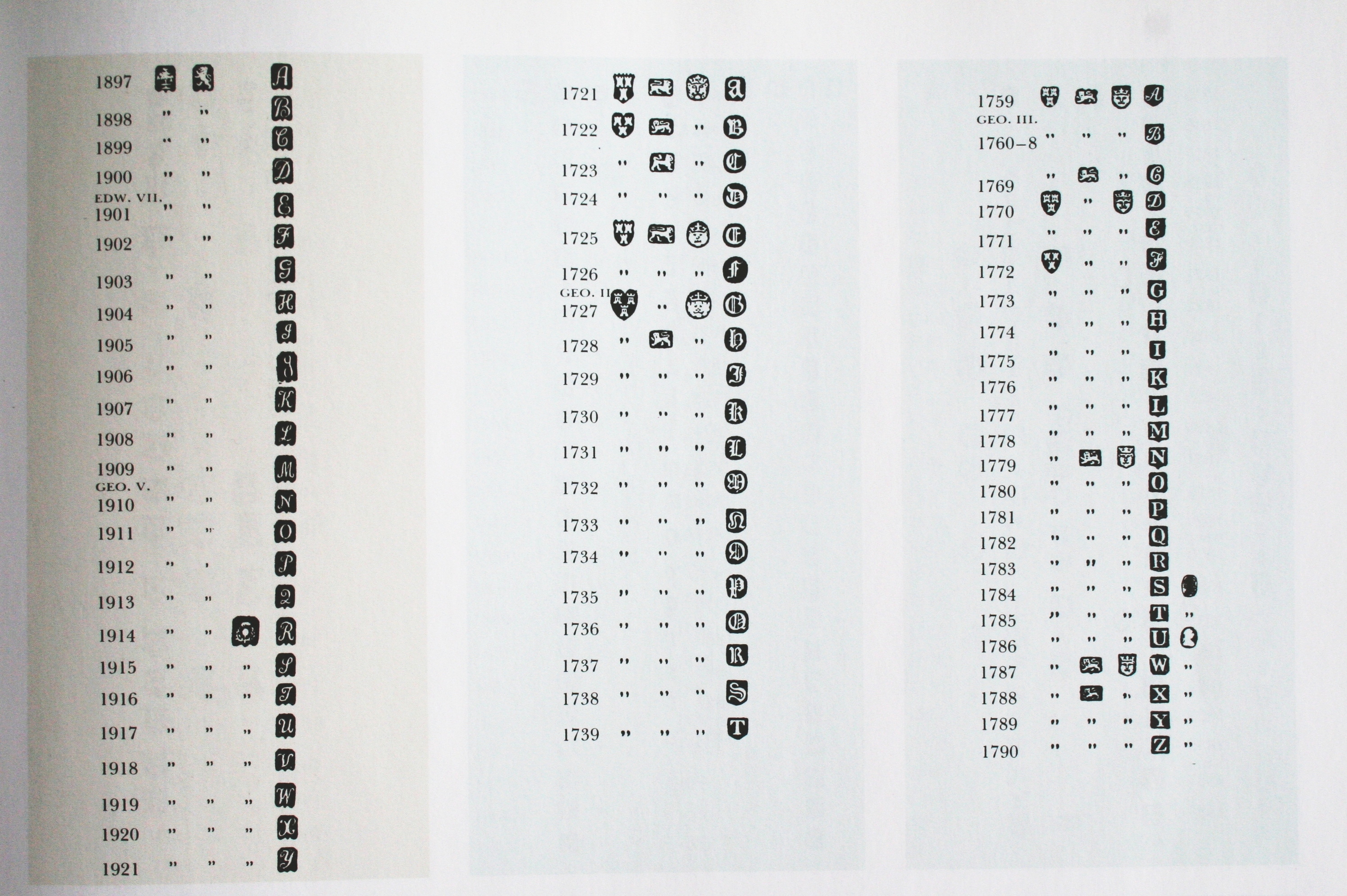
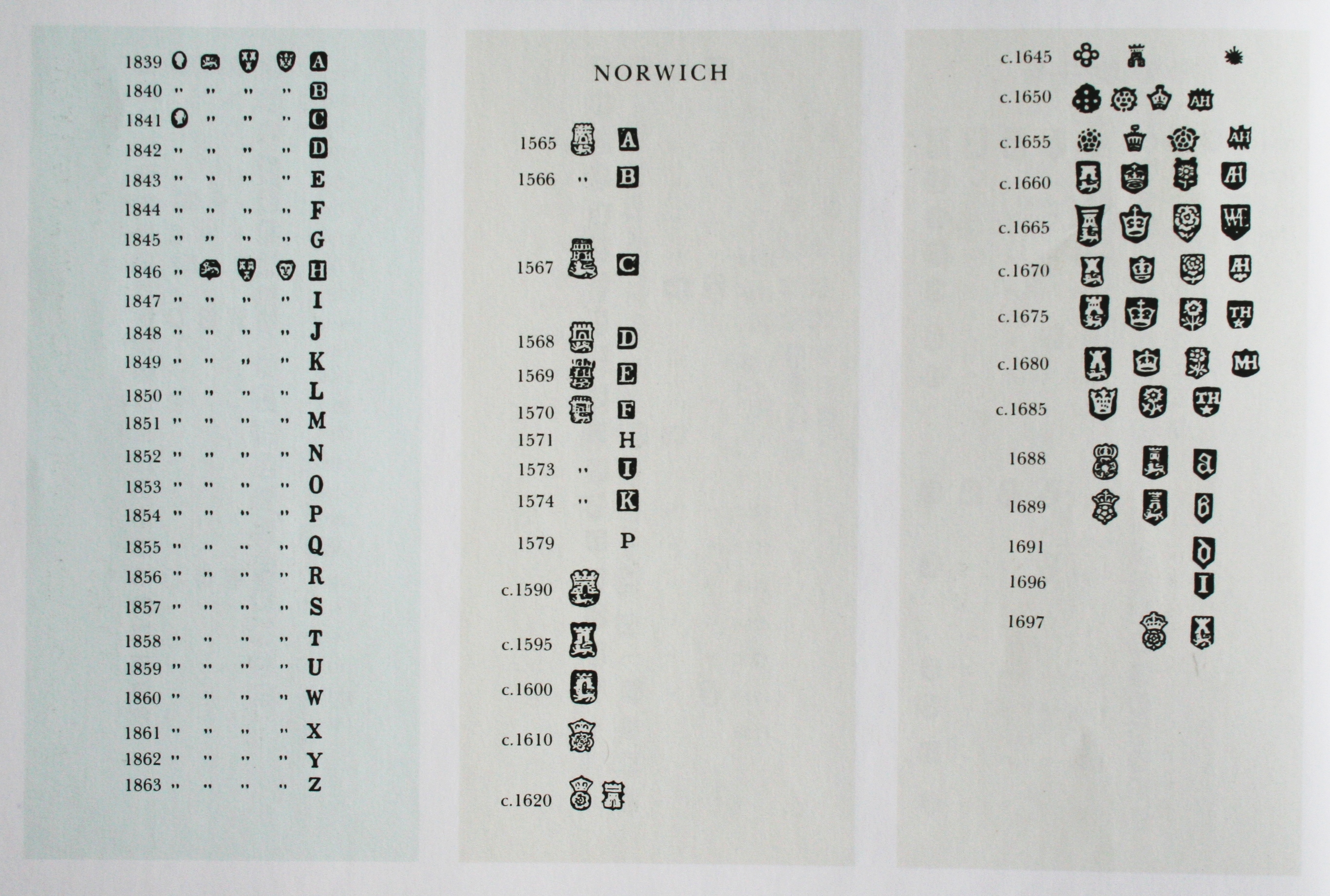
The reference pages below are from a standard silver hallmarks guide. Use the office headings to jump to the series you need.
London
Birmingham
Dublin
Edinburgh
Exeter
Glasgow
Newcastle
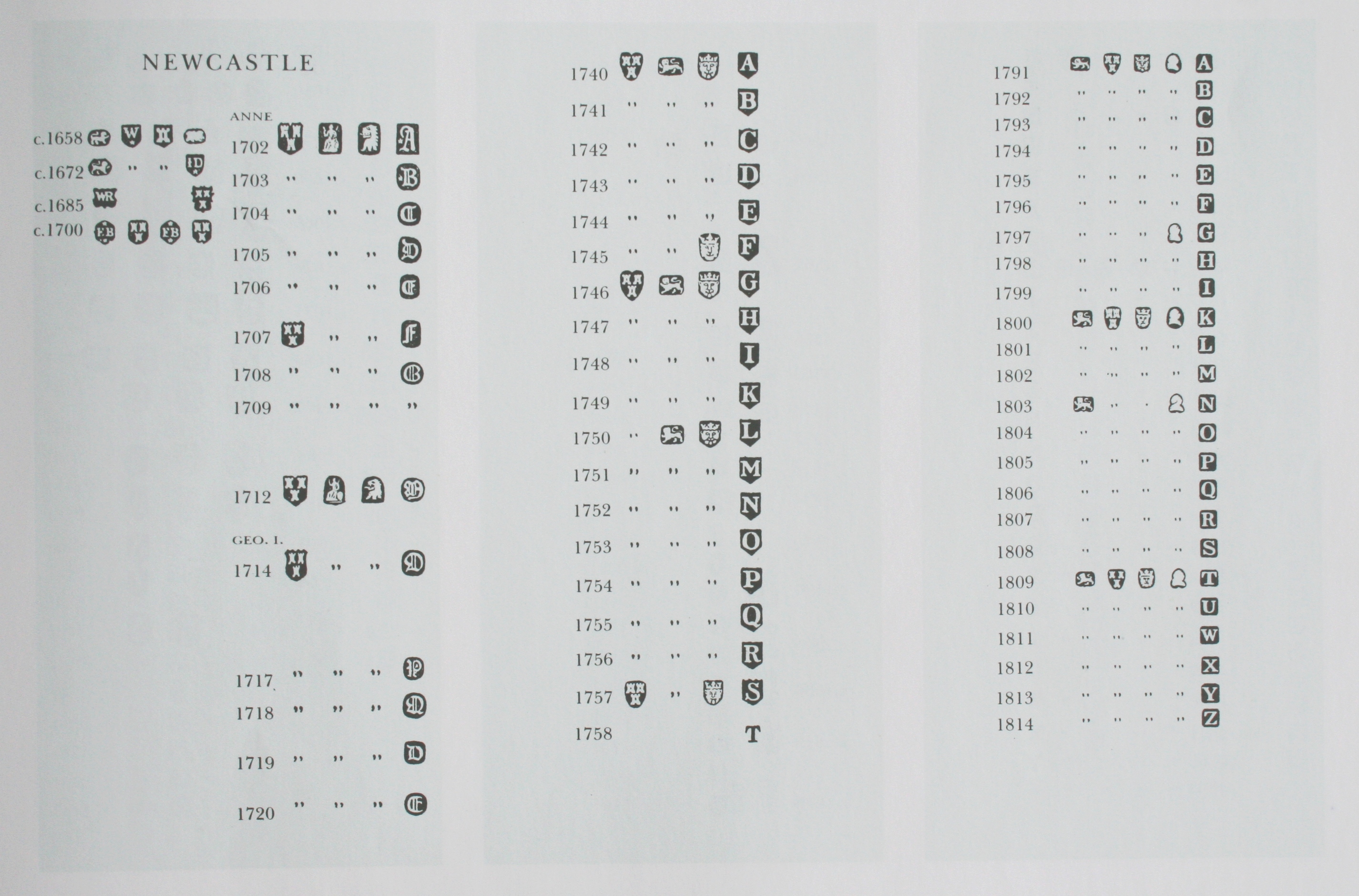
Newcastle (cont.) & Norwich
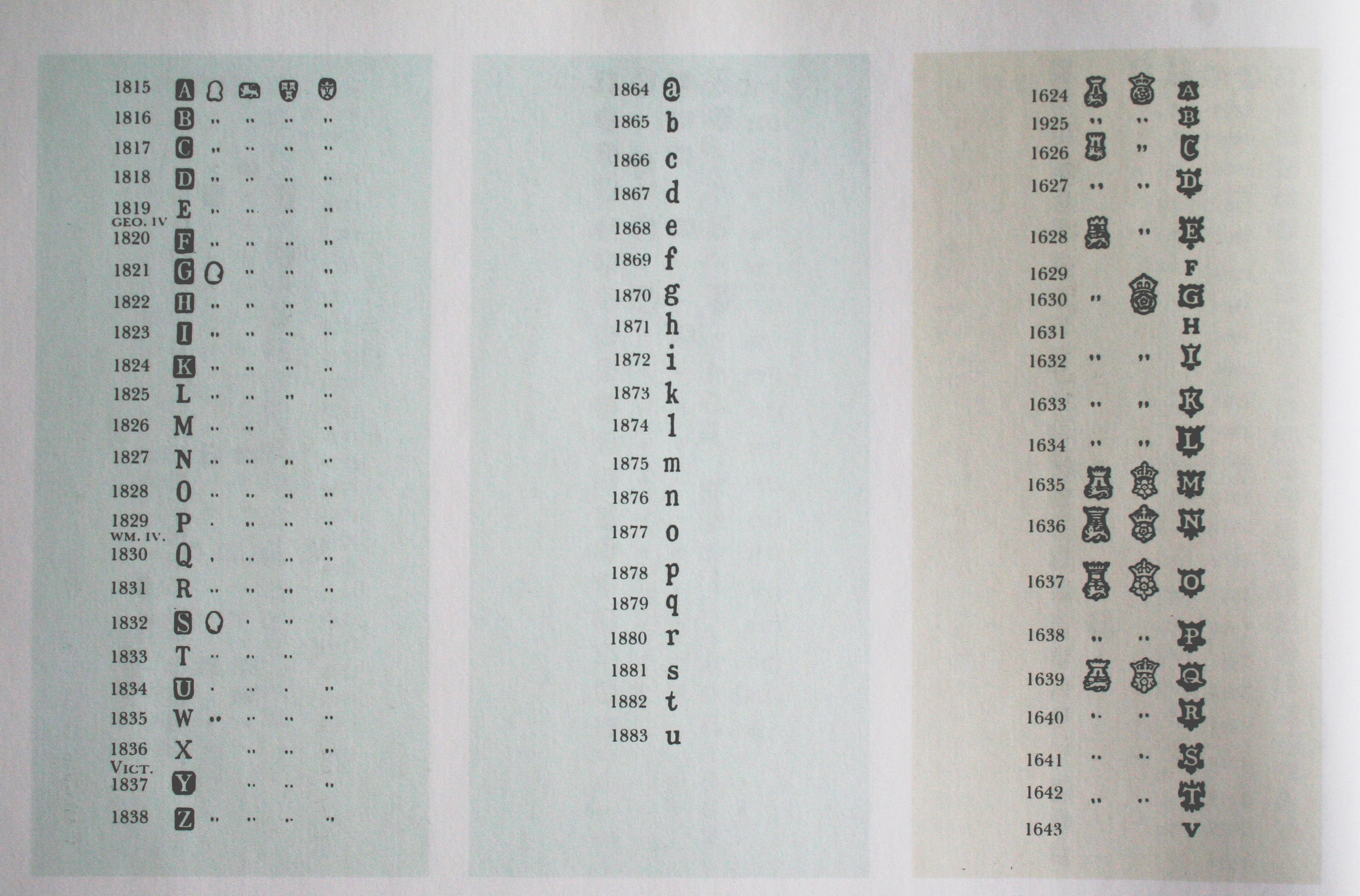
Sheffield & York