
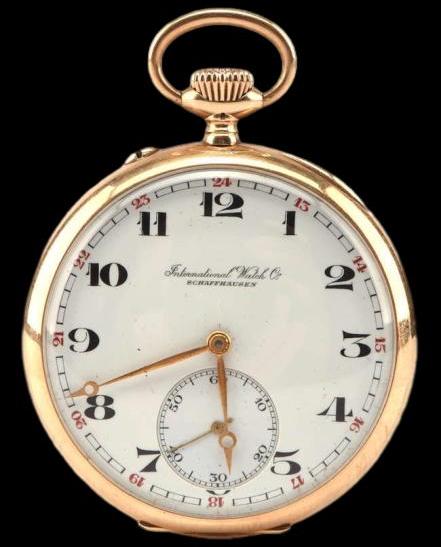
IWC Pocket Watch
The International Watch Company — IWC Schaffhausen — has one of the most unusual origin stories in Swiss watchmaking. It was founded not by a Swiss craftsman but by an American engineer, in a Swiss town chosen not for its watchmaking tradition but for its access to water power. The result was a manufacture that from its earliest days combined Swiss craft expertise with American-inspired precision engineering, producing pocket watches of exceptional quality that are now among the most keenly collected of all antique Swiss timepieces.
Florentine Ariosto Jones
The founder of IWC was Florentine Ariosto Jones, a Boston watchmaker who had worked at the American Waltham Watch Company and absorbed its philosophy of precision machine-made watchmaking. Jones believed that the American approach — using precision machinery to produce standardised, interchangeable components — could be transplanted to Switzerland, where access to skilled labour was better and costs were lower than in America.
In 1868 Jones chose Schaffhausen, a town on the Rhine in northern Switzerland, as the location for his factory. Schaffhausen had a powerful waterfall — the Rheinfall, one of the largest in Europe — that provided abundant mechanical power, and good rail connections that facilitated the import of raw materials and export of finished watches. It was not a traditional watchmaking centre, which meant that Jones had to build his workforce from scratch, training local people in his American methods.
The Factory and Early Production
Jones built a modern factory equipped with precision machinery on American principles, and began production in 1868. The early watches were produced in the American sizes and style — larger movements with full plates, lever escapements, and keyless winding — intended primarily for the American market. The quality was high from the outset, reflecting the precision manufacturing approach.
Financial difficulties forced Jones to sell his stake in 1875, and the company passed through several owners before settling into stable Swiss ownership. The workforce, trained in Jones’s American methods, continued producing movements of consistently high quality throughout these transitions.
The Pallweber Digital Display
One of the most remarkable IWC pocket watches is the Pallweber, introduced in 1884 — a jumping hours and minutes display that showed the time digitally through two apertures in the dial, rather than with conventional hands. The Pallweber mechanism was licensed from Josef Pallweber of Salzburg and produced by IWC in both pocket watch and wall clock versions.
Pocket Watch Grades and Series
IWC produced pocket watches in both Lépine (open-face) and Savonnette (hunter case) configurations, in a range of grades from standard to the highest railroad and presentation quality. The company’s movements were characterised by their robust construction, excellent regulation, and — in the higher grades — superb finishing of the traditional Swiss type.
| Grade Type | Jewels | Features | Notes |
|---|---|---|---|
| Standard | 15–17 | Lever escapement, keyless wind | Widely produced; good quality throughout |
| Railroad | 17–19 | Adjusted 5+ positions, lever set | Approved for railroad service; highly sought |
| Presentation | 17–21 | Finest finishing, gold settings | Produced for special commissions |
| Pallweber | 19 | Jumping digital display | 1884–1887; now very scarce and valuable |
| Grande Complication | Various | Repeater, calendar, chronograph | Small numbers; exceptional collector value |
The Lepine and Savonnette Cases
IWC pocket watches came in two principal case types: the Lépine (open-face, with the crown at 3 o’clock) and the Savonnette (hunter case, with the crown at 12 o’clock and a hinged cover protecting the crystal). The Lépine style was more common for railroad and professional use; the Savonnette in gold or silver was preferred for dress and presentation watches.
IWC cases were typically made in the company’s own workshops to high standards, and many surviving examples retain their original cases in excellent condition. The quality of IWC case fitting — the precision with which back, bezel and middle fit together — reflects the engineering culture of the manufacture.
Company Timeline
Collecting IWC Pocket Watches
IWC pocket watches are among the most actively collected of all antique Swiss timepieces, driven by the brand’s strong contemporary reputation and the genuine quality of the historical pieces. Pallweber examples are the holy grail and reach extraordinary prices; grande complication pieces are similarly valued. Standard railroad and dress grades are more accessible but still command premiums over comparable Swiss competitors.
Condition is especially important for IWC collectors. The engineering culture of the manufacture means that movements in good condition often run with remarkable accuracy even after 100 years; a well-preserved IWC pocket watch is frequently a genuinely useful timepiece as well as a collector’s item. Dials should be crack-free and original; hands should be unrestored.
See the IWC wristwatch page for the continuation of the company’s story into the modern era.
IWC Pocket Watches on eBay
See also: IWC Wristwatches — Omega Pocket Watch — Longines — Railroad Watches