
Military Pocket Watches
Military pocket watches occupy a special place in the collecting world. They combine superb mechanical quality — governments demanded accuracy and durability that commercial watches rarely needed to meet — with direct historical provenance. A watch that once timed an artillery barrage, coordinated a trench assault or navigated an aircraft carries weight that no catalogue piece can match.
They are also, as a collecting category, remarkably well documented. Military contracts specified exact requirements; those requirements were stamped, engraved or printed on the watches themselves. For the collector, this makes identification and authentication more systematic than almost any other area of pocket watch collecting.
Why Armies Needed Accurate Pocket Watches
Until the wristwatch became standard issue during World War I, the pocket watch was the universal military timekeeper. The need for synchronised time was acute and sometimes a matter of life and death: artillery barrages had to lift at the exact moment infantry crossed no-man's-land; naval ships needed to hold formation; railway timetables moved troops and supplies on margins measured in minutes.
The requirements this imposed on military watches were stringent. They needed to keep accurate time across a range of temperatures. They needed to be robust enough to survive rough handling, vibration, and the occasional drop. They needed large, highly legible dials — readable in poor light and at a glance. And they needed a centre-seconds hand (sometimes called a hack seconds hand) so that watches could be synchronised to a common time standard by stopping and restarting the seconds hand precisely.
How to Identify a Genuine Military Issue Watch
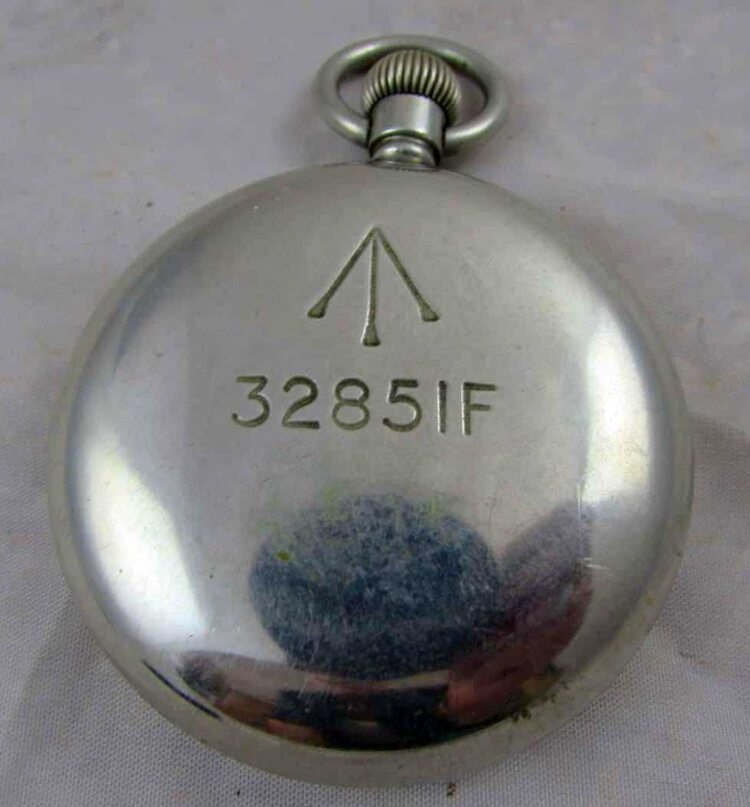
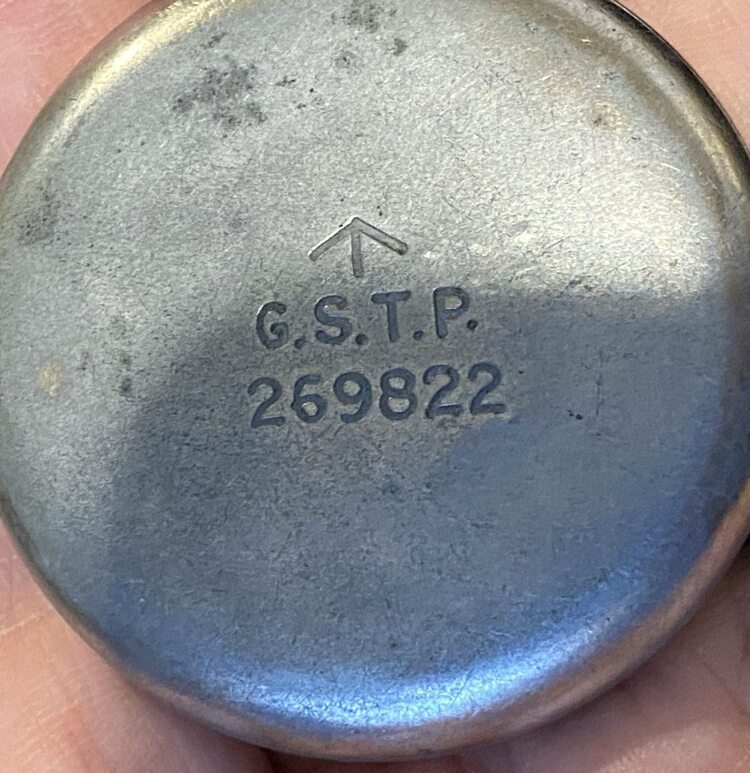
The single most important step is to identify the military acceptance marks on the case. These are physical stamps or engravings applied by the issuing authority — not by the manufacturer — and are therefore much harder to fake convincingly than a signature or dial marking. The main marks to know are:
The pheon or broad arrow mark (↑) has indicated British government property since the 17th century. On a watch case it confirms the piece was taken into official British military service. Usually accompanied by a year and often a stores reference number.
Waterproof Wrist Watch — a British designation from World War II, applied to watches that met the waterproofing standard required for combat use. Found on wristwatches rather than pocket watches, but sometimes confused by collectors.
General Service Time Piece — British designation for the standard-issue pocket watch of WWI and the inter-war period. Stamped below the broad arrow with a stores serial number beneath. See the caseback photographs above for a genuine example.
American military watches are marked U.S. Property or U.S. Army Air Forces on the caseback or movement, with a contract number in the form W-106-QM- followed by the contract serial. Hamilton, Elgin and Waltham all supplied the US military.
The South African campaigns of 1899–1902 were among the first conflicts in which accurate timekeeping was a formal staff requirement. The British Army placed contracts with Swiss and English makers for open-face pocket watches to a standard specification: white enamel dial, bold black Arabic numerals, subsidiary seconds, and a robust nickel or silver case. Many of these were made by Swiss ébauche factories and cased in England before issue.
Pre-WWI British military pocket watches are scarcer than WWI examples and more varied in specification. The broad arrow is present on genuine pieces; stores references and issue dates are often engraved on the inner caseback.
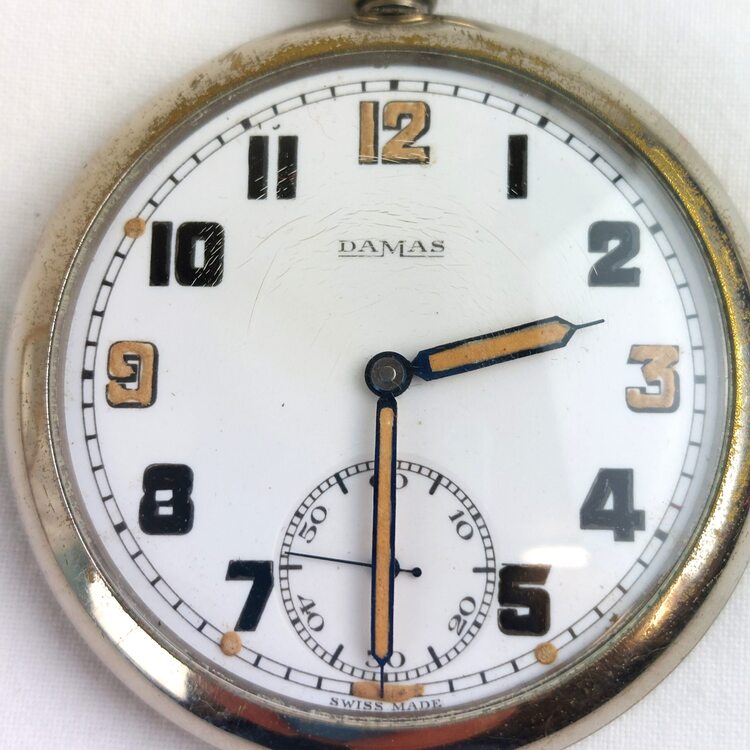
The scale of WWI created an enormous demand for standardised military watches. The British War Department placed large contracts with Swiss manufacturers — notably through London agents — for G.S.T.P. marked pocket watches. These typically have:
- White enamel dial, luminous Arabic numerals (radium-based early in the war, zinc sulphide later)
- Centre seconds hand for synchronisation
- Nickel silver open-face case with broad arrow, year, and G.S.T.P. or similar designation stamped on the inner caseback
- A simple lever escapement movement, often Swiss-made to an English specification
WWI also saw the transition to the wristwatch for frontline use. Early trench watches were pocket watch movements in wire-lugged wrist cases — a direct precursor to the modern wristwatch. These transitional pieces are collected enthusiastically in their own right.
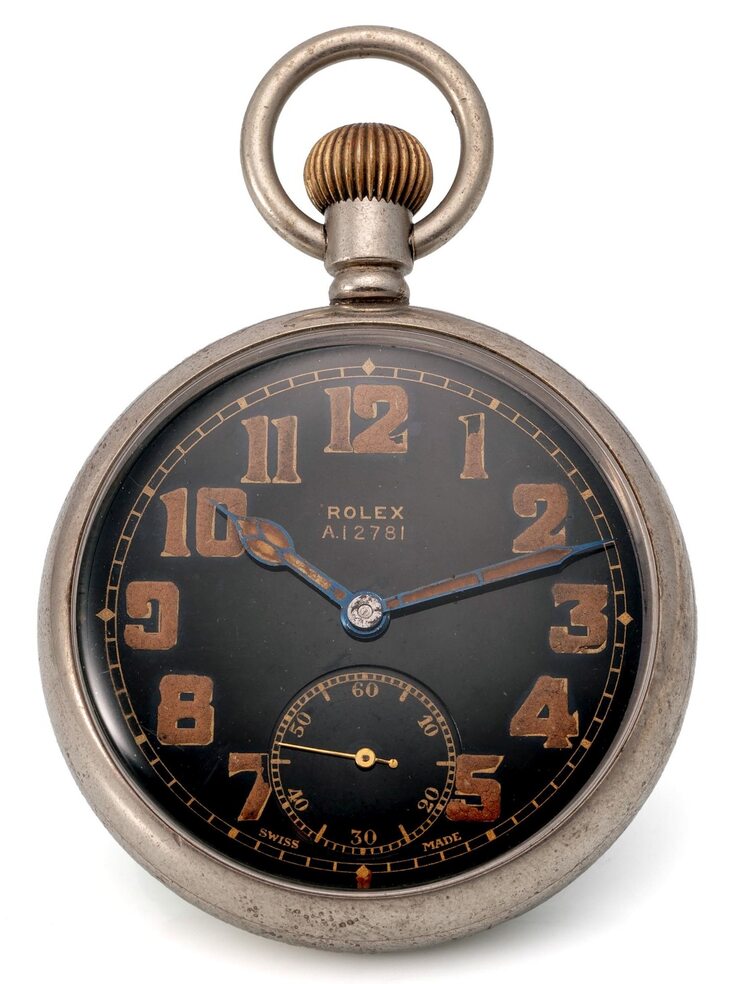
By World War II the pocket watch was being rapidly displaced by the wristwatch for most military roles. However, certain specialist uses retained the pocket watch format: navigation, artillery timing, and observer’s use where a large, highly legible instrument was needed.
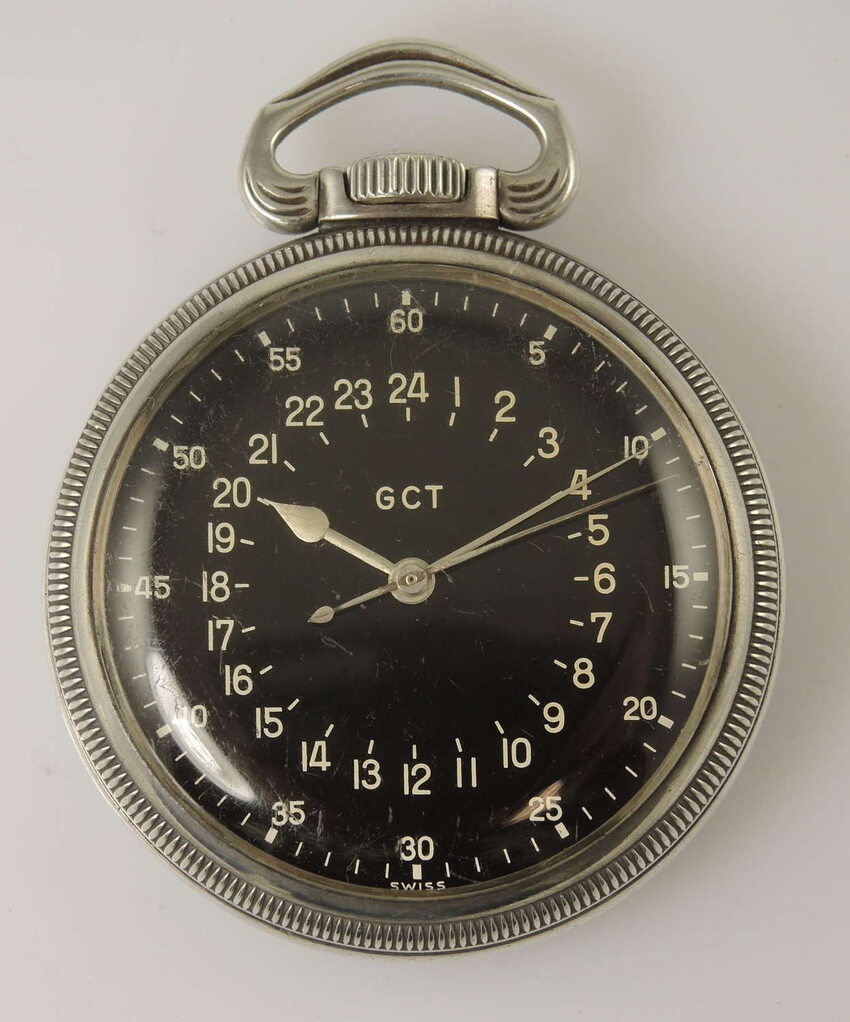
The most important American military pocket watch of WWII is the Hamilton 4992B — the standard US Army Air Forces navigator’s watch. It deserves a section of its own:
| Hamilton 4992B — Specification | |
|---|---|
| Size | 16-size (approximately 43mm movement diameter) |
| Jewels | 22 jewels |
| Escapement | Lever escapement, adjusted to 6 positions |
| Dial | White with bold black Arabic numerals, luminous hands and numerals, 24-hour inner chapter ring |
| Case | Chrome-plated brass, screw-back, signed U.S. Army Air Forces |
| Function | Hacking seconds (balance stops when crown pulled out for synchronisation) |
| Production | c.1942–1969; over 80,000 made |
The 4992B was used by USAAF navigators throughout WWII and continued in US military service into the 1960s. It is one of the most collected military watches of any type, and Hamilton serial numbers allow precise dating. For the serial number table, see our Hamilton serial number page.
British WWII issue pocket watches were typically Swiss-made to War Office specification, with the broad arrow, broad arrow over C (Canadian forces), or specific RAF designations stamped on the caseback. The 6B/234 and 6B/159 designations indicate RAF-issue observer’s pocket watches; these are particularly sought after.
Notable Suppliers to Military Forces
Hamilton Watch Company (Lancaster, Pennsylvania) was the pre-eminent American military watch supplier. Beyond the 4992B, Hamilton supplied the 21-jewel Model 21 ship’s chronometer and the 992B railroad/military grade movement. Hamilton’s military contracts ran from WWI through to the Vietnam era.
Waltham and Elgin both supplied the US military, as did Illinois on smaller contracts. In Britain, the Swiss makers IWC, Longines, Omega and Jaeger-LeCoultre all fulfilled War Office contracts; movements were frequently Swiss-made but cased in England under British sub-contract.
For the German military, A. Lange & Söhne, Glashütte makers generally, and various Swiss ébauche factories supplied the Wehrmacht and Kriegsmarine. German military pocket watches from WWI and WWII are a significant collecting category in their own right, though authentication is complex and reproductions circulate widely.
What to Look For When Buying
- Primary case marks — broad arrow, designation, year These should be stamped clearly and crisply into the metal of the caseback, not engraved freehand. The impression should show the same level of age and wear as the surrounding case surface. Fresh-looking marks on a worn case are a serious warning sign.
- Consistency of marks across case components Open both the outer and inner casebacks. Military marks typically appear on the inner caseback; the outer may show a contract reference. All marks should be consistent in style, period and degree of wear.
- Movement matches the stated contract Cross-check the movement against known contract specifications. A Hamilton 4992B case should contain the correct 16-size 22-jewel Hamilton movement — not a replacement from a different maker. Serial numbers allow production dating via the Hamilton serial number table.
- Dial originality Original military dials are specific to contract: the numerals, lume application and subsidiary seconds layout are defined by the specification. Replacement or restored dials are common on heavily-used pieces. A correct dial adds significantly to value.
- Luminous material condition Early military watches used radium-based luminous paint, which remains mildly radioactive indefinitely. This is not considered a significant health risk from handling but is worth knowing. Later pieces use zinc sulphide or tritium. Flaking or missing lume on a military dial reduces value and authenticity.
- Hacking function (if specified) Military contracts from the 1930s onwards typically required a hacking seconds function — the balance wheel stops when the crown is pulled out to allow synchronisation. Test this: pull the crown to the setting position and confirm the seconds hand stops immediately and precisely.
- Beware of assembled “military” watches A common problem is a commercial movement in a genuine military case, or genuine marks re-stamped onto a non-issue case. Research the specific designation and compare against known genuine examples. Reference books — Faber & Unger’s Military Timepieces for German watches, and the NAWCC literature for American pieces — are invaluable.
Approximate Values
| Type | Period / Issue | Approx. Range |
|---|---|---|
| British G.S.T.P., broad arrow, Swiss movement | WWI, 1914–1918 | £200–£550 |
| Hamilton 992B, US military contract | WWII, 1940s | £250–£600 |
| Hamilton 4992B, USAAF navigator’s watch | WWII, 1942–1945 | £400–£1,000 |
| British RAF 6B/xxx designation, Swiss movement | WWII, 1939–1945 | £350–£900 |
| IWC or Longines, confirmed British War Office contract | WWI / inter-war | £500–£2,000 |
| Pre-WWI British military, Boer War period | 1899–1913 | £350–£1,200 |
Related Pages
- Hamilton Pocket Watch — the dominant American military supplier
- Hamilton Serial Numbers — date your 4992B or 992B precisely
- Railroad Pocket Watches — similarly demanding precision standards
- Chronograph Pocket Watches — military-issue chronographs
- Pocket Watch Values
- Current eBay Auctions