
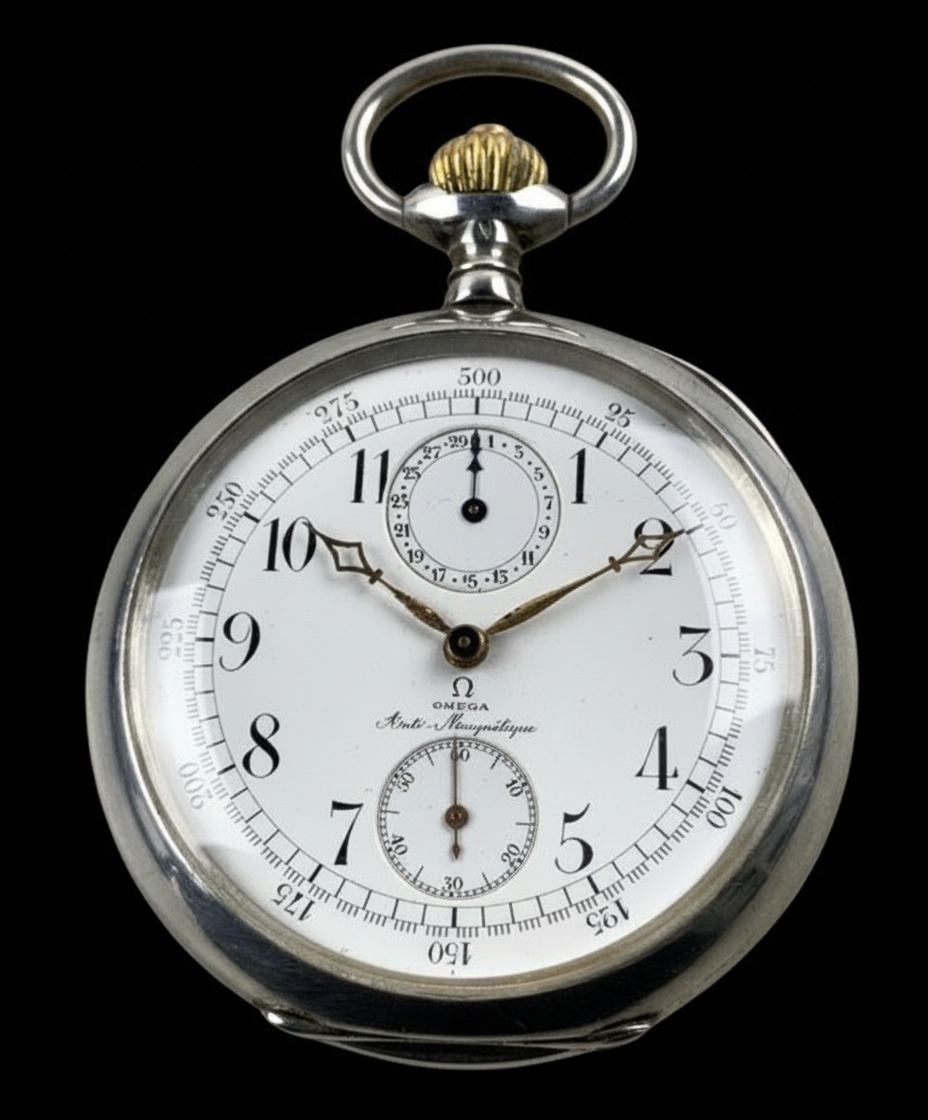
Omega Pocket Watch
Omega is today best known as the watchmaker of the Moonwatch and the Seamaster, but the company’s origins lie firmly in the pocket watch era. Founded in 1848 as a workshop assembling watches from bought-in parts, it evolved over half a century into one of the great integrated Swiss manufactures — and the pocket watch was the vehicle for that transformation. At its peak in the late 19th and early 20th centuries, Omega produced more pocket watches than almost any other Swiss maker, while simultaneously achieving the highest precision at international observatory competitions.
Louis Brandt and the Early Workshop
The company was founded by Louis Brandt in La Chaux-de-Fonds in 1848. Brandt began by assembling pocket watches from parts supplied by local artisans, selling finished watches to traders in Italy and England. The business grew steadily, and by the time of Brandt’s death in 1879, annual production had reached several thousand watches.
His sons Louis-Paul and Césare took over the business and immediately embarked on an ambitious transformation. In 1880 they relocated to Biel (Bienne), a town with better rail connections and a growing industrial workforce, and began the shift from assembly to integrated manufacture. By 1882 they had opened a factory with precision machinery capable of producing standardised, interchangeable movement components — a revolution in the Swiss industry.
The Omega Calibre of 1894
The pivotal moment in the company’s history came in 1894 with the introduction of a revolutionary new pocket watch movement — a 19-ligne calibre so significant that the company adopted its name as the brand name for all future watches. This movement — known as the Labrador calibre, later renamed Omega — was designed with fully interchangeable parts that could be replaced without adjustment, a level of precision manufacturing previously unknown in Swiss watchmaking.
The company officially adopted “Omega” as its name in 1903, by which time the brand was established across Europe and in export markets from America to the Far East.
Observatory Competition Results
Like Zenith, Omega entered its finest movements in the international observatory chronometer competitions and achieved remarkable results. Between 1900 and 1940, Omega movements won over 10 first prizes at the Kew and Neuchâtel observatories, and observatory-certified Omega pocket watches rank among the most accurate mechanical timepieces ever produced.
The performance at Kew Observatory in England was particularly significant, as the Kew certificate was accepted by the British Admiralty for navigation chronometers. An Omega pocket watch with a Kew A-class certificate is a document of extraordinary precision and represents the very pinnacle of the company’s pocket watch production.
Railroad and Military Grades
Omega supplied pocket watches to railways and military forces across Europe and beyond. Swiss, British, and many other European railways specified Omega watches for their personnel, and the company’s reputation for reliability under demanding conditions made it a preferred supplier for military contracts.
| Grade | Jewels | Application | Notes |
|---|---|---|---|
| Standard time-only | 15–17 | General civilian use | Most common; widely available |
| Railroad grade | 17–19 | Railway service | Adjusted 5 positions; lever set on some models |
| Military | 15–17 | Army/Navy issue | Broad arrow and military marks on some examples |
| Observatory | 17–19 | Precision timing | Kew and Neuchâtel certified; highest collector value |
| Presentation | 19–21 | Gifts and awards | Finest finishing; often in gold cases |
The Pocket Watch Legacy
Omega produced pocket watches from 1848 until the mid-20th century, by which time the wristwatch had entirely displaced the pocket watch in everyday use. The company’s transition to wristwatches was seamless — the engineering culture and manufacturing precision that had made the pocket watches outstanding served equally well in the new format. See the Omega wristwatch page for the continuation of the story.
Company Timeline
Collecting Omega Pocket Watches
Omega pocket watches offer an excellent combination of quality, variety and accessibility. At the top end, observatory-certified examples and grande complication pieces reach significant prices at specialist auction. At the other end, standard 15-jewel movements in silver cases from the 1900–1940 period can be found for modest sums and represent genuine Swiss manufacture quality.
The most actively sought Omega pocket watches among collectors are the observatory-certified pieces, the military-issue watches with broad arrow or other service marks, and the early examples from the Labrador/Omega calibre era of the 1890s and 1900s. Presentation pieces in gold cases with fine dials command strong premiums.
Condition priorities are as elsewhere: original dial without cracks or repainting, original hands, running movement, and ideally original case. Omega serial numbers are well documented and can be dated accurately from published references.
Omega Pocket Watches on eBay
See also: Omega Wristwatches — Longines — Zenith — IWC Pocket Watch