
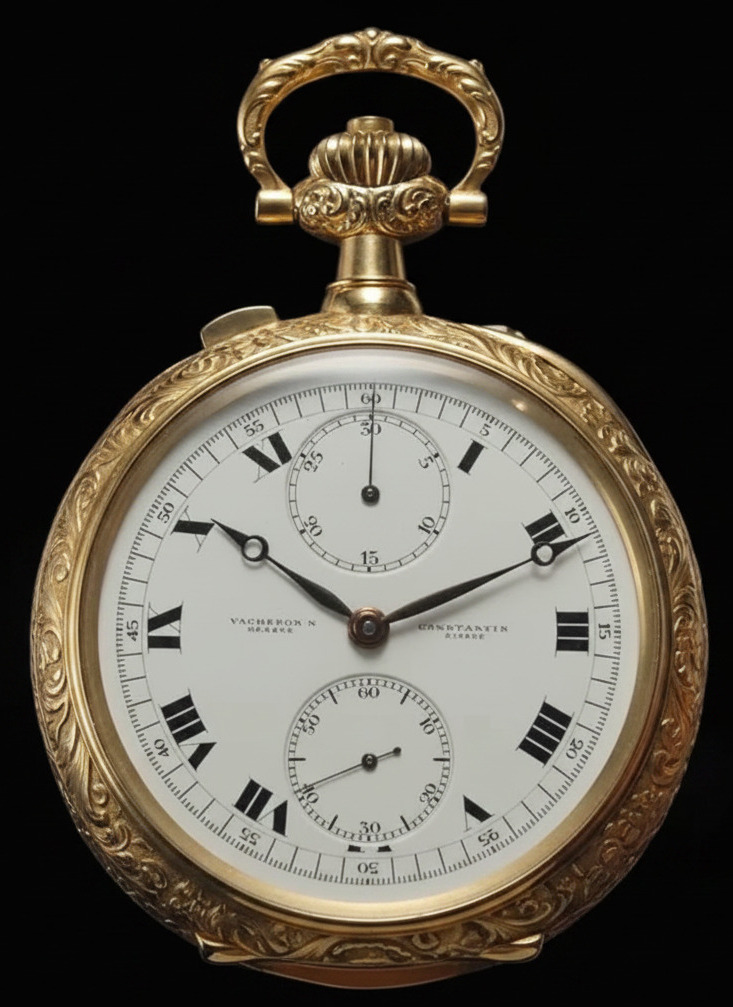
Vacheron Constantin Pocket Watch
Vacheron Constantin holds a distinction that no other watchmaker can claim: it is the oldest watch manufacturer in continuous operation anywhere in the world. Founded in Geneva in 1755 — a full generation before the American Revolution — the company has produced watches without interruption ever since, through revolutions, wars, economic crises and the quartz shock of the 1970s. Its pocket watches, produced across more than two centuries, represent some of the most refined horology ever achieved, and the finest examples are among the most valuable antique watches on the market.
Jean-Marc Vacheron and the Geneva Workshop
The company was founded by Jean-Marc Vacheron in Geneva in 1755. Geneva was already established as a centre of fine watchmaking, its craft guilds and apprenticeship traditions producing generations of skilled horologists. Vacheron established his workshop in the tradition of the finest Geneva makers, producing hand-finished movements of exceptional quality for a wealthy clientele.
The Constantin part of the company name arrived in 1819, when François Constantin joined as a business partner. Constantin was a brilliant commercial mind who understood that fine watchmaking required not just superb craft but access to wealthy customers across Europe. His travels — he is credited with the motto “do better if possible, and that is always possible” — opened markets in France, Italy, Russia and beyond, transforming a respected Geneva workshop into an internationally recognised luxury brand.
The Nineteenth Century: Great Complications
The nineteenth century was the golden age of the complicated pocket watch, and Vacheron Constantin was at the forefront. Pocket watches of this era were the most complex portable mechanisms ever created, incorporating minute repeaters, perpetual calendars, chronographs, equation of time displays, and astronomical indications within cases small enough to carry in a waistcoat pocket.
The technical demands of these movements required the very finest watchmakers, and Vacheron Constantin’s workshop attracted exceptional talent. The company developed its own ébauches (movement blanks) and trained its craftsmen to the highest standards of the Geneva tradition, including the exacting finishing requirements — bevelling, polishing, perlage — that distinguish a truly fine movement from a merely competent one.
Enamel and Decorative Cases
Many Vacheron Constantin pocket watches of the 18th and 19th centuries were housed in cases of extraordinary decorative elaboration. Geneva’s tradition of enamel miniature painting — painting detailed scenes in translucent enamel on a gold base — reached its highest expression in watch cases, and Vacheron Constantin was closely associated with the finest Geneva enamellers.
These cases depicted landscapes, mythological scenes, portraits, flowers and birds in enamel of astonishing delicacy, sometimes set with diamonds, rubies or pearls around the border. The combination of a technically superb movement with a case of museum-quality decorative art made these watches objects of extraordinary cultural as well as horological significance. Examples with original enamel cases in good condition are among the most sought-after items in the antique watch market.
The Maltese Cross
The Maltese cross has been the symbol of Vacheron Constantin since 1880, when it was incorporated into the movement design as a functional component — a cross-shaped part of the mainspring barrel system that limits the number of turns and ensures the spring operates within its optimal range. It was subsequently adopted as the company’s hallmark and trademark, appearing on movements and dials and serving as an immediate identifier of authenticity.
On antique Vacheron Constantin pocket watches, the presence of the Maltese cross on the movement is an important authentication indicator, though it should be verified alongside other features including the movement serial number and overall quality of finishing.
Company Timeline
Collecting Vacheron Constantin Pocket Watches
Vacheron Constantin pocket watches occupy the very top tier of the antique watch market. Simple time-only examples from the 19th century in plain cases will typically start at several thousand pounds at specialist auction; grande complication examples can reach six or seven figures. Enamel-cased examples with fine paintwork command extraordinary premiums.
Authentication is critical and challenging. The prestige of the name means that Vacheron Constantin movements are occasionally found in non-original cases, or that inferior movements are placed in signed Vacheron cases. Serious buyers should insist on specialist authentication and ideally provenance documentation. The movement serial number can be checked against Vacheron Constantin’s own archives for watches made after about 1880.
For the collector of more modest means, Vacheron Constantin pocket watches in plain silver cases with simple movements do occasionally appear at general auction at prices that, while not cheap, are within reach. These offer a genuine piece of the world’s oldest watchmaker at a fraction of the cost of a grande complication.
Vacheron Constantin on eBay
Genuine Vacheron Constantin pocket watches appear occasionally on eBay. Exercise caution and verify authenticity carefully before bidding on high-value examples.
See also: Patek Philippe — Jaeger-LeCoultre — Audemars Piguet — Repeater Watches