
Jaeger-LeCoultre Pocket Watch
Jaeger-LeCoultre is known in the watchmaking trade as “the watchmakers’ watchmaker” — a title earned not through the prestige of its own name on the dial, but through the extraordinary quality of the movements it supplied to the greatest houses in Switzerland. For much of the 19th and early 20th century, movements bearing the LeCoultre name inside were sold by Patek Philippe, Vacheron Constantin, and other luxury brands under their own names. The LeCoultre manufacture in the Vallée de Joux produced some of the most technically accomplished movements in watchmaking history.
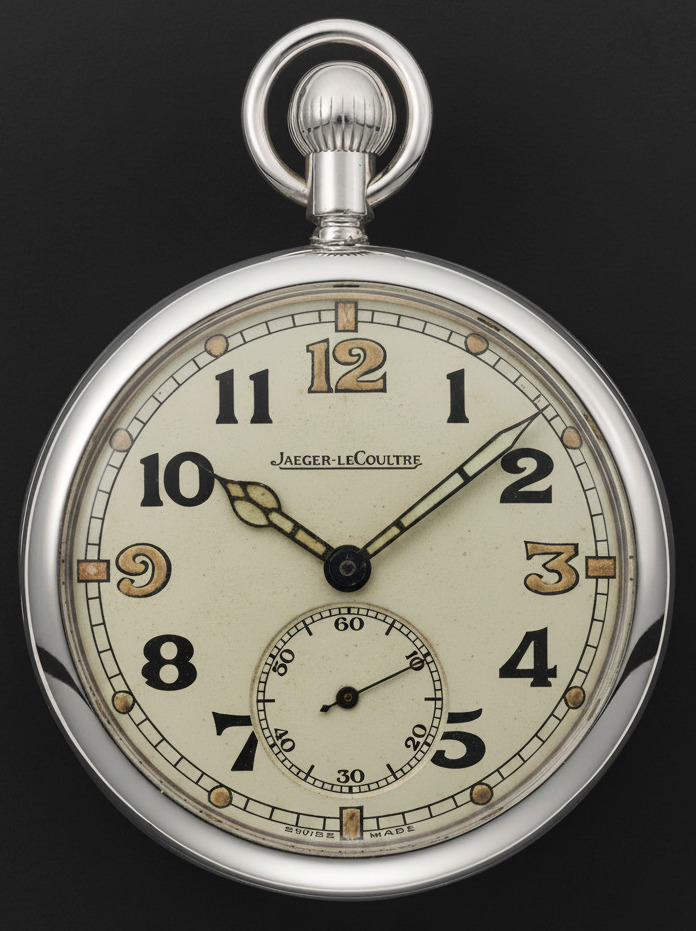
Antoine LeCoultre and the Vallée de Joux
The company was founded by Antoine LeCoultre in Le Sentier, in the Vallée de Joux in the Swiss Jura, in 1833. The Vallée de Joux had been a centre of specialised watchmaking for over a century — its isolated farming communities had developed watch part making as a winter cottage industry, and by the 19th century the valley was producing some of the finest specialised components in Switzerland.
LeCoultre’s genius was to bring the scattered cottage industry together under one roof, creating an integrated manufacture capable of producing complete movements from raw materials. He invested heavily in machinery and trained his workforce to exceptional standards, rapidly establishing Le Sentier as a source of movements of the highest quality.
The Millionometre
Antoine LeCoultre’s most celebrated invention was the millionometre, developed in 1844 — a precision measuring instrument capable of measuring to one thousandth of a millimetre. This was an extraordinary achievement for the period, and it enabled LeCoultre’s workshop to produce components to tolerances that were simply impossible for competitors without equivalent measuring capability.
Supplying the Great Houses
Through the second half of the 19th century and into the 20th, LeCoultre supplied ébauches and complete movements to many of the most prestigious names in Swiss watchmaking. This arrangement suited both parties: LeCoultre could concentrate on what it did best — designing and manufacturing movements of exceptional quality — while the houses that purchased from it could focus on case design, finishing, sales and the management of their prestigious brands.
The result was that a significant proportion of the finest 19th-century Swiss pocket watches, regardless of whose name appears on the dial, contain LeCoultre movements. Collectors who understand this provenance will find it adds considerably to their appreciation of pieces signed by other makers. A Patek Philippe pocket watch from the 1880s with a LeCoultre movement inside is arguably doubly distinguished.
Ultra-Thin Movements
LeCoultre became particularly celebrated for its ultra-thin pocket watch movements — calibres of extraordinary flatness that allowed the creation of pocket watches so slim they were almost disc-like. The technical challenges of making a complete, reliable movement within a thickness measured in millimetres are considerable: every component must be redesigned, and the tolerances must be held to a precision that would have been impossible before the millionometre.
Ultra-thin LeCoultre movements were supplied to the major houses and cased in elegant, slender gold cases that represented the height of Edwardian and Art Deco taste. These watches remain highly sought by collectors today — their refined elegance and technical achievement make them as desirable aesthetically as they are historically significant.
The Jaeger Connection
The Jaeger part of the company name arrived through an arrangement with the Parisian instrument maker and watchmaker Edmond Jaeger, who had developed ultra-thin movement designs of his own and sought a manufacturer capable of producing them to the required precision. LeCoultre was the obvious choice, and the two companies collaborated from the early 20th century. In 1937 LeCoultre acquired the rights to the Jaeger name in Switzerland, and the combined Jaeger-LeCoultre name was formally adopted.
Company Timeline
Collecting Jaeger-LeCoultre Pocket Watches
Pocket watches signed Jaeger-LeCoultre (or LeCoultre, in earlier pieces) represent some of the finest Swiss horology available to collectors. Ultra-thin examples in gold cases are the most sought after and command significant premiums; grande complication pieces occasionally appear at major auction and can reach extraordinary prices.
Collectors should be aware of the ébauche-supply history when examining pieces signed by other makers. If you own a Patek Philippe or Vacheron Constantin pocket watch from the late 19th or early 20th century, it may well contain a LeCoultre movement — this is not a deception but a recognised and historically significant arrangement. The movement serial number and calibre designation can sometimes be traced through LeCoultre’s own records.
More accessible examples of LeCoultre pocket watches can be found in silver cases with simple time-only movements, typically from the late 19th and early 20th century. These offer genuine LeCoultre quality at prices well below the grandes complications, and are an excellent entry point into the brand.
Jaeger-LeCoultre on eBay
See also: Patek Philippe — Vacheron Constantin — Audemars Piguet