
Settings of a Calendar Watch Winding Crown
A few people have written to ask about the correct way to set a calendar watch — specifically which crown position does what, and in what order you approach them. It's a surprisingly common source of anxiety for first-time owners of good mechanical watches, and the anxiety is justified: get it wrong at the wrong moment and you can damage one of the more delicate mechanisms inside an otherwise extremely robust piece of engineering.
I've photographed two of my own watches in detail to illustrate each crown position — a Rolex Oyster Perpetual Datejust and a Breitling Chronomat. Both use screw-down crowns, which is standard on any serious sports or dress watch, and both follow the same four-position sequence. The positions are the same across the two watches; what differs is the date-change window, which is discussed separately at the bottom of the page. Once you've worked through this a couple of times on your own watch, the sequence becomes as natural as winding the watch itself.
Rolex Oyster Perpetual — Crown Positions
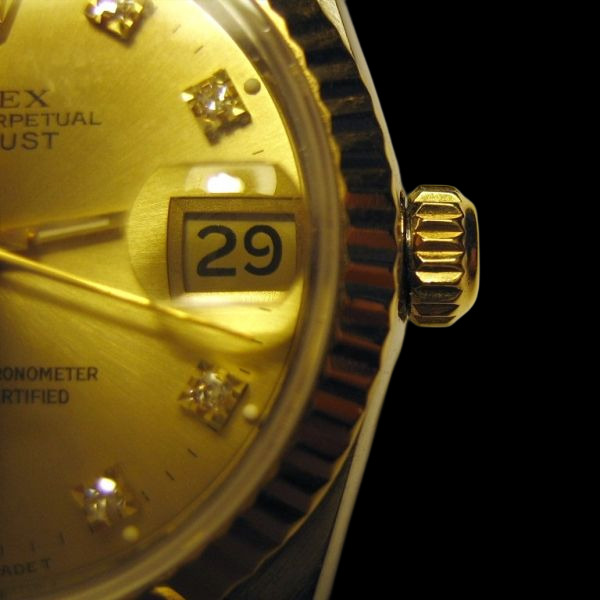
The Rolex Oyster Perpetual Datejust used here is a full-yellow-gold example with a diamond dial. It shows the crown positions particularly clearly because the polished gold crown stands out sharply against the fluted bezel. The screwed-down Oyster crown is one of the details Rolex have refined over nearly a century — it seals the case so effectively that unscrewing it takes a deliberate two-finger action, which is also a useful reminder that you're about to interact with the movement.
| Crown position | What it does |
|---|---|
|
Position 1 — Fully screwed down
The crown is wound home and sealed against the case. This is the normal wearing position. The Oyster case is now hermetically sealed against water and dust; the watch should always be worn with the crown in this state. You can see here how flush the crown sits against the case side — there is no projecting stem to catch on anything. Before doing anything else with a Rolex, the crown must be unscrewed first. Attempting to pull the crown without unscrewing it will achieve nothing and will place unnecessary stress on the tube. |
|
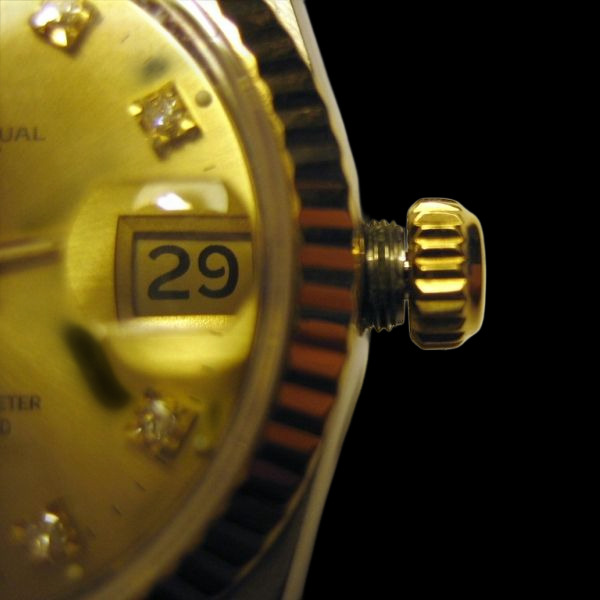
Position 2 — Unscrewed, flush
After unscrewing the crown it sits naturally at this position, protruding very slightly from the case. The watch can now be manually wound by rotating the crown clockwise. This is an automatic movement that winds itself during normal daily wear, so manual winding is rarely necessary — but it's useful after the watch has been off the wrist for several days and the power reserve has run down. A few turns will get it going again. |
|
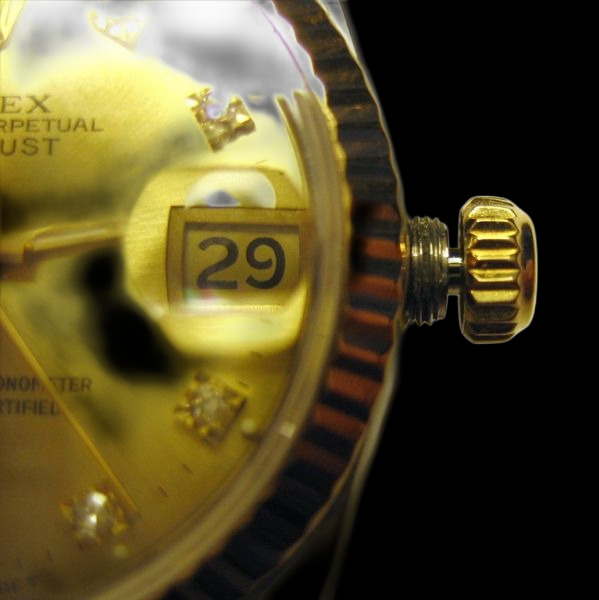
Position 3 — First click (date & day setting)
Pull the crown gently outward until you feel and hear a distinct click. In this position the date — and day of the week, on Day-Date models — can be changed by rotating the crown. Turn slowly; the date wheel advances quickly and it's easy to overshoot by a day. The recommended technique is to set the date to one day before the correct date here, then move the crown to Position 4 and advance the hands forward through midnight to complete the change. This ensures the AM/PM indicator is correct and avoids the watch being 12 hours out. |
|
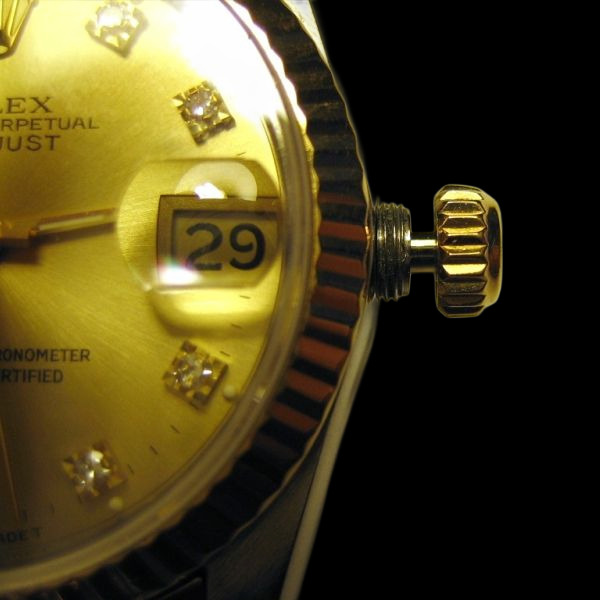
Position 4 — Second click (time setting)
A further pull brings the crown to its outermost position with a second definite click. The second hand stops — this is the hacking mechanism that allows you to synchronise the watch precisely against a time signal. Set the hands to the correct time by rotating the crown in either direction. Never rotate the hands anticlockwise when the hour hand is passing through midnight (between roughly 9 pm and 3 am). The date mechanism begins engaging during this window, and backwards hand movement can damage it. When setting is complete, push the crown back in to Position 2 and screw it firmly down to restore the Oyster seal. |
| ⚠ Remember — Never wind the hands anticlockwise between 9 and 3 (passing through midnight) | |
Breitling Chronomat — Crown Positions
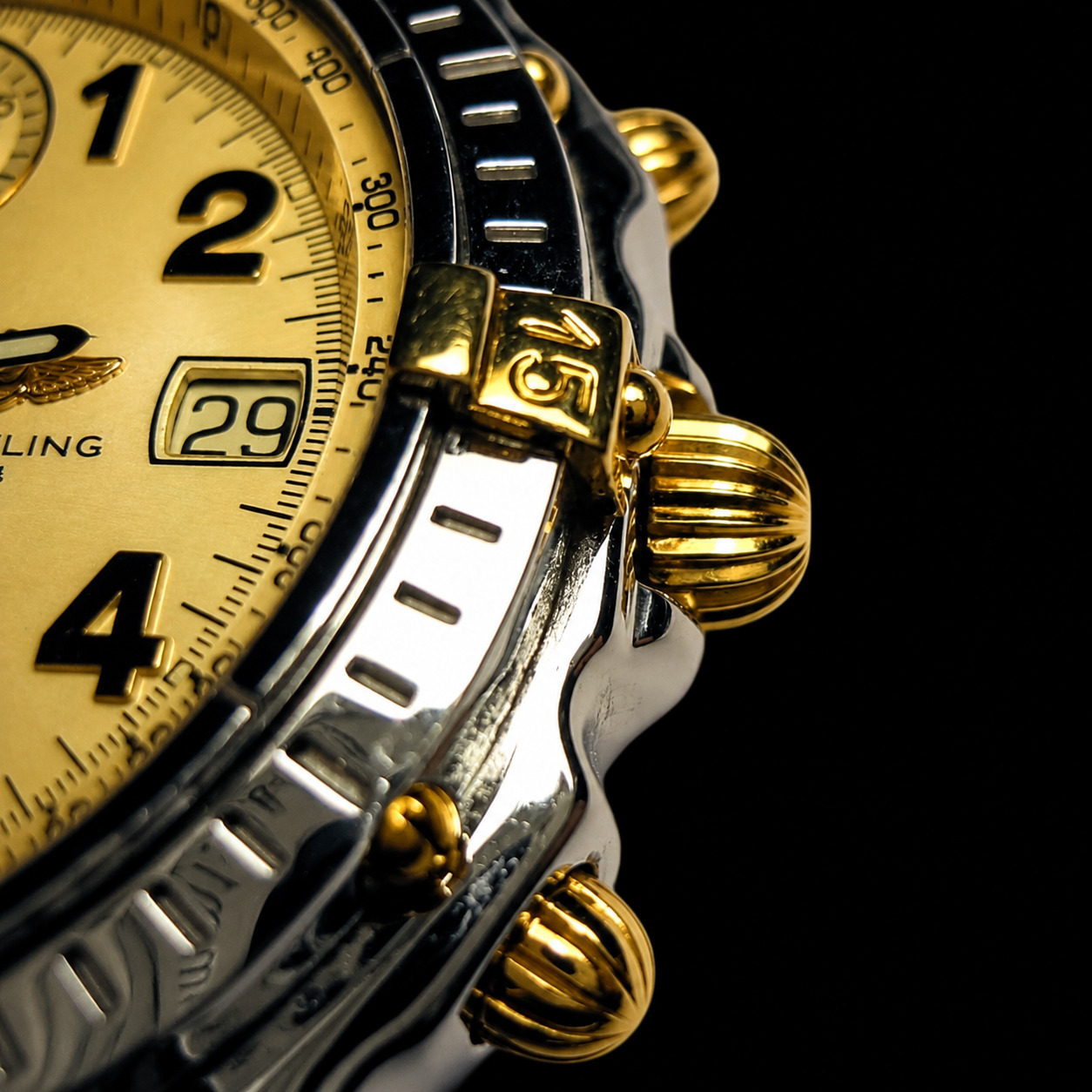
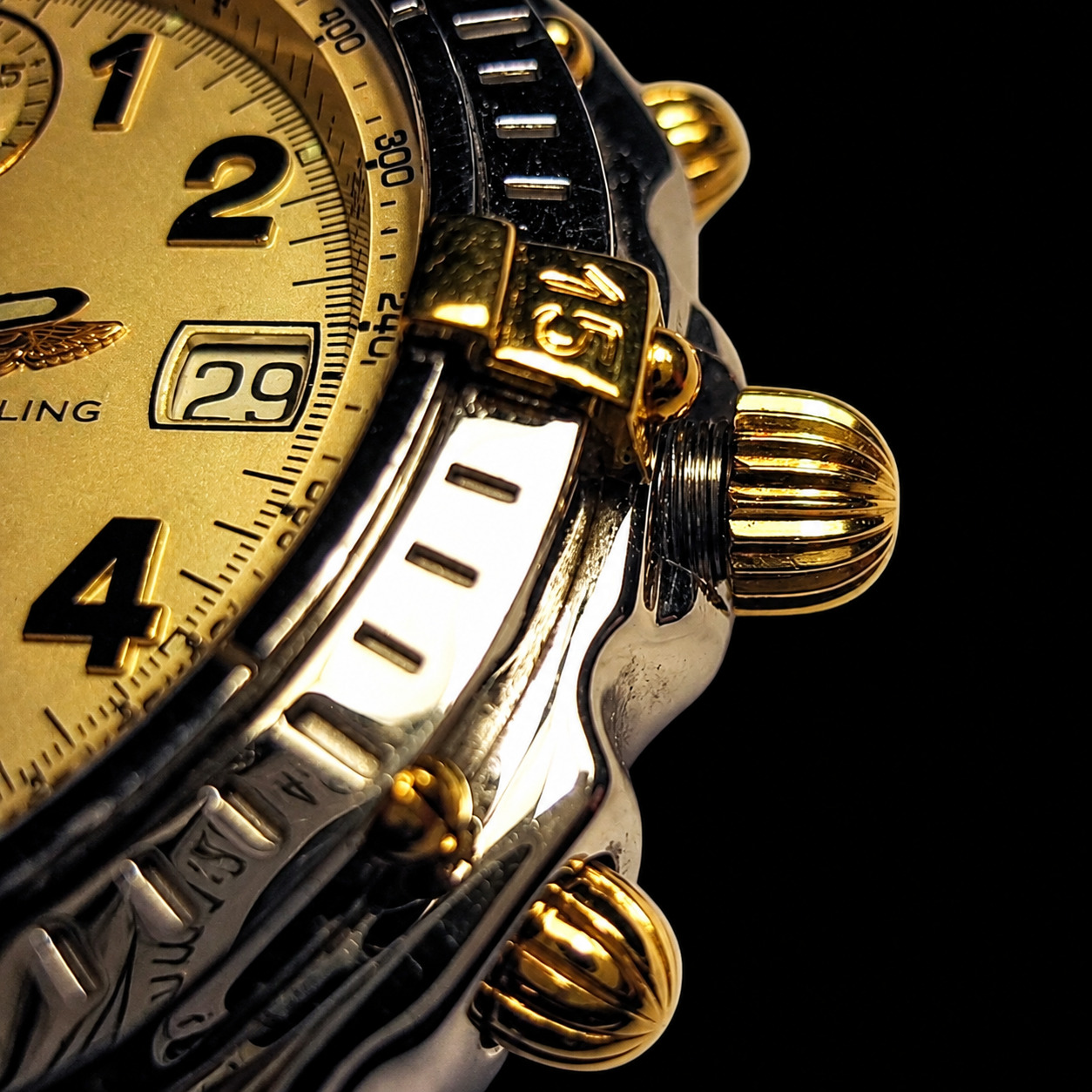
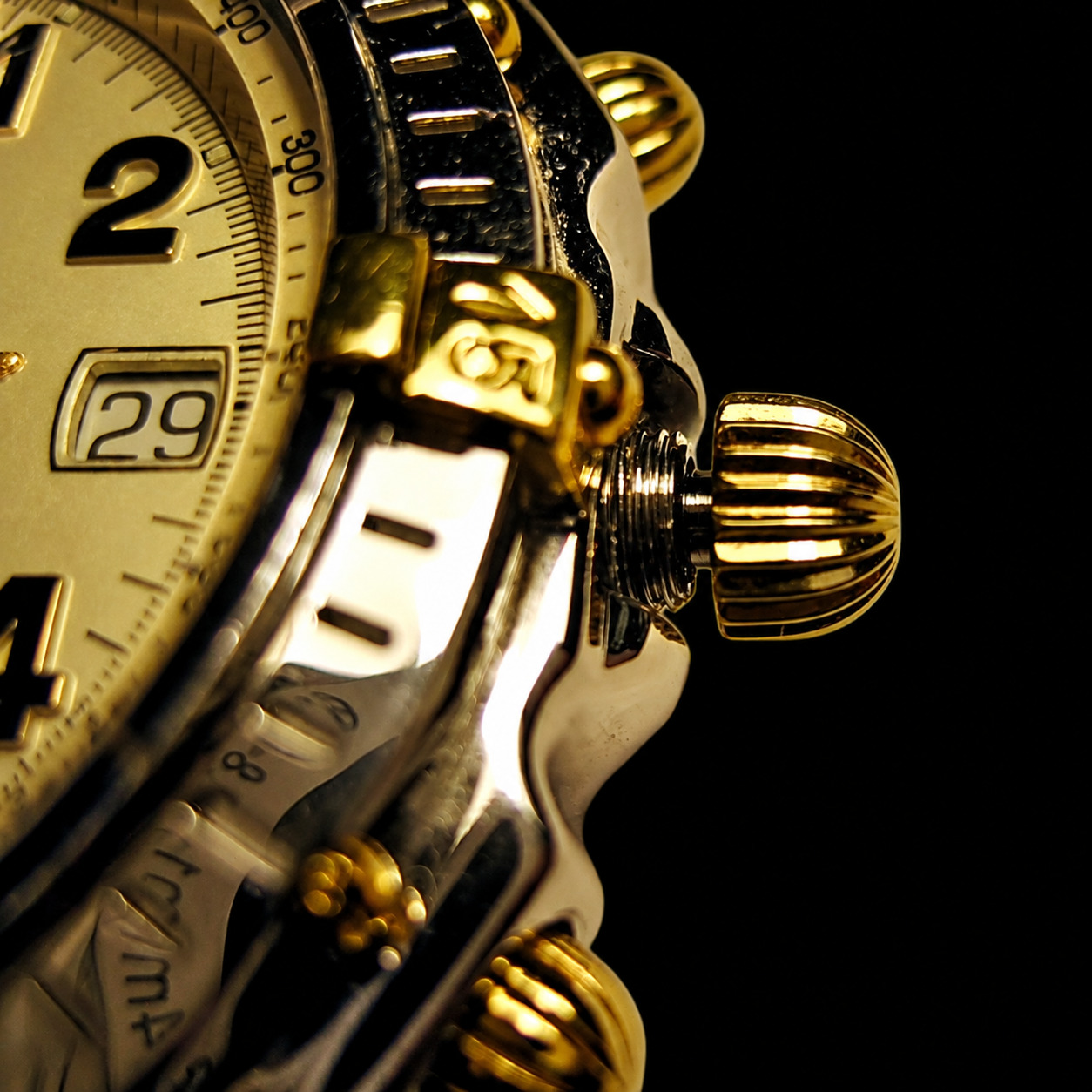
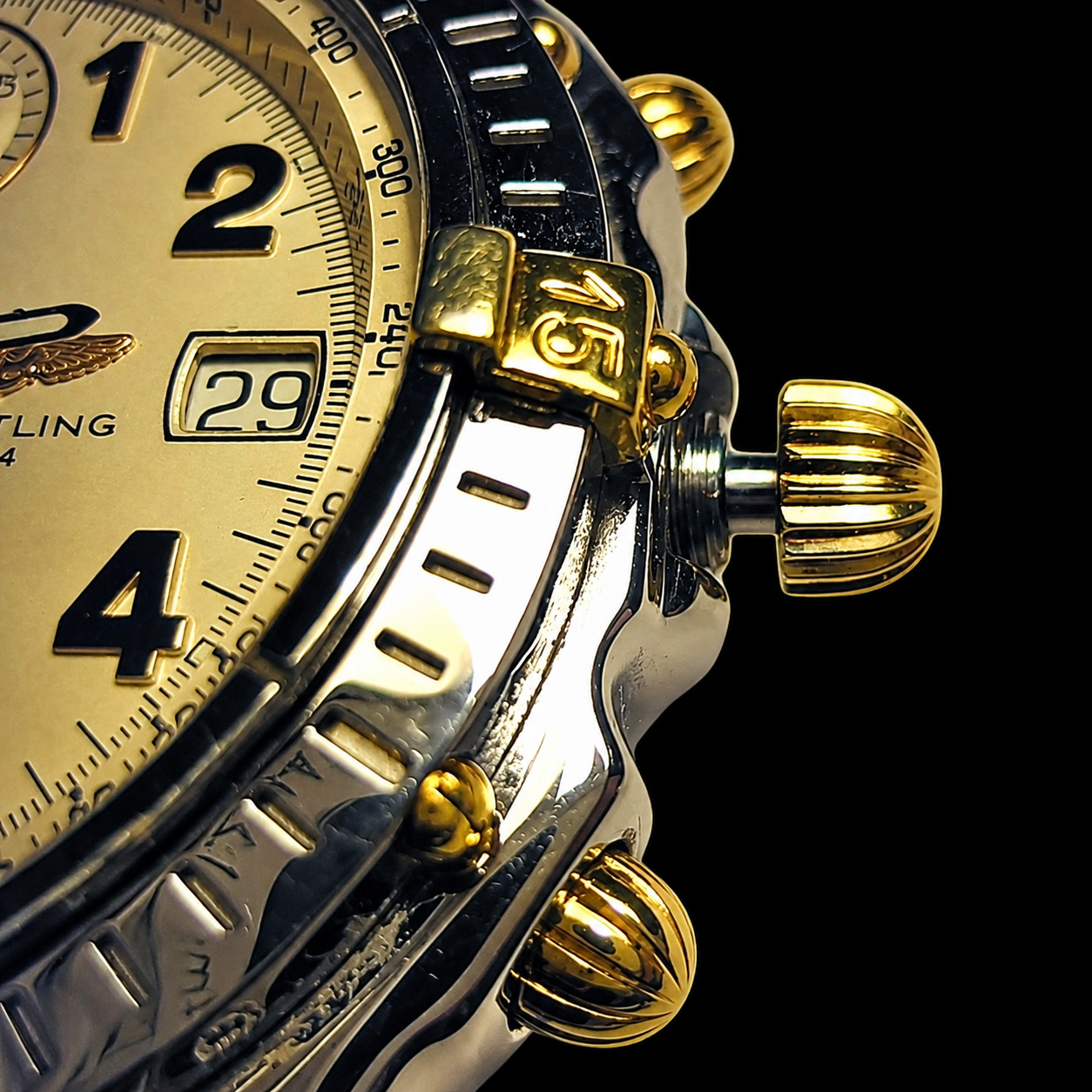
The Breitling Chronomat shown here is a two-tone steel and yellow gold version. The crown is considerably larger than the Rolex's — deliberately so. Breitling's aviation heritage means the watch was designed to be operated while wearing gloves, and every part of the crown interaction reflects that: the fluted gold crown body has deep ridging for grip, and the gold guard surrounding the crown stem protects it from accidental knocks. The numbered position markers engraved on the guard (visible in the close-up photographs) show each crown position clearly.
| Crown position | What it does |
|---|---|
|
Position 1 — Fully screwed down
The crown screwed fully home against the case. This is the sealed wearing position. The Chronomat's crown assembly is notably more complex than a simple Oyster crown — the outer guard, the numbered position marker and the screw-down mechanism are all engineering in their own right. The date display showing 29 is clearly visible on the dial at 3 o'clock in this photograph — the Chronomat's date window is generously proportioned and easy to read at a glance. |
|
Position 2 — Unscrewed, flush
Crown unscrewed and sitting at its natural resting position flush with the case. The numbered guard is now clearly visible, showing the current position. From here the movement can be manually wound by turning the crown clockwise — useful after extended storage. The large, deeply ridged crown body makes this operation straightforward even with slightly clumsy fingers, which is entirely intentional given the Chronomat's intended user. |
|
Position 3 — First click (date setting)
Crown pulled outward to the first click position. The date can now be advanced by rotating the crown. The numbered guard moves outward with the crown stem, making the position change visible as well as tactile. As with any date-setting operation, turn steadily and deliberately — the date wheel moves faster than expected and overshooting is a common beginner's error. Remember the date-change caution: the Breitling's mechanism begins engaging considerably earlier in the evening than the Rolex's. See below. |
|
Position 4 — Second click (time setting)
Crown pulled to its fully extended position at the second click. The second hand stops, allowing precise synchronisation. In this photograph the crown is visibly extended well clear of the case, the guard sitting proud of the case flank — the difference in travel between positions is generous on the Chronomat and clearly felt as well as seen. Set the hands to the correct time, then push the crown back through each position and screw firmly down. The anticlockwise-through-midnight rule applies here exactly as it does on the Rolex — and on the Breitling the danger window starts earlier. The full explanation is in the next section. |
| ⚠ Remember — Never wind the hands anticlockwise between 9 and 3 (passing through midnight) | |
When Does the Date Change? Rolex vs Breitling
The two watches handle their date changes very differently, and the difference matters practically. The rule against winding backwards through midnight exists because the date mechanism begins moving during a window around midnight — and the width of that window varies significantly between manufacturers.
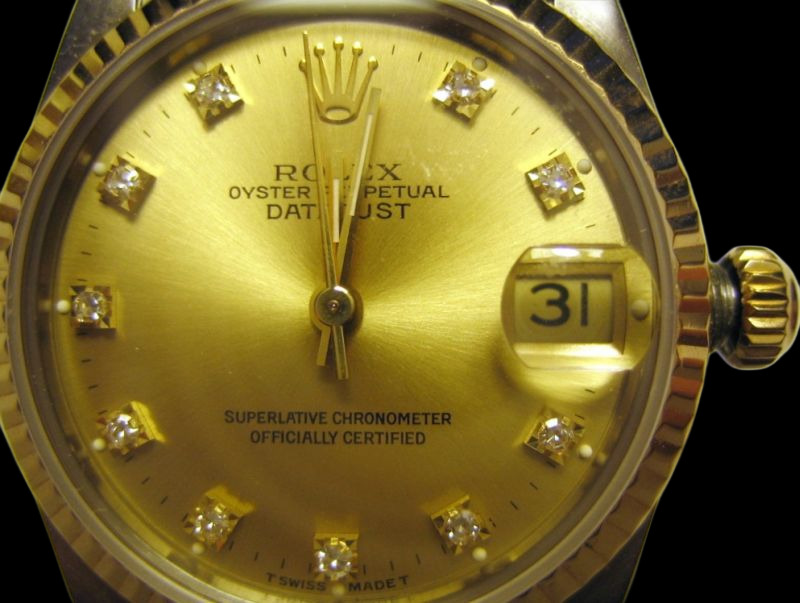
The Rolex date function changes at just past midnight, and it does so almost instantaneously — in well under half a second. Rolex's date mechanism uses a fast-acting detent system that flicks the date disc over in a single snap. It happens so quickly that even watching the dial with full concentration, it's nearly impossible to catch in the act. The danger window is extremely narrow, perhaps a minute or two either side of midnight.
That said, the rule still stands. The mechanism does pre-load during the approach to midnight, and the detent is under spring tension for some time before the change itself occurs. Don't wind backwards from around 11:45 pm to be safe.
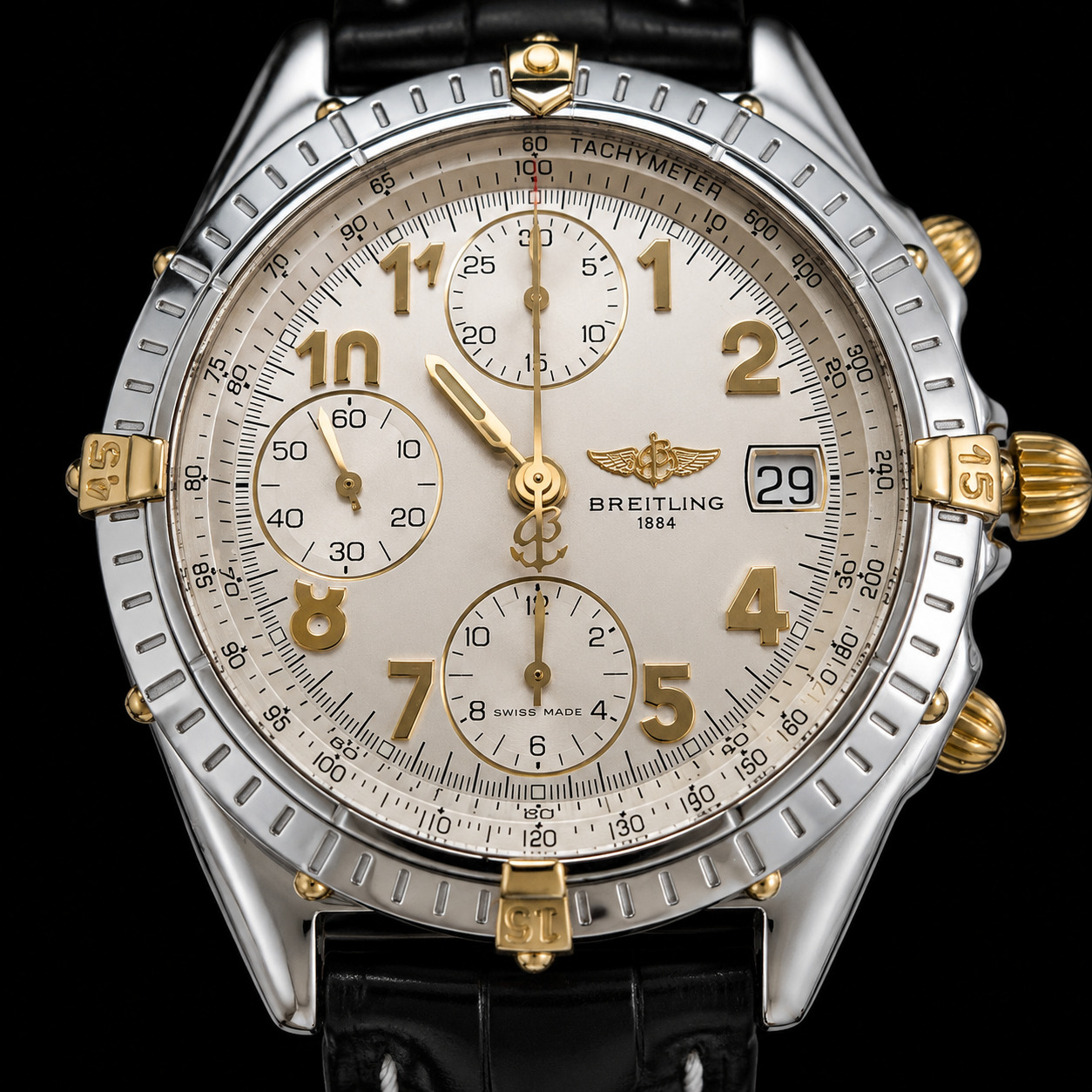
The Breitling Chronomat starts its date change at around 10:45 pm — a full 75 minutes before midnight. Unlike Rolex's snap mechanism, the Chronomat's date disc moves gradually, the mechanism engaging progressively over that long approach window rather than in a single fast movement. The change is slow enough to photograph, which is what you can see here.
This means the no-backwards-winding rule on the Breitling is considerably wider in practice. From around 10:30 pm I wouldn't turn the crown anticlockwise at all. Two hours of restriction per day sounds significant, but once you're aware of the habit it becomes as automatic as anything else about wearing a mechanical watch.
The practical takeaway is simply to know your own watch. If you wear a Rolex, a brief period of caution around midnight is all that's required. If you wear a Breitling — or any other watch with a gradual date mechanism — build in a wider margin. And if you're ever unsure about a specific watch, the conservative approach is always correct: when in doubt, don't wind backwards between 9 pm and 3 am, and you will never damage a date mechanism.
Related Pages
- The Rolex Oyster — full history, chronology and model guide
- The Breitling Watch — from the 1884 chronograph workshop to the Navitimer
- Watch Winders — keeping your automatic wound when it's not on the wrist
- Wristwatches Index