
The Breitling Watch
The Breitling watch company was established in 1884 by a man called Léon Breitling. Breitling lived in St. Imier, Switzerland — the same Jura valley town that gave birth to Longines — and his now famous workshop began by making chronographs and precision scientific instruments where exact time measurement was critical. This was not a fashion business; it was a supplier to engineers, scientists and sports officials who depended on accurate timing as a professional requirement. Léon continued along this line of work until his death in 1914. Luckily, his son Gaston took up the reins and the following year, in 1915, produced what is now recognised as the world's first wristwatch chronograph — a creation that proved immediately popular with the pilots of the Great War, for whom accurate timing during navigation missions was a matter of survival.
By 1923 Gaston had handed the company to his own son, Willy Breitling. Willy proved to be the entrepreneur the business needed. A few years later, in 1936, he negotiated the honour of being named Official Supplier to the Air Force — an appointment that catapulted Breitling onto the world stage and made their watches part of the standard equipment of military aviation. It wasn't long before the watches were also being supplied across the Atlantic to members of the American armed forces.
The Breitling watch became synonymous with flying and concentrated its efforts on producing superlative chronographs for pilots around the world. Among their notable creations was the Chronomat in 1942 — featuring a circular slide rule bezel that allowed calculations of airspeed, fuel consumption and distance — and in 1952, the watch that would come to define the brand entirely: the Navitimer.
The Navitimer — Navigator's Timepiece
The Navitimer included an in-built slide rule computer to aid navigation, combining the chronograph's timing function with a rotating circular slide rule calibrated for flight calculations. It was embraced by pilots around the world and adopted as the official watch of the Aircraft Owners and Pilots Association (AOPA). You might reasonably argue that the Navitimer was the most practically useful wristwatch ever made — the pilots who wore it depended on it not for status but because it made their work more accurate.
Breitling also went into space in 1962, when astronaut Scott Carpenter wore a Cosmonaute — a Navitimer variant with a 24-hour rather than 12-hour dial, allowing crews to distinguish day from night in the continuous daylight of orbit — aboard the Aurora 7 capsule. The Cosmonaute proved supremely accurate throughout the flight and became a bestseller worldwide. Breitling and Omega therefore share the distinction of having had watches in space in the early years of the space age, with Omega going to the moon in 1969.
As with most quality mechanical watches of the era, the natural next step was an automatic movement, and Breitling went one further: in 1969 they joined with Hamilton, Büren and Heuer to create the Calibre 11 — the world's first self-winding chronograph movement. It was a technically demanding achievement that had been a competitive goal for several manufacturers simultaneously; the fact that Breitling was among the four to cross the line first speaks to the depth of their movement engineering.
Near-Collapse and the Schneider Revival
1979 proved a pivotal year, with Ernst Schneider taking over from Willy Breitling when the company ran into severe financial difficulties — as did most precision mechanical watchmakers during the quartz crisis. Schneider's business acumen and genuine enthusiasm for the brand saved the company. He relaunched the Chronomat in 1984 with modern production values and the existing brand reputation intact, and it quickly became one of the most popular chronometers in the world — a position it has maintained since. The Schneider family ran Breitling until 2017, when a private equity sale began a new chapter in the company's story.
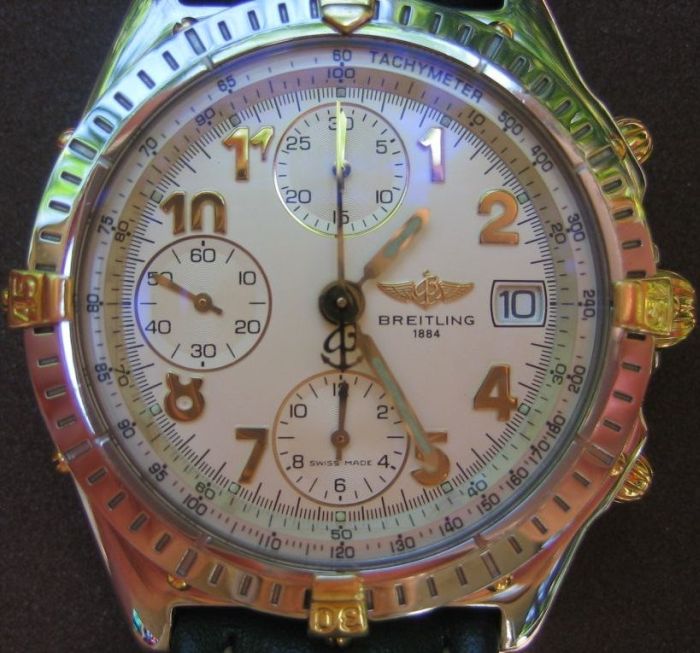
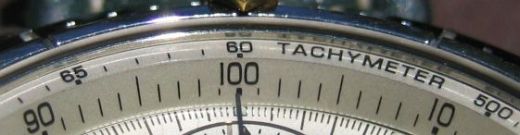
The tachymeter: The scale printed on the bezel of many Breitling chronographs — including the Chronomat illustrated here — is a tachymeter. It is used to calculate the average speed of any object over a measured distance: start the chronograph as the object crosses a known starting point, stop it as the object crosses a point exactly one unit further on (one mile, one kilometre), and read the speed directly from the tachymeter scale. No arithmetic required. It was standard equipment for racing drivers and pilots long before digital devices made such calculations trivial.
Breitling Chronology
| Year | Event |
|---|---|
| 1884 | Léon Breitling opens his chronograph workshop in St. Imier, Switzerland |
| 1892 | The workshop relocates to La Chaux-de-Fonds, the centre of Swiss watchmaking |
| 1914 | Léon Breitling dies; his son Gaston takes over |
| 1915 | Gaston produces the world's first wristwatch chronograph, enabling pilots to time events on the wrist for the first time |
| 1923 | Development of the first independent chronograph push-piece — previously the winding crown served this function. Willy Breitling, Gaston's son, takes over leadership. |
| 1932 | Willy adds a second return-to-zero push-piece, allowing measurement of successive time intervals and proper stopwatch function |
| 1936 | Breitling is named Official Supplier to the Air Force |
| 1942 | The Chronomat is launched, featuring a circular slide rule bezel. Breitling also begins supplying the U.S. Armed Forces. |
| 1952 | The Navitimer is launched — a chronograph with integrated navigation computer, adopted by the Aircraft Owners and Pilots Association (AOPA) |
| 1962 | A Breitling Cosmonaute accompanies astronaut Scott Carpenter into orbit aboard Aurora 7 |
| 1969 | Breitling joins Heuer, Hamilton and Büren to launch the Calibre 11 — the world's first automatic chronograph movement |
| 1979 | Ernst Schneider acquires the company and begins rebuilding it around its aviation heritage |
| 1984 | The Chronomat is relaunched and becomes one of the world's most popular chronometers |
| 1985 | The Aerospace is launched — a multifunction electronic chronograph in titanium |
| 1995 | The Emergency is launched, with a built-in micro-transmitter broadcasting on the 121.5 MHz aircraft emergency frequency |
| 1998 | The B-1 multifunction chronograph is launched, developed in cooperation with aviation professionals |
| 2017 | The Schneider family sells Breitling to CVC Capital Partners; a new management chapter begins |
eBay Breitling Auctions
Search current eBay listings for Breitling watches: