
Waterbury Pocket Watch
The Waterbury Watch Company occupies a unique place in the history of American horology: it produced the most technically unconventional pocket watch ever manufactured at scale, sold it for a dollar at a time when most pocket watches cost ten times as much, and in doing so put the first accurate timepiece into the pockets of millions of ordinary Americans. The Waterbury was not the finest watch ever made — its designers would have been the first to admit that — but it was arguably the most democratic, and its influence on the mass-market watch industry was profound.
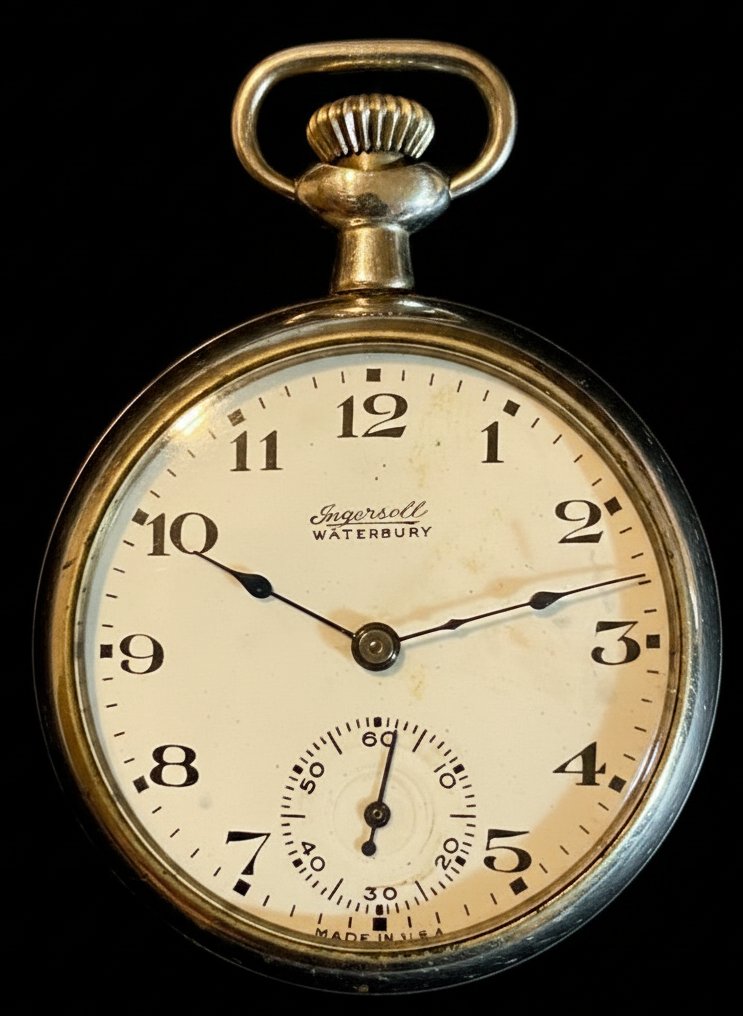
Waterbury, Connecticut
The company was established in Waterbury, Connecticut, a city already famous for its brass manufacturing. The abundant local expertise in brass working — and the availability of cheap rolled brass — made Waterbury an ideal location for a watch manufacturer whose entire business model depended on driving component costs to an absolute minimum.
The Benedict & Burnham Manufacturing Company, already established in Waterbury as a brass goods manufacturer, provided the industrial and financial backing for the watch venture. The watch company was formally incorporated as the Waterbury Watch Company in 1880.
The Long-Wind Movement
The technical heart of the Waterbury watch was the extraordinary “long-wind” movement, designed by D.A.A. Buck and patented in 1878. To understand why this design was necessary, it helps to understand the economics of conventional watchmaking.
A standard Swiss or American pocket watch of the period contained between 80 and 150 individual components, many of them requiring skilled hand-finishing. The mainspring, barrel, click, ratchet wheel and associated parts alone represented significant cost. Buck’s solution was radical: eliminate as many of those components as possible by designing a movement with no traditional escapement and no conventional winding mechanism.
The result was a watch that could be manufactured and retailed for approximately one dollar — at a time when the cheapest conventional pocket watch cost around four or five dollars, and a respectable Swiss import cost ten or more. Accuracy was limited to perhaps a few minutes per day, but for a working man who simply needed to know roughly what time it was, the Waterbury was a revelation.
The Series Watches
Waterbury watches were produced in lettered series, from Series A through to Series N, each representing a development or revision of the basic design. The series system allows collectors to date Waterbury watches approximately and to identify which variant of the movement they have.
| Series | Approx. Dates | Key Features |
|---|---|---|
| A – C | 1880–1883 | Original long-wind design; paper dial; round nickel case |
| D – F | 1883–1887 | Improved movement; porcelain dial introduced on some grades |
| G – I | 1887–1891 | Case styles diversified; hunting cases added; engraved cases common |
| J – L | 1891–1895 | Conventional lever escapement introduced on higher grades |
| M – N | 1895–1898 | Final long-wind series; conventional movements increasingly dominant |
The Jumbo and Comic Dial Watches
Among the most collectible Waterbury variants are the novelty and promotional models produced during the 1880s and 1890s. The most famous is the “Jumbo” model, an oversized version of the standard Waterbury produced as a promotional item to capitalise on the fame of P.T. Barnum’s celebrated elephant Jumbo, who died in 1885. These large-cased watches — significantly bigger than a standard pocket watch — were sold as curiosities and gifts, and genuine examples are now quite scarce.
Comic dial watches featuring characters, advertisements and decorative scenes were also produced for the promotional market. These are eagerly collected today both by watch collectors and by advertising and novelty collectors, and good examples can command prices well above the standard Waterbury grades.
Transition to Conventional Movements
By the early 1890s it was clear that the long-wind design, however economical to produce, was reaching the limits of its commercial appeal. Improved manufacturing techniques had brought the cost of conventional lever-escapement movements down considerably, and consumers were beginning to expect more accurate timekeeping even in cheap watches.
The Waterbury company began offering conventional movements in higher-grade series from around 1891, and by the mid-1890s the long-wind design was being phased out. The conventional movements were manufactured by the company itself and by purchased ébauches (rough movements) from other suppliers.
The New England Watch Company
The Waterbury Watch Company was reorganised in 1898 as the New England Watch Company, retaining the same factory and many of the same staff but operating under new management and capitalisation. The New England Watch Company continued to produce inexpensive pocket watches under various brand names — including the “Trenton” brand — until it too ran into financial difficulties.
In 1914 the New England Watch Company’s assets were acquired by Robert Ingersoll & Brothers, consolidating the low-end American watch market into a single dominant player. The Ingersoll dollar watch — itself directly inspired by the Waterbury model — went on to become the most recognisable cheap watch in the world. See the Ingersoll page for the continuation of this story.
Company Timeline
Collecting Waterbury Watches
Waterbury watches are collected for their historical significance as much as their horological merit. The long-wind movement is a genuine mechanical curiosity — completely unlike any conventional pocket watch — and working examples are a pleasure to demonstrate. The Series A through C watches are the most historically significant; later series with conventional movements are less distinctive.
The Jumbo models and comic dial variants command the highest prices among collectors. Standard long-wind models in good running condition are modestly priced — usually well under £100 — making them accessible entry points for new collectors. The main condition concern is the paper dial, which deteriorates badly with moisture; a Waterbury with an intact, legible original dial is worth considerably more than one with a damaged or replaced dial.
Because the long-wind movement is unlike any other, repair requires some specialist knowledge. The mainspring is much longer than a conventional spring and must be handled carefully; standard watchmaking tools and techniques do not always apply directly.
Waterbury Watches on eBay
Waterbury watches appear regularly on eBay, particularly from American sellers. Long-wind examples, Jumbo models and comic dial variants are the most actively sought.
See also: Ingersoll & the Dollar Watch — New England Watch Company — Timex