
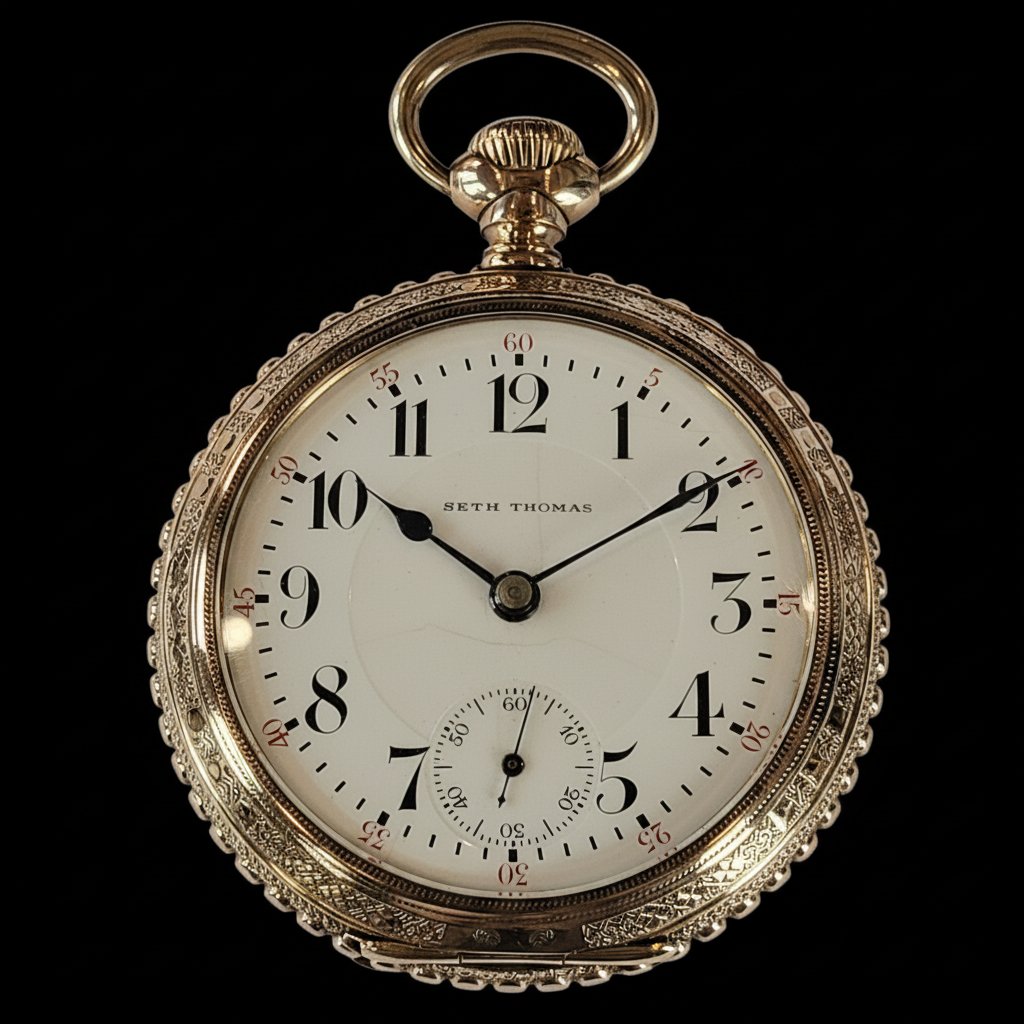
Seth Thomas Pocket Watch
Seth Thomas is one of the great names of American horology — a company that began making clocks in 1813 and turned to pocket watches forty years later, eventually producing millions of movements before the industry contracted in the early twentieth century. Thomas pocket watches occupy an interesting position in the collector market: they are less celebrated than Waltham or Hamilton, yet the finest grades — particularly the Maiden Lane series — are genuinely exceptional movements that rival anything produced in America.
Seth Thomas the Man
Seth Thomas was born in Wolcott, Connecticut in 1785. He learned the clockmaking trade under Eli Terry, one of the pioneers of American mass-produced timekeeping, and in 1813 established his own clock factory in Plymouth Hollow, Connecticut. By the time of his death in 1859 he had built one of the most successful clock businesses in America. The company he founded, reorganised as the Seth Thomas Clock Company after his death, continued under family and then corporate ownership well into the twentieth century.
The decision to enter the pocket watch market came in 1853, when the company established a watch division alongside its clock operations — making Seth Thomas one of the earliest American firms to attempt factory-produced pocket watches, predating Elgin and following only a few years behind Waltham.
The Plymouth Hollow Factory
The first Seth Thomas watches were produced at Plymouth Hollow from 1853 onwards. Early production was slow and quality inconsistent — the machinery and techniques required for watch production were considerably more demanding than clock manufacture, and the company struggled to achieve the volumes and precision that would make the enterprise commercially viable.
The town of Plymouth Hollow was renamed Thomaston in 1866 in honour of Seth Thomas, and the factory remained there throughout the company's watchmaking history. Unlike Waltham or Elgin, which built dedicated watch towns around their factories, the Seth Thomas watch operation always coexisted with the clock business — sharing facilities, management and workforce with the much larger and more profitable clock division.
Movement Design and Construction
Seth Thomas movements followed the mainstream American full-plate and later 3/4-plate designs of the period. Early movements used a distinctive full-plate layout with the balance wheel visible from the back; later grades adopted the 3/4-plate configuration that became standard across the American industry in the 1880s and 1890s.
The company produced movements in the standard American sizes: 18-size was the primary pocket watch grade for most of the 19th century, with 16-size becoming dominant from the 1890s onwards as the industry moved toward slimmer cases. Jewel counts ranged from 7 in the plainest grades to 17 and 21 in the finest railroad and presentation grades.
One distinguishing feature of many Seth Thomas movements is the quality of finishing on the higher grades. The Maiden Lane series in particular received exceptional anglage (bevelling), damascening (pattern finishing on the plates), and jewelling that stands comparison with the finest American work of the period.
The Maiden Lane Series
The Maiden Lane is the most celebrated Seth Thomas pocket watch, named after the street in New York City that was then the centre of the American jewellery and watch trade. Produced in both 18-size and 16-size, the Maiden Lane was the company's top-of-the-line railroad and presentation grade, featuring 17 or 21 jewels, adjusted to multiple positions and temperatures, and finished to a very high standard.
The 18-size Maiden Lane, produced from the 1880s, is particularly sought after by collectors. These movements feature beautifully finished 3/4 plates with elaborate damascening patterns, gold jewel settings, and careful regulation. The 21-jewel versions adjusted to five positions are among the finest American railroad watches ever produced and today command significant premiums over ordinary Seth Thomas grades.
Later 16-size Maiden Lane movements continued the tradition into the early twentieth century. By this period the Seth Thomas watch division was operating in a highly competitive market against Hamilton, Illinois and Elgin, and the Maiden Lane represented the company's attempt to compete at the premium end of the railroad watch market.
Railroad Grades
Seth Thomas produced several grades approved for railroad service, a critical market in the late 19th and early 20th century. Railroad-approved watches required a minimum of 17 jewels, adjustment to at least five positions and three temperatures, a lever set (to prevent accidental time changes), a minimum accuracy of 30 seconds per day, and an open-face case with a white dial and bold Arabic numerals.
| Grade Name | Size | Jewels | Adjusted | Notes |
|---|---|---|---|---|
| Maiden Lane | 18s, 16s | 17, 21 | 5 positions | Top railroad grade; most sought by collectors |
| Henry Molineux | 18s | 17 | 5 positions | Named grade; strong railroad service record |
| Eagle | 18s, 16s | 17 | 5 positions | Mid-range railroad grade |
| Edgewater | 16s | 17 | 5 positions | Late production railroad grade |
| Special | 18s | 17 | 3 positions | Lower railroad grade |
Company Timeline
Identifying Seth Thomas Watches
Seth Thomas movements are signed on the plate, typically reading "Seth Thomas" with the grade name and jewel count. The serial number is stamped on the back plate and can be used to date the movement to within a year or two of manufacture using published serial number tables.
The cases supplied with Seth Thomas watches were not always made by the company itself — like most American makers, Thomas supplied movements that were then cased by jewellers and retailers. Cases may carry Seth Thomas branding or simply the case manufacturer's mark. A Thomas movement in a plain unmarked case is no less authentic than one in a signed case.
Collecting Seth Thomas Pocket Watches
The Maiden Lane grades attract the most collector interest and the highest prices. A 21-jewel Maiden Lane in good condition and original case can fetch several hundred pounds or dollars at auction, and exceptional examples in pristine condition command more. The named grades (Henry Molineux, Eagle) are also collected, while the plainer 7- and 11-jewel grades are affordable entry points into the brand.
Condition is paramount, as with all antique pocket watches. Movements should run cleanly and the dial should be free of cracks or repainting. Original cases are preferred; a Thomas movement in a later replacement case loses some collector appeal. The elaborate damascening on higher-grade movements should be clearly visible under magnification — worn or polished-out plate finishing significantly reduces value.
Because Seth Thomas produced far fewer watches than Waltham or Elgin, genuinely rare grades do appear and can surprise at auction. The collector who takes the time to study the grade hierarchy and serial number tables will occasionally find undervalued pieces — particularly outside specialist watch auctions where general antique dealers may not recognise the significance of a Maiden Lane grade.
Seth Thomas on eBay
Seth Thomas pocket watches appear regularly on eBay. The Maiden Lane grades are most actively traded; plain grades are common and inexpensive. Use the buttons below to search current listings.
See also: Waltham — Elgin — Hampden — Railroad Watches