
New England Watch Company
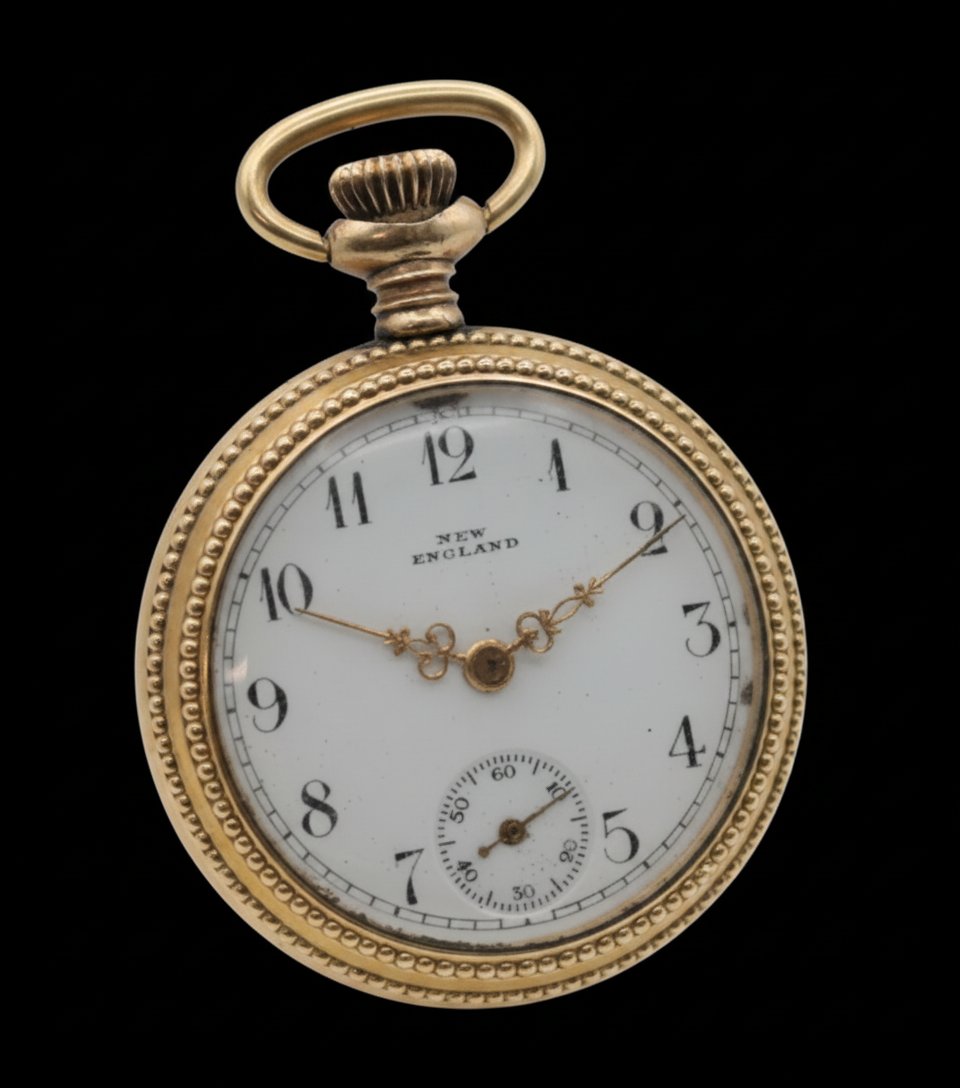
The New England Watch Company is the middle chapter of one of American horology’s most interesting stories — the transformation of the pocket watch from a luxury item into a mass-market necessity. It was born from the reorganisation of the Waterbury Watch Company in 1898, continued the work of making cheap, reliable watches available to ordinary Americans, and eventually passed its assets to Robert Ingersoll & Brothers in 1914, completing a chain of companies that shaped the low-end American watch market for nearly forty years.
Origins in Waterbury
The Waterbury Watch Company had pioneered the dollar pocket watch with its extraordinary long-wind movement from 1880 onwards, selling millions of watches through a distribution network that reached hardware stores, tobacconists and mail order catalogues. By the mid-1890s, however, the long-wind design was becoming obsolete. Improved manufacturing techniques had made conventional lever-escapement movements cheap enough to produce economically, and consumers were expecting more accurate timekeeping.
Waterbury had made the transition to conventional movements in its later series watches, but the company’s finances were under strain. In 1898 it was reorganised under new management and capitalisation as the New England Watch Company, retaining the Waterbury factory and workforce but abandoning the Waterbury brand name in favour of a fresh start.
The Trenton Brand
The New England Watch Company is best known to collectors for its “Trenton” branded watches — an enduring puzzle, since the company was based in Waterbury, Connecticut, not Trenton, New Jersey. The Trenton name was adopted as a trade brand, one of several names under which the company sold its movements to jobbers, retailers and mail order houses.
Trenton movements are typically conventional lever-escapement designs in 18-size and 16-size, with 7 to 17 jewels depending on grade. They are competently made but not exceptional — the company’s purpose was volume production at low cost, not the production of precision timepieces. Nonetheless, higher-grade Trenton movements can show surprisingly good finishing and regulation for their price point.
Trade and Private Label Brands
Like many American watch companies of the era, New England Watch Company supplied movements to retailers and distributors who sold them under their own brand names. This practice, known as private labelling, means that many New England Watch Company movements exist under names that give no indication of their true origin.
| Brand Name | Notes |
|---|---|
| Trenton | Primary house brand; most commonly encountered |
| New England | Used on some higher-grade movements |
| Tradesman | Sold through hardware and general stores |
| Excelsior | Export and promotional grade |
| Various retailer names | Many unnamed movements supplied to jobbers for private labelling |
Identifying a New England Watch Company movement under a private label requires checking the serial number against published tables, or examining the movement design which is distinctive once you know what to look for. The pillar plate layout, jewel settings and finishing style are consistent across the company’s output regardless of the brand name on the dial.
Movement Design
New England Watch Company movements are straightforward conventional lever-escapement designs following the American industry standard of the period. They use 3/4-plate construction in the later grades and full-plate in some earlier examples. Jewel counts of 7 are standard in the base grades; 11 and 15 jewel versions exist in mid-grade models; the best Trenton grades achieve 17 jewels with adjustment to three or more positions.
The quality of manufacture is honest rather than outstanding — these were working watches made to a price, and they generally kept reasonable time and gave years of service. Many survive in running condition today, a testament to the soundness of the basic design even if the finishing lacks the elegance of higher-grade American makers.
Competition and Decline
The New England Watch Company operated in an increasingly competitive market. Ingersoll’s dollar watch — itself the direct descendant of the Waterbury model — was dominating the very cheapest end of the market, while Waltham, Elgin and Hamilton were offering superior movements at only slightly higher prices in the mid-market. New England was caught between these pressures without the volume of Ingersoll or the reputation of the major makers.
The company also struggled with the broader contraction of the American watch industry in the early twentieth century. Imports from Switzerland were increasing, consumer tastes were shifting, and the economics of watch manufacturing were changing. By the early 1910s the company was in financial difficulty.
Acquisition by Ingersoll
In 1914 Robert Ingersoll & Brothers acquired the assets of the New England Watch Company, adding its factory capacity and machinery to the Ingersoll operation. This effectively completed the consolidation of the Waterbury-lineage companies into a single entity. The New England Watch Company name disappeared, and production at the Waterbury factory was integrated into Ingersoll’s operations.
Ingersoll itself would subsequently be acquired by Waterbury Clock Company in 1922, continuing the long process of consolidation that eventually produced the modern Timex organisation. The thread from the original Waterbury long-wind watch of 1880 to the Timex of today runs directly through New England Watch Company and Ingersoll.
Company Timeline
Collecting New England Watch Company Watches
New England Watch Company / Trenton watches are not widely collected for their own sake, but they are interesting historically and can be found very cheaply. The main collector interest lies in private-label variants with unusual retailer names, novelty cases, and the occasional higher-grade Trenton movement that shows better finishing than expected.
Because these watches were made in large numbers and sold cheaply, many survive. They are often found in mixed lots at estate sales and auctions, frequently overlooked because the brand name is unfamiliar. A working Trenton in a decent case is a useful everyday beater watch and a tangible piece of American industrial history, typically available for well under £50.
The main identification challenge is the variety of brand names. If you find a cheap American pocket watch with an unfamiliar name on the dial, checking the serial number and movement style against New England Watch Company records will often reveal the true origin.
New England Watch Co. on eBay
Search for Trenton watches and New England Watch Company movements on eBay using the buttons below.
See also: Waterbury Watch Company — Ingersoll & the Dollar Watch — Timex