
The Musical Pocket Watch
Musical pocket watches are among the most enchanting horological objects ever created. At the press of a button, tiny pins on a revolving cylinder pluck miniature tuned steel teeth — playing a melody so small and precise it seems impossible that human hands could have made it. The finest examples combine music with automata — tiny figures that move in time with the melody on the dial — creating mechanical theatre of extraordinary ingenuity.
How Musical Pocket Watches Work
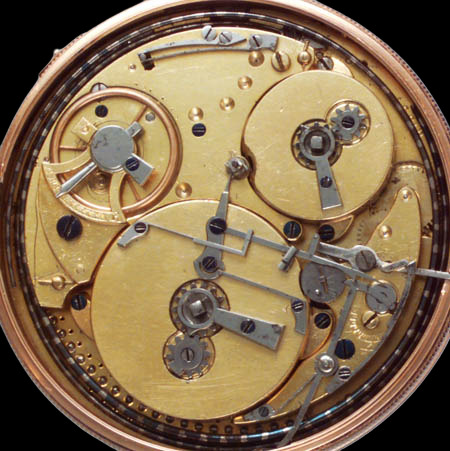
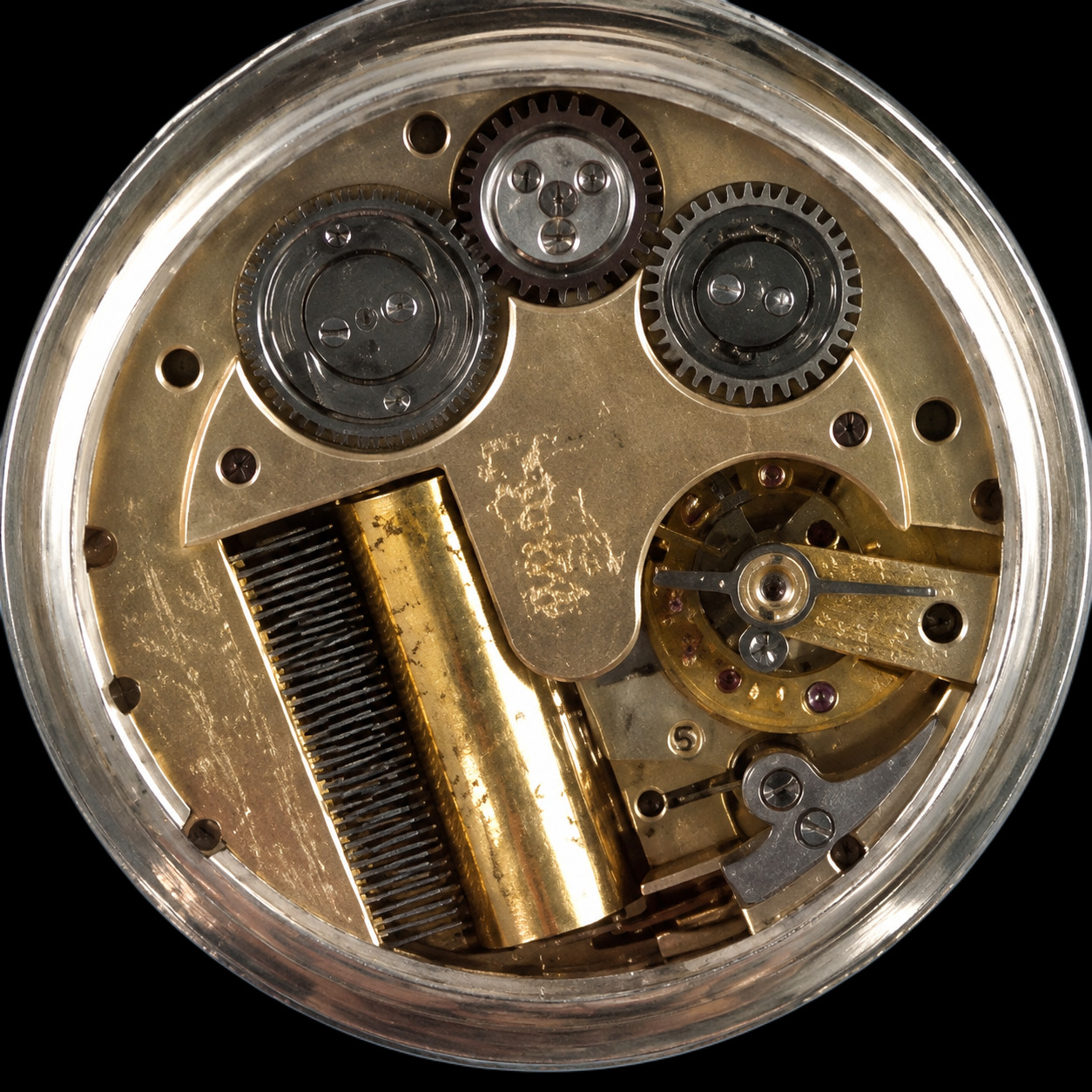
The movement of a musical pocket watch is essentially a miniaturised musical box built alongside the conventional going train. Two entirely separate mechanisms share the same case and are driven by separate mainsprings:
- The going train drives the hands in the normal way
- The musical train drives the pinned cylinder (or disc) across the steel comb
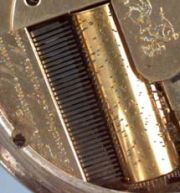
The musical train is activated by a push-piece on the side of the case. When pressed, a lever releases the musical mainspring and the cylinder begins to rotate. As it turns, the carefully placed pins lift and release the individual teeth of the comb in precise sequence — each tooth tuned to a specific note by its length and mass. The result is a complete melody from a mechanism that fits within the depth of a pocket watch case.
A fan-fly governor — a small paddle-wheel that spins in air resistance — regulates the speed of the musical train, ensuring the tune plays at the correct tempo rather than running away uncontrolled. This is visible in the movement photographs as a small spinning fan on an arbor.
Automaton Musical Watches — The Pinnacle of the Art
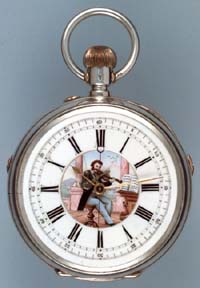
The most spectacular musical watches are those that incorporate automata — animated figures that move in synchronisation with the music. These represent the summit of 18th and 19th century Swiss watchmaking, combining horology, music and mechanical theatre in a single object small enough to carry in a waistcoat pocket.
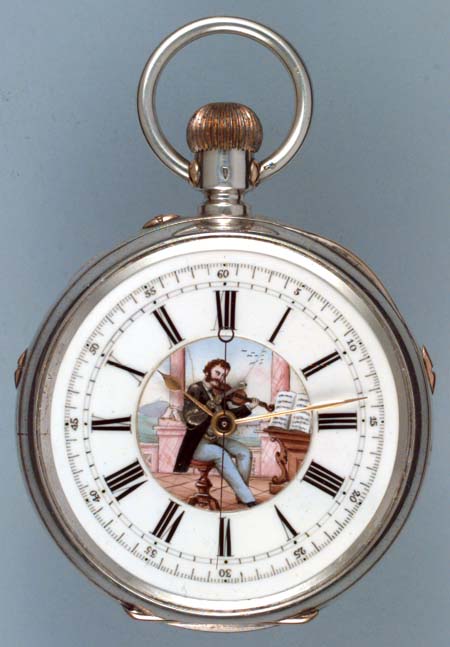
The violinist shown in the silver watch above is a classic automaton subject. A fine lever connected to the musical train moves his bow arm in a realistic bowing action as the music plays. Other common automaton subjects include:
- Musicians — violinists, flautists, harpsichordists
- Blacksmiths — hammering alternately on an anvil
- Couples — dancing figures
- Animals — birds pecking, dogs running
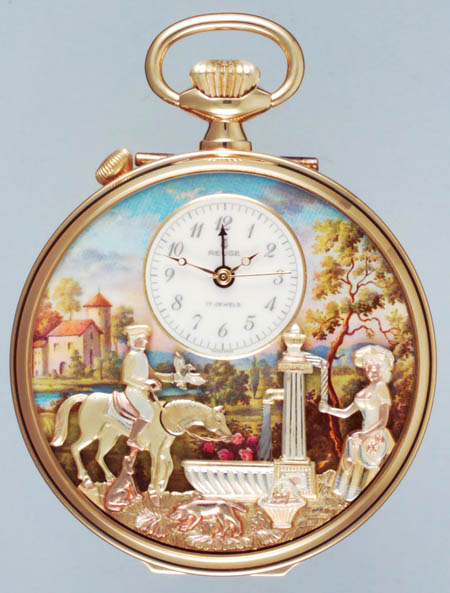
- Pastoral scenes — as in the gold watch, with horse, rider and cherub
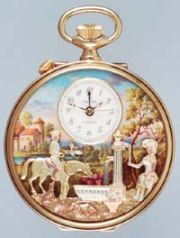
The gold automaton watch shown throughout this article is a particularly fine example of the highest class of Swiss automaton watchmaking, probably dating from the 1880s–1900s. The dial surround carries a fully three-dimensional cast gold scene — horse and rider, a cherub at a decorative column fountain, and small birds. The background is a hand-painted enamel landscape with a château, water and trees. When the musical train is released, multiple elements animate simultaneously, creating a miniature theatrical spectacle.
The Musical Movement — Front and Back
History of the Musical Pocket Watch
Musical watches became fashionable in the late 18th century, reaching the height of their popularity between approximately 1790 and 1880. Geneva was the principal centre of production — the city's long tradition of skilled hand labour and its concentration of specialist component makers made it uniquely suited to producing these extremely complex objects.
The workshops of Piguet & Meylan in Le Brassus produced some of the finest examples, often combining music with repeating mechanisms and automata. Jaquet-Droz — already famous for their life-size automata (writing boy, draughtsman, musician) — also produced superb musical watches. Many of the finest examples were made for export to Turkey, China and the courts of Asia, where European automata and musical objects were enormously fashionable gifts between rulers.
By the mid-19th century, production had shifted toward the Vallée de Joux and Sainte-Croix regions of Switzerland, where families specialising in musical movements developed exceptional skill and efficiency. The decline of the musical pocket watch as a category came with the rise of the cylinder phonograph and gramophone in the 1890s — mechanical music made by turning pins on a cylinder suddenly seemed old-fashioned against recordings of real performers.
Types of Musical Pocket Watch
| Type | Description | Relative Rarity |
|---|---|---|
| Simple musical | Single tune, cylinder and comb only, no automata | Common |
| Multi-tune musical | Two or three tunes selectable by push-piece or lever | Uncommon |
| Musical + repeater | Both musical and quarter/hour repeating functions | Rare |
| Automaton musical | One or more animated figures move in time with the music | Rare |
| 3D automaton musical | Three-dimensional cast figures with multiple moving parts | Very Rare |
| Musical + repeater + automaton | Full triple complication — the rarest and most valuable | Extremely Rare |
Collecting Musical Pocket Watches
Working examples command a significant premium over non-working pieces — the delicate comb teeth are easily damaged, and very few repairers today have the expertise to restore them properly. Before purchasing any musical watch, always ask the seller to demonstrate that the music plays, and listen carefully to ensure all notes are clear and none are missing or buzzing (a sign of damaged or bent comb teeth).
| Type | Approximate Price Range (working) |
|---|---|
| Simple single-tune musical | $300–$1,500 |
| Multi-tune musical | $800–$3,000 |
| Musical + repeater | $2,000–$8,000 |
| Automaton musical (simple) | $3,000–$12,000 |
| Automaton musical (3D scene, gold) | $10,000–$50,000+ |
| Triple complication (music + repeat + automaton) | $20,000–$100,000+ |
Famous Makers
- Piguet & Meylan — Le Brassus, Switzerland; arguably the finest musical watch makers
- Jaquet-Droz — Geneva; combined musical mechanisms with extraordinary automata
- Nicole & Capt — Geneva; prolific producers of high-quality musical watches
- Frères Rochat — Geneva; famous for singing bird pieces and automata
- Reuge — Sainte-Croix; still produces musical movements today
- Patek Philippe — Made some of the finest combined repeater/musical/automaton pieces