
The Masonic Pocket Watch
The Masonic pocket watch is one of the most intriguing sub-categories in pocket watch collecting. Decorated with Masonic symbols — the square and compasses, the all-seeing eye, the level, the plumb, the trowel — these watches were owned by Freemasons as proud symbols of membership and fraternal values. At their most elaborate, they are genuine works of horological art. At their most extraordinary, the entire movement was designed in the form of Masonic symbols — as in the remarkable Dudley Watch Company pieces described below.
Masonic Symbolism on Pocket Watches
Freemasonry uses a rich vocabulary of symbols drawn from the tools of stonemasons — the craftsmen who built the great medieval cathedrals. On pocket watches, these symbols appear engraved on case backs, painted on enamel dials, or — in the most exceptional pieces — incorporated directly into the structure of the movement itself. Common symbols include:
- Square and Compasses — The most universally recognised Masonic emblem. The square represents morality; the compasses represent the limits of desire.
- All-Seeing Eye — The Eye of Providence, representing the watchful eye of the Grand Architect of the Universe.
- Level — Symbolising equality among all Masons regardless of rank.
- Plumb — Representing uprightness of character and conduct.
- Trowel — Used symbolically to spread the cement of brotherly love.
- Sun and Moon — Representing day and night, the two great lights that rule the Lodge.
- Five-Pointed Star — The Eastern Star, associated with the Order of the Eastern Star (the female branch of Freemasonry).
- Columns of Solomon — The twin pillars Jachin and Boaz from the porch of Solomon's Temple, representing strength and establishment.
- The Letter G — Standing for both God and Geometry, at the centre of the square and compasses.
The Dudley Watch Company — The Ultimate Masonic Pocket Watch
No discussion of Masonic pocket watches is complete without the Dudley Watch Company of Lancaster, Pennsylvania. Founded and run by a devoted Freemason, the company produced what are without doubt the most extraordinary Masonic watches ever made — pieces in which the movement itself was designed to embody Masonic symbolism in every component.

William Wallace Dudley
William Wallace Dudley was a dedicated Freemason who rose to the rank of Grand Master of the Grand Lodge of Pennsylvania. His passion for Freemasonry and his interest in watchmaking came together in a unique vision: to create a pocket watch movement that was not merely decorated with Masonic symbols, but was itself an embodiment of Masonic architecture and symbolism — a timepiece that a Master Mason would instantly recognise as one of their own.
Dudley founded his company in Lancaster, Pennsylvania around 1920, sourcing movements from Waltham (and later Hamilton) and then converting and redecorating them to his own extraordinary specifications. The result was unlike anything produced before or since in American watchmaking.
The Dudley Movement — Masonic Architecture in Metal
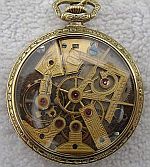
The Dudley movement is immediately recognisable. The main plate and bridges are cut and shaped to represent the working tools of a Master Mason — a combination of the Bible (the great oblong square of the main plate), the Square and Compasses, the trowel, the level, the plumb, and other Masonic working tools. The barrel bridge, for instance, is shaped as an open Bible; other bridges represent different Masonic emblems.
Where a standard watch movement has plain, functional plates, the Dudley has plates that are cut, pierced and engraved to resemble specific Masonic symbols. The result is a movement that reads as a visual catechism of Masonic symbolism — understandable to any Entered Apprentice, but bewildering to the uninitiated.

Dudley Production — Three Models
The Dudley Watch Company produced three distinct models, all in size 12 open-face:
| Model | Period | Base Movement | Jewels | Notes |
|---|---|---|---|---|
| Model 1 | 1920–1923 | Waltham | 19 | Earliest and rarest. Most sought-after by collectors. |
| Model 2 | 1923–1935 | Waltham | 19 | Revised plate layout; slightly more common. |
| Model 3 | 1935–1941 | Hamilton | 17 | Final model; Hamilton base movement used after Waltham supply ended. |
Total production across all three models was extremely limited — estimated at fewer than 15,000 watches total over the company's entire 20-year run. This rarity, combined with the extraordinary nature of the movement design, makes genuine Dudley Masonic watches highly collectible and valuable.
Masonic Case Designs — Beyond the Dudley
The Dudley Watch Company represents the ultimate expression of Masonic watchmaking, but the broader category of Masonic pocket watches encompasses a wide range of styles and price points. Most were made by mainstream manufacturers — Waltham, Elgin, Hamilton, Illinois — with Masonic decorations applied to the case, dial, or both.
Types of Masonic Watch Decoration
- Engraved case back — The most common type. A standard watch with the square and compasses (and often the owner's Lodge number and initiation date) engraved on the case back. These are the most affordable entry point for collectors.
- Masonic dial — The dial itself carries Masonic symbols, often replacing the standard hour markers with emblems — compass at 12, square at 3, trowel at 6, level at 9, and so on. Some have all-seeing-eye graphics in the centre.
- Enamel dial — The most elaborately decorated examples have hand-painted enamel dials depicting Masonic scenes — Lodge interiors, the pillars of Solomon's Temple, or allegorical subjects. These are the rarest and most valuable of non-Dudley Masonic watches.
- Compass-shaped case — Some watches were made in cases shaped as the Masonic compass, with the case outline following the V-shape of the open compass. A handful were made as the square. These are curiosities and extremely rare.
- Lever dial — Watches where the hour hand is replaced by a moveable pointer in the shape of a compass leg, swinging across the dial face.
Collecting Masonic Pocket Watches
Masonic watches appeal both to watch collectors and to Masonic collectors — expanding the potential buying pool and maintaining firm prices. The category spans an enormous price range, from a few dollars for a plain engraved case to many thousands for a fine Dudley Model 1 in original condition.
| Type | Typical Price Range |
|---|---|
| Standard watch with engraved Masonic case back | $50–$300 |
| Watch with printed or applied Masonic dial | $150–$600 |
| Watch with enamel Masonic dial | $500–$3,000 |
| Dudley Model 3 (Hamilton base) | $800–$1,500 |
| Dudley Model 2 (Waltham base) | $1,200–$2,500 |
| Dudley Model 1 (Waltham base, earliest) | $2,000–$5,000+ |
| Exceptionally rare Masonic complication watches | $5,000–$20,000+ |
Related Pages
- Pocket Watch Collecting
- Pocket Watch Values
- Waltham Pocket Watch — base movement for Dudley Models 1 & 2
- Hamilton Pocket Watch — base movement for Dudley Model 3
- Skeleton Pocket Watches
- Spotting Fake Pocket Watches
- eBay Pocket Watch Auctions