
The South Bend Watch Company
The South Bend Watch Company makes for an unlikely story: an Indiana automobile dynasty investing in pocket watches, building a million-dollar factory, and somehow producing some of the finest railroad-grade movements in American horology — only to have the whole enterprise brought low by the Great Depression before anyone had a chance to adapt to the wristwatch era. The watches they left behind, though, are very much worth finding.
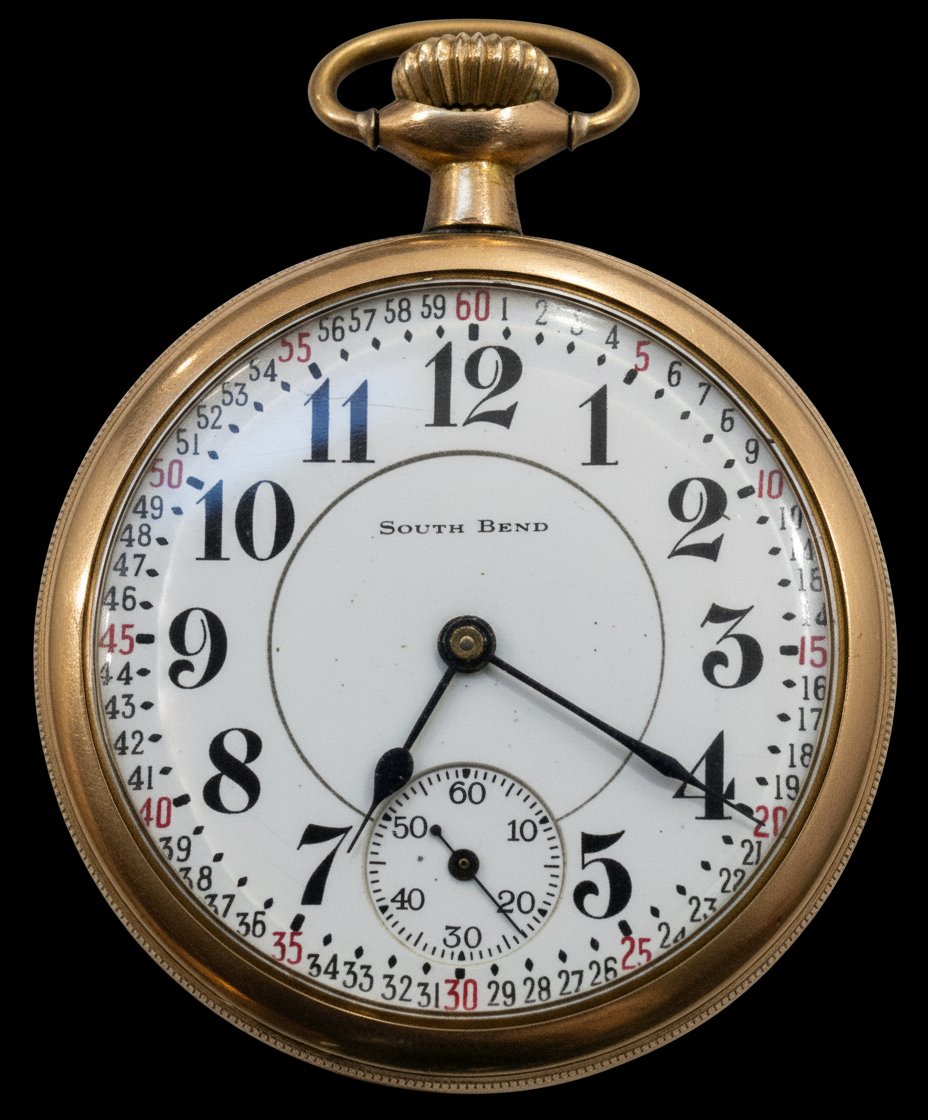
From Columbus to Indiana — the Studebaker Connection
The South Bend story properly begins in Columbus, Ohio, where Dietrich Gruen and his associates founded the Columbus Watch Company in 1874. Columbus made decent movements and earned a modest reputation over nearly three decades, but by 1902 the company was in financial trouble and looking for buyers. The purchasers turned out to be an intriguing pair: George and Clement Studebaker Jr., sons of the Clement Studebaker who had co-founded the famous Studebaker Brothers Manufacturing Company — the wagon and carriage makers who would eventually become an automobile manufacturer. The Studebaker brothers were not watchmakers, but they had capital, organisational ability, and the surname that would define South Bend's most famous grade.
The Columbus assets were moved to South Bend, Indiana, a new million-dollar factory was built on Mishawaka Avenue, and 145 former Columbus employees were hired to staff it. A crucial appointment was W.C. Shelton Sr., brought from the Appleton Watch Company in Wisconsin to oversee production. Clement Studebaker Jr. became president. Production began in 1905, with the first South Bend movements being full-plate designs clearly descended from the Columbus patterns — South Bend even picked up their serial numbering approximately where Columbus left off, beginning at around 370,000.
The Purple Ribbon Watch and the Ice Test
South Bend's early marketing was notably aggressive. Their initial campaign featured showroom displays of South Bend watches running inside solid blocks of ice — "every South Bend Watch must stand the ice test" — a claim that produced at least one memorable piece of feedback from a dealer, who wrote to the company pointing out that while the watches may run perfectly in a cake of ice, they would not run in his customers' trousers. The ice campaign was eventually replaced by a more dignified approach: a purple ribbon laid across the watch in its presentation box. The purple ribbon became South Bend's signature, and the company became known in the trade simply as the maker of the Purple Ribbon Watch.
The company sold only through accredited dealers, scrutinising buyers before filling orders — a positioning that placed South Bend firmly in the quality tier. Their literature stated explicitly that they did not supply everyone who asked, and this exclusivity was part of their appeal. All South Bend watches carried a lifetime guarantee.
The Studebaker Grade
The grade that put South Bend on the serious collector's map shares its name with the owning family — and it predates the car by enough years that the name came from the Studebakers, not the other way round. The Studebaker grade was introduced as a railroad watch, with the first 18-size versions (grades 323 and 329) advertised from around 1910. Buyers received a certificate guaranteeing the watch would pass any newly introduced railroad requirements for five years from purchase — an unusually bold commitment at a time when railroad companies were ratcheting up their specifications.
The 16-size Studebaker followed in 1911 as grades 229 (21-jewel) and 223 (17-jewel). The most commercially successful South Bend railroad grade was the 16-size, 21-jewel grade 227, with approximately 43,000 made — a respectable figure that speaks to the trust railroad men placed in it. All Studebaker grades were bridge-model movements, nickel-finished, adjusted to multiple positions.
The Polaris — South Bend's Pinnacle
If the Studebaker grades were South Bend's reliable workhorses, the Polaris was their thoroughbred. A 16-size, 21-jewel, 3/4-plate movement in open-face configuration only, the Polaris was guaranteed against factory defects for ever — not merely for five years. A coupon came with the watch entitling any recognised agent to make repairs at no charge to the owner. It was listed at $100 in the 1913 catalogue, equivalent to roughly $2,400 today. The Polaris does not appear in later catalogues, suggesting production was limited and relatively brief. A genuine Polaris in fine condition is a serious collector's piece.
Grade Numbering System
South Bend used a logical numbering system that makes grade identification straightforward once you know the code. The first digit indicates movement size: 1 = 0-size or 6-size, 2 = 16-size, 3 = 18-size, 4 = 12-size. The third digit indicates case style: even numbers denote hunter-case movements, odd numbers are open-face. So grade 227 is a 16-size open-face movement; grade 328 is an 18-size hunter. Grades ran from 100 to 431.
The Studebaker Watch Company — and Decline
In 1923 South Bend incorporated a separate entity called the Studebaker Watch Company, a mail-order operation selling directly to the public on credit terms: one dollar down, $3.50 per month. The Studebaker Watch Company watches were made on the same production lines as the South Bend line but carried "Studebaker" dials, slightly simplified production, and the "8 Adjustm'ts" marking. They could be purchased alongside pearl necklaces, pocket knives, and jewellery from the same catalogue — a significant step down from the accredited-dealer exclusivity that had defined the company's image.
The mail-order credit business proved a trap. When the Depression arrived in 1929, South Bend found itself holding a large volume of delinquent payment accounts from customers who could no longer afford their instalment payments, and the banks would not extend credit in those conditions. On Thanksgiving Eve, Wednesday 27 November 1929, the company's 300 employees were told the factory would close until January 1, 1930. It never reopened. Liquidation began in January 1932 and was complete by 1933, with creditors paid off at fifty cents on the dollar. W.C. Shelton, who had run production since the beginning, completed the assembly of approximately 35,000 watches that were partially finished at the time of closure, and continued to operate a service department until his own retirement in 1954.
The factory building survived at 1720 Mishawaka Avenue for nearly three decades — warehouse, bottling plant, Army reserve centre — until a fire destroyed it in July 1957.
Serial Numbers and Production Dates
South Bend began serial numbering at approximately 370,000, continuing from where Columbus Watch left off. All serial numbers are on the movement, not the case.
| Serial Number | Approx. Year |
|---|---|
| 370,000 – 450,000 | 1905–1907 |
| 450,000 – 560,000 | 1907–1910 |
| 560,000 – 680,000 | 1910–1913 |
| 680,000 – 800,000 | 1913–1917 |
| 800,000 – 950,000 | 1917–1923 |
| 950,000 – 1,100,000 | 1923–1929 |
| 1,100,000 – 1,200,000 | 1929 (assembled by Shelton post-closure) |
Serial number dates are approximate — plates were sometimes blanked in batches and finished later as demand required, so a movement could have been completed a year or two after its serial number was assigned. For detailed grade-level lookup, NAWCC Chapter 149 maintains a South Bend Watch Database at southbendhorology.com, and the Pocket Watch Database at pocketwatchdatabase.com has individual movement records.
Collecting South Bend Today
South Bend is genuinely underappreciated. The company's relatively small total output — under 1.2 million watches, well below Waltham, Hamilton, or Elgin — means quality grades turn up less often and are worth finding when they do. The Studebaker grades are recognisable and respected among railroad watch collectors. The Polaris is rare and commands a real premium. Even the more ordinary grades are well-made, typically in bridge-model nickel plates with good finishing. Parts availability is reasonable given the similarity to Columbus Watch Company movements, and most South Bend calibres can be serviced without undue difficulty.
One thing to know: South Bend watches marked "Studebaker" on the dial could be either the high-grade pre-1923 Studebaker grades from the South Bend line, or the later, slightly simplified Studebaker Watch Company mail-order pieces. Check the movement for the grade number and compare it against the known grade list. High-grade Studebaker movements (grades 223, 227, 229, 323, 329) are desirable; the later mail-order pieces, identifiable by the "8 Adjustm'ts" marking and the absence of a grade stamp, are worth less.