
The Rockford Watch Company
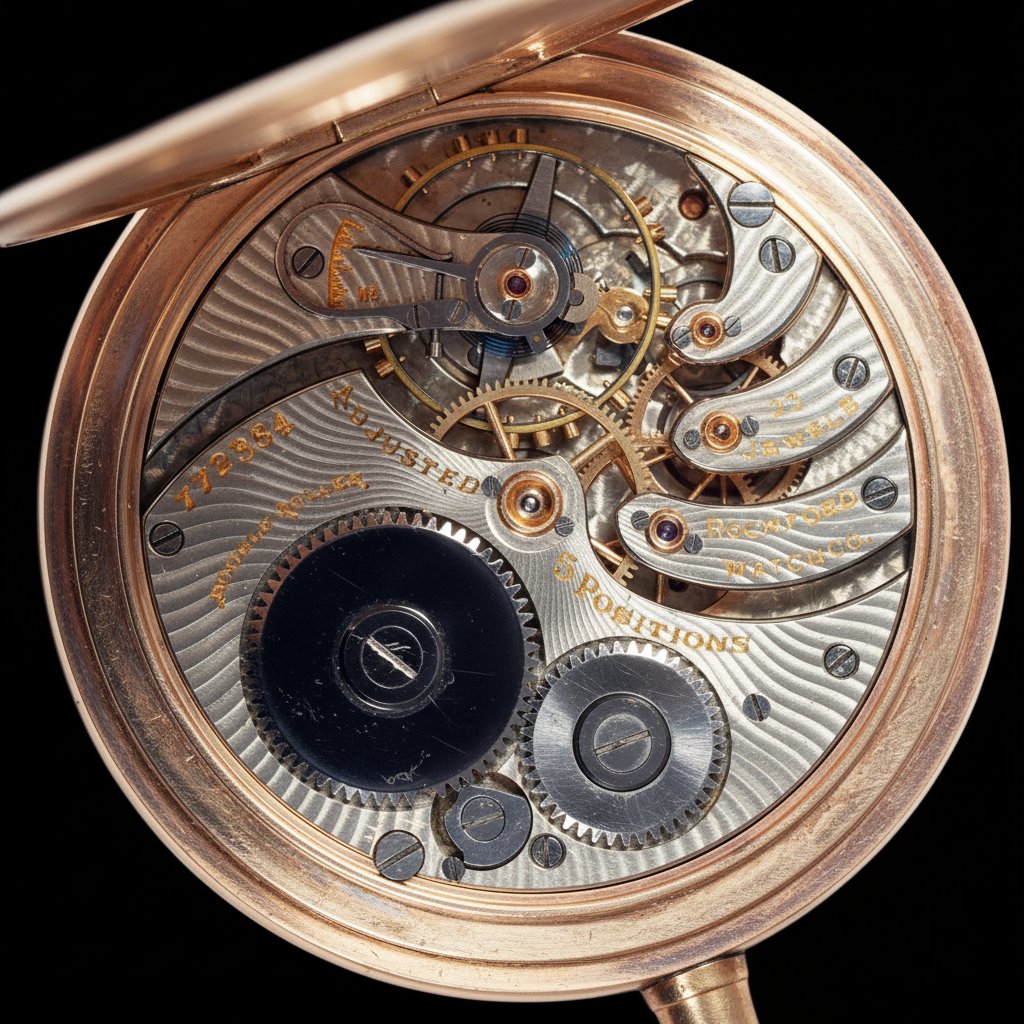
Rockford, Illinois sits 93 miles west of Chicago on the Rock River — a city that in the 1870s had everything a nascent watchmaker could want: skilled labour, good rail connections, and proximity to the Chicago markets. The Rockford Watch Company made the most of all three, producing nearly a million watches over four decades before closing in 1915. They were never the largest American maker, but they were among the most consistent — turning out good-quality movements at fair prices, with a particular reputation among railroad men that was entirely earned.
Cornell Watch Company Roots
The Rockford story begins not in Rockford but in Chicago, where Paul Cornell and J.C. Adams established the Cornell Watch Company in 1870 using machinery shipped from the defunct Newark Watch Company of New Jersey. Cornell manufactured a range of 18-size grades from a factory in suburban Chicago, building a modest reputation before financial difficulties forced a reorganisation and relocation to San Francisco in 1874. The California venture didn't last — Cornell closed in 1876.
Before the San Francisco move, Cornell employees P.H. Wheeler and C.W. Parker had negotiated a different future. Retaining some of the Cornell equipment, they helped organise the Rockford Watch Company in 1874 — incorporated with $150,000 capital by Hosmer P. Holland, Israel Sovereign, and George Troxell. The factory building was completed in 1875–76, and the first Rockford movement — an 18-size gilt full-plate keywind — reached the market on 1 May 1876.
Growth and a Railroad Reputation
Growth was steady if not spectacular. By 1877 Rockford was producing its own 3/4-plate nickel movements that fit standard-size cases, and by 1881 the factory was turning out 70 watches per day with demand consistently ahead of supply. The U.S. Naval Observatory was using Rockford watches as reference timekeepers — a rare endorsement that the company was not shy about advertising.
The railroad connection was almost geographic inevitability: three rail lines ran through Rockford itself, and the company marketed directly and aggressively to railroad men from the early 1880s. A Rockford catalogue from 1882 was pointedly titled Railroad Time Keepers. The strategy worked. Rockford movements earned a place on the approved lists of multiple railroads, and the company's high-grade pieces were accepted for railroad service as early as the 1890s.
The highest early grades were signed "Ruby" or "Ruby Jewels" — a reference to the ruby jewels used in the movement rather than any fictional place name — with the designation later simplified to a stylised letter R beside the jewel count. This marking, once you know to look for it, is a reliable indicator of a high-grade Rockford movement.
Insolvency, Reorganisation and the Illinois Watch Case Connection
By 1888 the factory had 350 employees and was producing around 150 movements per day — the largest and most successful industrial complex in the Rockford region. Then the 1890s arrived and brought their particular problems: the collapse of the National Association of Jobbers in 1891, a general watch price war, and intensifying competition from both Swiss makers and the larger American factories. Rockford reduced production and briefly suspended operations, and in 1896 the stockholders declared insolvency.
The company was reorganised as the Rockford Watch Company, Ltd. in 1901 and became a subsidiary of the Illinois Watch Case Company of Elgin — a fitting arrangement, since the case company's principals, J. Franks and M.C. Eppenstein, understood the watch business intimately. Production continued under the new ownership, with the second half of Rockford's total output — roughly half a million watches — concentrated in the years between 1902 and 1915.
The factory building still stands in Rockford. It housed several small businesses for decades after Rockford Watch closed, and the building's survival is a minor miracle given what happened to so many American watch factory buildings in the twentieth century.
Notable Grades
Rockford's grade numbering system assigns numbers in the 500s and 600s to their most commonly encountered movements. Even-numbered grades were for hunting cases; odd numbers for open face. The railroad grades — those that met the requirements for railroad time service — include:
- Grade 87 — 18-size, 15-jewel, open face. One of the earliest Rockford grades accepted for railroad service in the early 1890s.
- Grade 84 — the hunting-case twin to Grade 87, 15-jewel.
- Grade 655 — 18-size, 21-jewel, lever-set. One of the Wind Indicator models built in 1913–15, featuring a power reserve indicator. The finest movements Rockford made.
- Grade 545 and Grade 547 — 16-size railroad grades of the reorganised company era, lever-set.
The Wind Indicator grades (built 1913–15, in both 16- and 18-size) represent Rockford's final technical achievement and are among the most sought-after by collectors. The wind indicator — a small hand that shows how much of the mainspring's power reserve remains — requires additional complication in the movement and was offered by only a handful of American makers. The lever-set 21-jewel versions (Grades 655 and 665) are the ones railroad-grade collectors want; a 17-jewel pendant-set version (Grade 665) was also made but did not meet railroad specifications.
Serial Numbers and Production Dates
Serial numbers are on the movement, not the case. Rockford numbering is not entirely consistent — the company's record-keeping was described as poor by contemporaries — and the dates below should be treated as approximations.
| Serial Number | Approx. Year |
|---|---|
| 1 – 20,000 | 1876 |
| 20,000 – 60,000 | 1877–1879 |
| 60,000 – 150,000 | 1880–1884 |
| 150,000 – 300,000 | 1885–1890 |
| 300,000 – 500,000 | 1891–1900 |
| 500,000 – 650,000 | 1901–1906 |
| 650,000 – 800,000 | 1907–1911 |
| 800,000 – 1,000,000 | 1912–1915 |
For detailed grade-level identification, the Pocket Watch Database at pocketwatchdatabase.com maintains individual Rockford movement records submitted by collectors.
Collecting Rockford Today
Rockford is one of those companies that rewards collectors who take the trouble to learn it. Total production of under a million watches means genuine scarcity for the rarer grades — you won't find Rockford movements in every antique fair the way you find Walthams and Elgins. The Wind Indicator grades command genuine premiums among railroad watch specialists. More ordinary grades are priced modestly and make excellent, reliable daily-carry watches. The movements are well-made and parts availability is reasonable — most Rockford calibres can be serviced without excessive difficulty.
The fact that Rockford closed in 1915 — before wristwatch production became the industry norm — means the entire Rockford output consists of pocket watches. There is no confusing a wristwatch movement that found its way into a pocket watch case, which can be a problem with later American makers. Every genuine Rockford movement was made specifically to be a pocket watch.
Related Pages
- Railroad Pocket Watches — the full story of railroad timekeeping standards
- Ball Watch Company — the man who set the standards
- Illinois Watch Company
- Pocket Watch Makers Index